

Investing in distressed bonds and Stansberry's Credit Opportunities newsletter; Stock Idea of the Day: Deutsche Bank; Sitting-Rising exercise
1) In my e-mail last Thursday about the Stansberry's Credit Opportunities newsletter, one of my readers, Nicholas C., e-mailed me an excellent question:
I watched the video for the credit newsletter and the marketing gives me pause. I know you have your qualms with the promotional language employed by this firm, so I am not looking to rehash that. I just get nervous any time I hear high returns, low risk.
Wouldn't a distressed debt strategy implode during an economic downturn, at precisely the time equities nose dive? What am I missing? Agree that in the wake of the next credit crisis there will be some bond values out there, but there will also (finally) be some underpriced equities. Late in an economic expansion, wouldn't this be the worst time to pile into distressed debt? I have a lot of respect for you, I'm not trolling you! I'm not a bond guy and it would be nice to have credit exposure. But would I be picking up cigar butts in front of a steamroller?
I forwarded the e-mail to Mike DiBiase, who publishes the newsletter, and asked him to reply. Here's what Mike wrote:
Those are good questions and I'm sure a lot of readers share Nicholas' sentiment.
It's true that the prices of corporate bonds will plunge during an economic downturn. That's when the best opportunities in the corporate bond market will appear... after a credit crisis. But that doesn't mean you shouldn't allocate any capital now to corporate bonds. Here's why...
First, it's important to remember that bonds are very different investments than stocks. If you are comfortable holding a bond to maturity, the price of the bond after you buy it is irrelevant. As long as the company that issued the bond doesn't default, you'll collect the full $1,000 par value of your bond, along with all of the interest payments along the way. The market price doesn't matter at all. You lock in your return when you buy the bond (again, as long as it doesn't default).
Also, it's important to point out that just because there's no credit crisis today, it doesn't mean there are no good distressed bond opportunities out there. Some individual bonds sell off for the same reasons that most bonds sell off during a credit crisis – fear. Bond investors – although usually smarter than the average stock investor – sometimes make mistakes. They overreact to short-term problems of companies. And because the bond market is much less liquid than the stock market, bond prices often collapse when there are a lot of sellers of a company's bonds.
The key to this strategy is finding the safe distressed bonds... the bonds where the market is getting it wrong. That's what my analysts and I do. We scour the corporate bond market every month looking for one or two bonds that are trading at distressed prices and offering large yields – but are, in fact, safe.
Our track record since launching Stansberry's Credit Opportunities in November 2015 proves you don't have to wait for a credit collapse to do well. The average return of our closed positions beats the high-yield market's return by 2.5 times – and even beats the stock market. Of course, we expect to do even better when the credit cycle turns. We can't wait...
Stansberry is running a special deal on the newsletter that expires soon – 50% off a one-year subscription, the lowest price ever offered... To take advantage of it, click here.
2) Today's Stock Idea of the Day is German bank Deutsche Bank (DB), which is trading close to its all-time (nearly three-decade) low, as you can see in this chart...
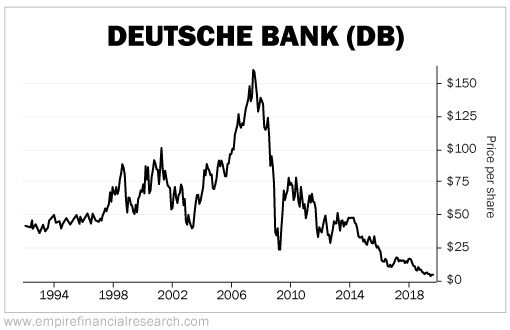
This is the kind of chart that makes the hearts of value investors like me beat rapidly with excitement!
DB hit my radar screen thanks to my friend Doug Kass of Seabreeze Partners, who gave me permission to share what he posted behind the paywall at Real Money Pro:
Why I'm Building a Large Speculative Long Position in Deutsche Bank
* For the first time in years, Deutsche Bank is showing a willingness to change and downsize in an attempt to confront the top-line sales and capital challenges
This morning I want to outline, in general terms, the case to own DB. (I will have a more expansive analysis in my Diary in the weeks ahead).
By means of background, Deutsche Bank is the largest financial services company in Germany. The bank consists of a number of businesses: traditional and investment banking, trading and asset management.
The trend in Deutsche Bank's shares over the next 2-3 years will be the byproduct of the bank's success in generating core revenue growth, a continued (and massive) cost-cutting and restructuring effort all weighed against a sluggish global economy.
Make no doubt about it, the challenge remains sizable (especially over the next 12-18 months) but not insurmountable though, from a securities analysis standpoint, visibility and reporting transparency makes precision of forecasts (and confidence in that EPS forecast) difficult.
However, with an equity capitalization under $16 billion, as mentioned last week, the shares have become a virtual call option to success of those endeavors.
Here is why I view the results as doable:
- The leverage to both the upside and downside and the range of possible outcomes remains broad – it is a function of bank management execution and success in generating sales growth and delivering cost cutting targets.
- Restructuring without a capital raise is always a difficult task – but I finally see the seriousness of strategy and the growing possibility of Deutsche Bank's management pulling it off.
- The decision to jettison a large portion of the bank's equity business (and one-fifth of the global staff) indicates that the restructuring is being taken seriously and the large German bank is finally willing to change in the face of years of persistent external challenges and weak internal management. Specifically, DB is preparing to cut costs by about -25% while growing core revenues on the order of +2% to +3% annually (which implies that nominal – stated – revenues are basically flat between 2018-2022. I see this as achievable, as it would mirror what Credit Suisse accomplished (sales, cost cuts) in the 2015-2018 interim interval.
- If successful (or even partially successful) the banks' return on tangible equity could soar over the next three years – albeit from a low (and negative) base. If achieved, regulatory support might provide relief in the form of lower bank capital requirements.
- If the signs of the restructuring yield some initial successes, the bank's regulators may take an increasingly positive and lenient view (from a capital requirement standpoint).
- Though the bank currently possesses a weakened capital position, I do not see any need over the short term (1-2 years) of a capital raise. Even a slower success rate in generating top-line growth and mid-line cost saves could result in a positive outcome for Deutsche Bank's share price – which includes a merger or the disposition of other key assets.
- As I previously wrote, almost regardless of outcome, Germany is likely to "backstop" the bank.
A Sharp Recovery in Profitability Is Possible by Fiscal Year 2023
I expect Deutsche Bank to achieve profitability in late 2021 (versus a loss of 1.75 euros/share in the current fiscal year) – despite a likely continued drag from nonperforming assets.
Though the variability to results are large, by FY 2022-2023 it is possible for the bank to record a marked improvement of its return on assets (to a still low but conservatively projected 0.25) return on tangible equity of better than 5%.
In terms of key assumptions, we conservatively assume a steady rise from the current low level of net interest margins (and income) and an acceleration of revenue growth to +3% in the out year (2023).
If met, EPS (in euros) could exceed 1.00 euro/share – producing an acceptable Tier One capital ratio and likely a much higher targeted share price (of about $13/share in the next 24 months and an even higher price in the out years).
Importantly, given the current low share price (and sizable 70% discount to book value), any evidence of success could produce a sharp near term improvement in a generally overvalued market in which investors (and traders) may be searching for potential turnaround stories.
Though speculative, I am placing DB on my Best Ideas List (at Friday's close of $7.67/share).
Position: Long DB (large)
3) I've always been fit and active, but as I've gotten older (I'm now 52) I've become much more focused on exercise and health, so I will periodically include articles in this area that I find interesting. Today's is: Sitting-Rising exercise: This anxiety-inducing fitness test purports to tell you how long you'll live. We investigated. Excerpt:
It seems a simple enough challenge: Sit down on the floor and get back up without the help of your hands or knees. Try it, though, and you might discover it's not as easy as it sounds.
This "sitting-rising" exercise was designed to predict mortality in middle-aged and older people...
The test requires you to lower yourself to the floor, crisscross style, without bracing yourself with your hands, knees, arms, or sides of your legs. If you can stand back up, again without the aid of those body parts, you've scored a perfect 10 (five points for sitting, five points for standing). You lose a point every time you support yourself with a forbidden joint or appendage.
The researchers tested 2,002 adults 51 to 80 years old, and then followed them until a participant died or until the study concluded, which was a median of 6.3 years. In that time, 159 people died — only two of whom had scored a perfect 10. Those who had the lowest score of zero to three points had a risk of death that was five to six times higher than those who scored eight to 10 points.
"It is well known that aerobic fitness is strongly related to survival, but our study also shows that maintaining high levels of body flexibility, muscle strength, power-to-body weight ratio and coordination are not only good for performing daily activities, but have a favorable influence on life expectancy," Araújo said in a 2012 news release.
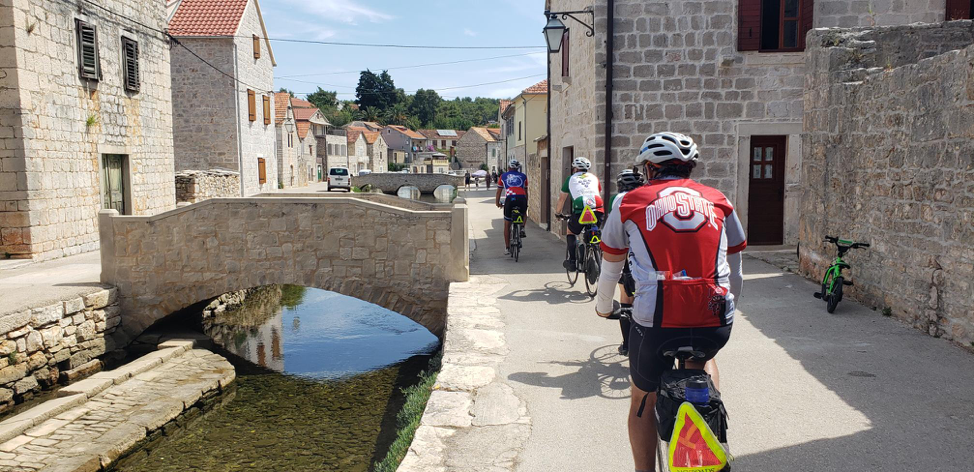
P.S. Speaking of exercise, my wife and I got a lot of it today on our Backroads trip, biking 42 miles all over the beautiful island of Hvar on Croatia's Dalmatian Coast. Here are two pics:

Best regards,
Whitney