

Is Tesla now a good short? Doug Kass thinks so; Excerpts from yesterday's e-mail to my coronavirus e-mail list; The best initial contact I've ever read
1) There's an old Wall Street saying: "Buy the rumor, sell the news."
Does this finally apply to Tesla's (TSLA) high-flying stock, which was up big pre-market (though traded flat this morning) after reporting its fourth consecutive quarterly profit, thereby qualifying it for inclusion in the S&P 500 Index?
I knew better than to get in the way of the biggest story stock I've ever seen, which is why I told my readers on October 24 – when Tesla was trading for less than $300 per share – that it was no longer a good short after the company surprised investors by reporting a profitable quarter.
But now, having risen nearly six times since then, swelling its market cap to around $300 billion, is it finally a good short?
My friend Doug Kass of Seabreeze Partners thinks so. As he wrote this morning:
Shorting Tesla!
* I have been waiting patiently to short Tesla for years
* Tesla goes on my Best Ideas List (short)Tesla (TSLA) is no longer a hard to borrow (short) – so, in accordance with my core shorting tenet of avoiding high short interest relative to average daily volume and float, I am free to short the stock.
Which I did this morning at $1,642.
I shorted even though I expect the stock to be included in the S&P (which I believe to be fully discounted – and more!) after achieving profitable quarterly results.
Tesla, with a market capitalization of over $300 billion, reached profitability by virtue of a heavy dose of regulatory credits, so it was a poor quality report.
While the capacity expansion of the next gigafactory in Texas will expand the company's delivery capacity, I have written volumes on Tesla's fundamentals – a more competitive EV market, etc. – in the past so I see no need to reiterate my views which have not changed.
Bottom Line
It is my view that Tesla will trade at $1,000/share before it trades at $2,000/share.
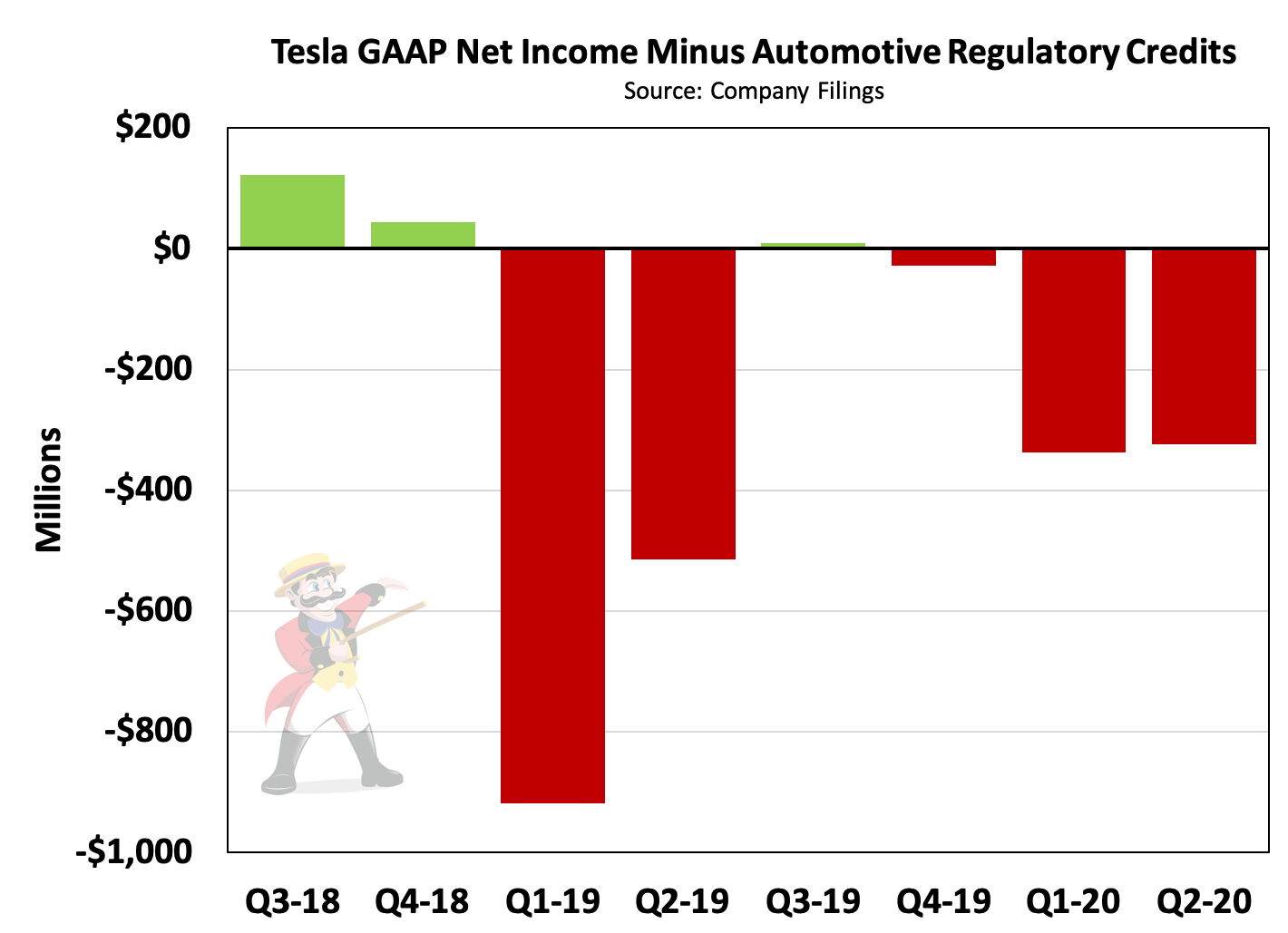
Regarding Doug's point about the source of Tesla's profitability, here are the facts: in the past four quarters, the company has reported cumulative GAAP net income of $368 million – but not from selling cars. Rather, this has been driven by carbon credits of more than $1 billion. (Over the same period, Tesla's market cap has grown by $248 billion.) This is what Tesla's net income would have been minus those credits (from @TESLAcharts on Twitter):
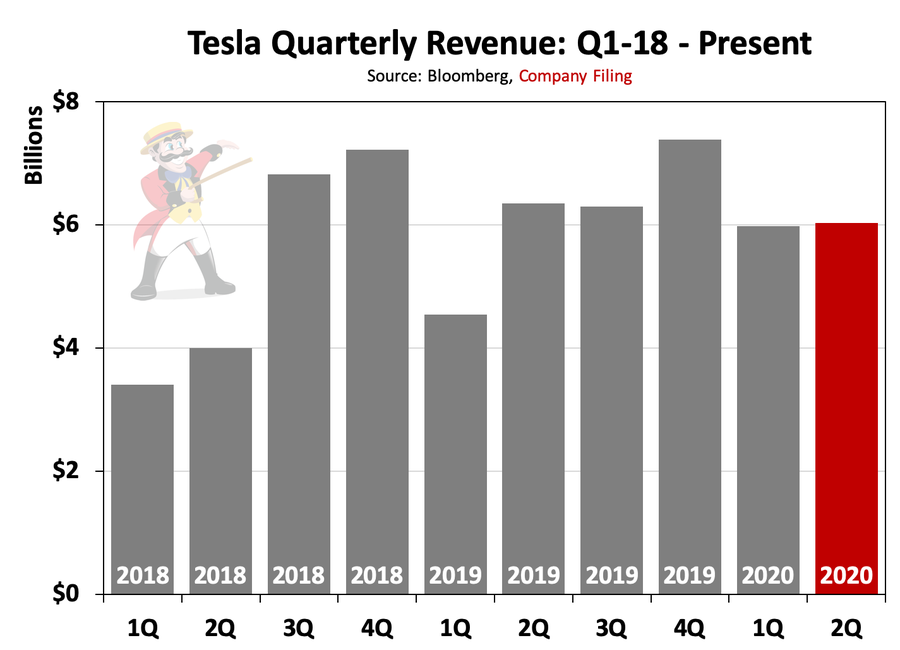
And, unlike other richly valued tech companies like Amazon (AMZN), Alphabet (GOOGL), and Facebook (FB), it's not like Tesla has been growing. In fact, as you can see in this chart (also from @TESLAcharts on Twitter), the company's revenue has declined over the past eight quarters:
In summary, I'm not pounding the table that Tesla's stock is a great short here. On the fundamentals, the company has a big lead in multiple enormous emerging markets, making this a very open-ended situation. Plus, to their credit, CEO Elon Musk and his engineers have consistently achieved things I wouldn't have thought possible. And, as for the stock, the cult around it is unlike anything I've ever seen.
But I do think odds are good that Doug is right that "Tesla will trade at $1,000/share before it trades at $2,000/share."
2) Below are excerpts from the e-mail I sent yesterday to my coronavirus e-mail list. If you wish to join it, simply send a blank e-mail to: cv-subscribe@mailer.kasecapital.com.
A very important article in the WSJ that, for the first time I've seen, takes all of the more than two dozen studies on the true infected (not case) mortality rate for the coronavirus: How Deadly Is Covid-19? Researchers Are Getting Closer to an Answer. As I wrote long ago, the virus is far more deadly than the seasonal flu – at least six times (and, I'd guess, based on the true number of flu infections, which isn't tracked, 10 times).
Yes, COVID-19 deaths are sharply skewed toward the elderly, but people are not over-reacting to be fearful of catching it, both because of the overall mortality rate, but also because of the "fat tail" outcomes for even younger people who survive, but suffer terrible long-term effects... Excerpt:
An analysis of 26 different studies estimating the infection-fatality rate in different parts of the globe found an aggregate estimate of about 0.68%, with a range of 0.53% to 0.82%, according to a report posted in July on the preprint server medRxiv, which hasn't yet been reviewed by other researchers.
"To say that we will ever have one absolute true estimate is erroneous. We can get an idea of a trend, but we need to be mindful that this can change and vary," said Lea Merone, a public-health physician and health economist at James Cook University in Australia who co-wrote the paper. "It is context dependent."
The CDC is now using the report as the basis for its own best-estimate for the infection-fatality rate in its pandemic planning scenarios. The agency's estimate is 0.65% as of July 10, higher than its previous estimates.
The fatality rate for an individual varies, sometimes markedly, depending on factors such as age, sex and the presence of pre-existing medical conditions, studies show.
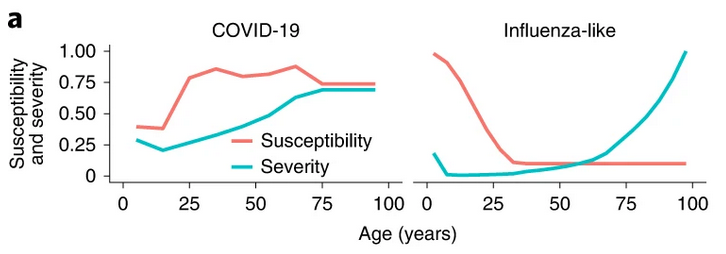
3) An interesting chart comparing COVID-19 to the flu, which shows that: a) people of all ages over age 25 are equally likely to catch COVID-19 (unlike the flu); and b) while young people are less likely to die of the COVID-19 than older folks, the risk is much higher than the flu (source):
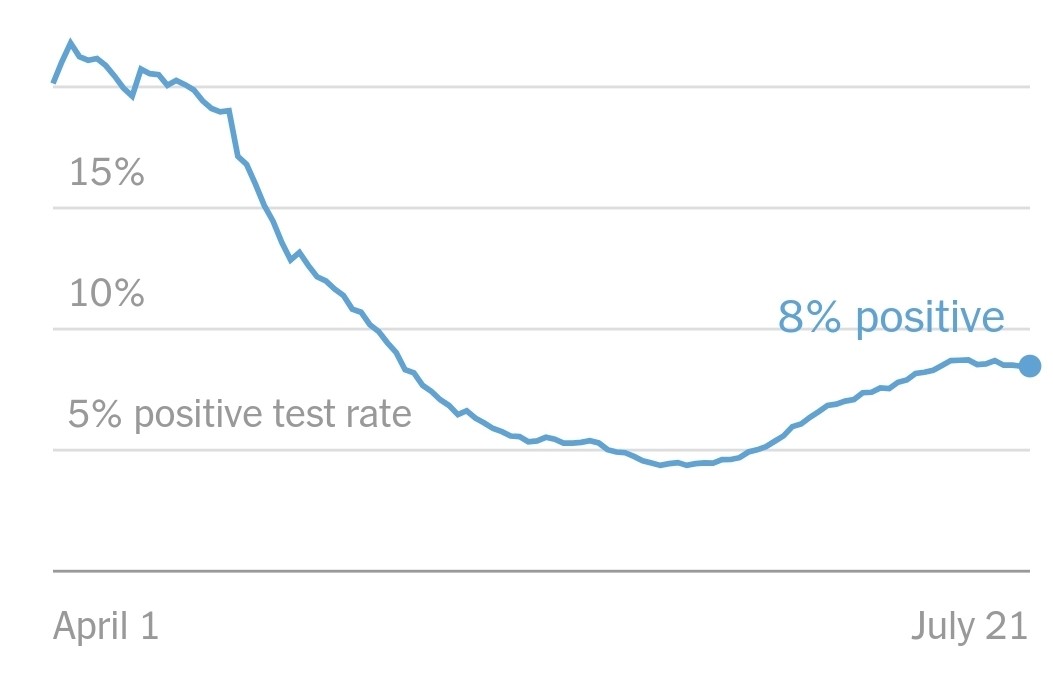
4) This chart puts to rest the silly idea that the rise in cases is simply due to more testing (from this article: The Rise in Testing Is Not Driving the Rise in U.S. Virus Cases):
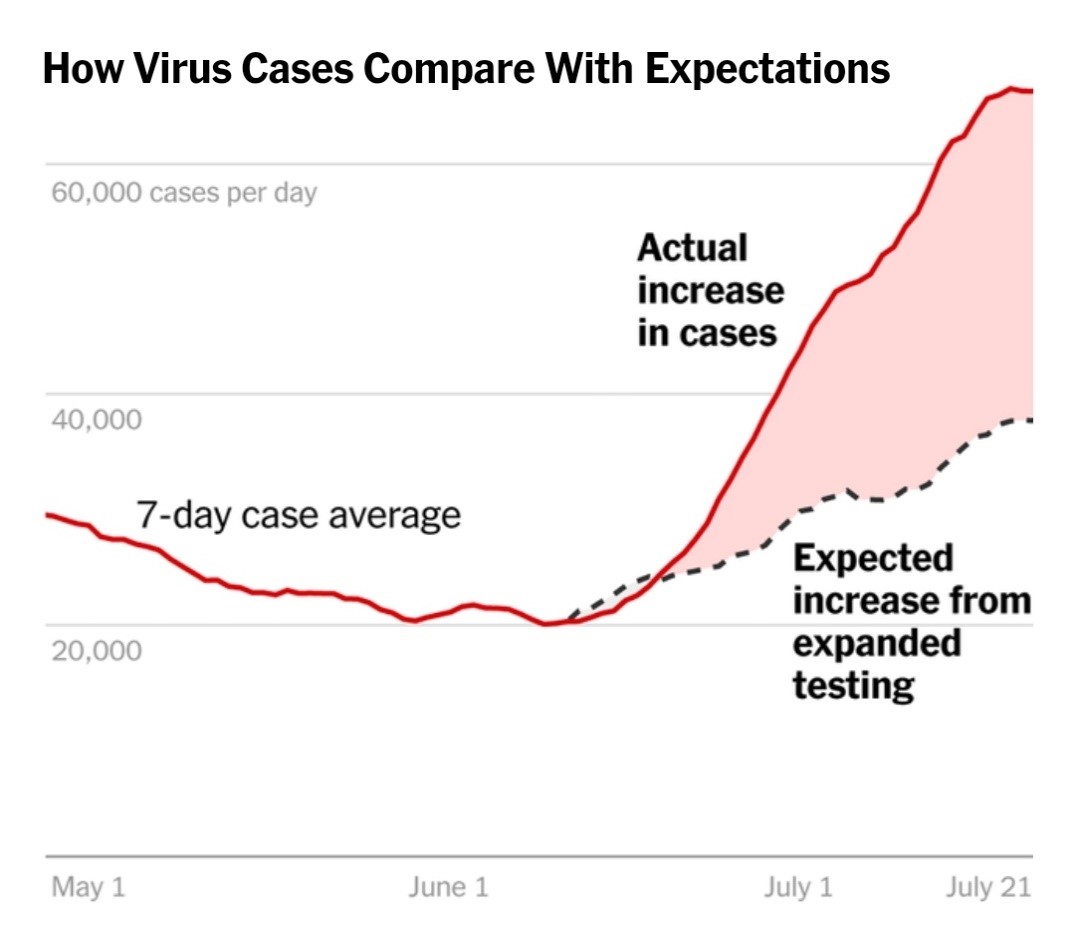
The rise in cases is, in fact, due roughly half to more testing and half to a near doubling in the percentage of people testing positive, reflecting the reality that the virus is spreading rapidly in many states:
5) This is outrageous and disgraceful – but, sadly, completely unsurprising: Want A COVID-19 Test? It's Much Easier To Get In Wealthier, Whiter Neighborhoods. Excerpt:
With nearly 4 million coronavirus cases across the United States and hospitalizations surging in different parts of the country, there continues to be a growing demand for tests. Today, Americans routinely wait for hours to get an exam — if they can get one at all. Access is not available equally nationwide. Simply put, where Americans live and how much income they earn can still determine the ease with which they get a COVID-19 test...
The novel coronavirus itself does not distinguish between Black and white Americans. But virtually every other aspect of U.S. society does, including the nation's response to COVID-19.
Our analysis revealed that, in many cities, testing sites in and near predominantly Black and Hispanic neighborhoods are likely to serve far more patients than those near predominantly white areas.
A similar disparity exists between richer and poorer neighborhoods, our analysis showed: Testing resources were more scarce in poorer areas, with fewer sites per person and sites located farther away. And the disparity could be even greater in real life, considering wealthier people could also get tested by private practitioners who are less likely to be reflected in our analysis.
6) The Northeast is the one part of the country doing well vis-à-vis the virus right now. Is it because we got hit so hard that we developed effective herd immunity or because it scared us into behaving ourselves better than folks elsewhere? Who knows? But it bodes well for the rest of the country... U.S. Northeast, Pummeled in the Spring, Now Stands Out in Virus Control. Excerpt:
As of this week, coronavirus cases are rising in 41 American states, and in many regions the situation has never been worse. Hospitalizations are nearing a record national high and deaths are the highest they have been since late May.
But amid this devastating wave, one region has managed to get the virus under control: the Northeast. New cases there remain below their April peak, and the region has five of the country's nine states with flat or falling case levels.
In just over two months, states along the East Coast – from Delaware to Maine – have gone from the country's worst hot spot to something resembling Europe. As in Italy and Spain, the Northeast was devastated by a rush of infections and deaths, and state leaders responded – after some initial hesitation – with strict lockdowns and large investments in testing and contact tracing. Like their European counterparts, Northeasterners also mostly followed the rules, including wearing masks, and have supported tough measures to bend the curve.
If the trends in the United States continue, the differences between the Northeast and the rest of the nation may become so pronounced by the fall flu season that some experts say they may resemble two different countries: one with overwhelmed hospitals and ballooning cases, and another that continues to wrestle a little with the virus, but manages to keep its economy in OK shape.
7) Picking up where I left off in yesterday's e-mail about step 3 of cultivating mentors – a compelling initial contact – here's the best I've ever read:
Dear Mr. Tilson:
We have never met. My name is Angelo Martorell and I am a recent 2015 Wharton MBA grad. I am a fan of yours both in the investing world and more recently in regards to your stance regarding our current president. Like him, I went to Wharton; unlike him, I was born in Mexico.
I had an incredibly tough time recruiting for an investment job during and after my MBA. Even though I won more stock pitch competitions than anybody at Wharton including the Boston Investment Conference, and the Sohn Investment competition, employers such as Baupost, Tiger Global and about 100 other hedge funds found a way to ding me.
After finding a position on a fund that soon after closed shop, I started my own fund with $4M. I have a ~120% return since June 2016.
I respect your knowledge on investments -- sometimes we are on the same side, and sometimes on the opposite. I believe you are a great person of integrity. I am completely self-taught, and have sold a business as a CFO before Wharton in CA. I am a 6x cycling national champion in both Mexico and the U.S.
Bottom line is I have no mentor. I have found few people to trust in this industry. I went through community college when I moved to the U.S. when I was 17 and my family has no connections.
If you have time to chat or feel inclined to give advice, you would have no idea how much it would mean to me.
Very best regards and from a Mexican – Gracias,
Angelo Martorell, CFA, Martorell Capital Partners, LLC
Pretty much every sentence here is compelling and personal – either to him or to me. Angelo had clearly done his homework.
I was happy to meet with Angelo. He became one of my first students at Kase Learning, and he and I now also have a close professional and personal relationship.
By the way... If you're writing to a current or potential mentor, whether via letter, e-mail or text, don't be sloppy. It needs to be clear, concise and well-written. If the person is older, you need to be at least somewhat formal. The salutation should be "Dear" instead of "Hi," and don't use the person's first name – it's "Mr." or "Ms." The first line might be something like, "It was a genuine pleasure speaking with you" not "It was great talking to you." And at the end, say "Sincerely yours" not "Best."
Lastly, beware of typos. The one that really drives me crazy is when someone tells me what a big fan they are of Berkshire Hathaway (BRK-B) CEO Warren "Buffet" (it's Buffett!).
Best regards,
Whitney