

Is the pandemic going to get worse?; W.H.O. Let China Take Charge; COVID versus flu IFR by age; Reopen schools; Great Barrington Declaration; COVID's Mysterious Long-Term Effects; European cases and hospitalizations; Slovakia
The number of new coronavirus cases in the U.S. hit an all-time high of 118,319 yesterday (with total cases approaching 10 million), and the number of daily deaths has crept back above 1,000 the past three days, as you can see in these two charts (the lines show the seven-day moving average):
Daily Cases

Daily Deaths

And things are even worse across most of Europe.
So with winter approaching, is this third surge of the virus going to be worse than the first two?
I think not, for reasons I outlined in e-mails I sent to my coronavirus e-mail list on Monday (below) and on October 16 and October 28 (if you'd like to join it, simply send a blank e-mail to: cv-subscribe@mailer.kasecapital.com)...
Daily cases are likely close to peaking and will soon start to decline... while deaths, a lagging indicator, will average around 1,200 – the level of the last three days – for perhaps another month and then follow cases downward.
Importantly, I don't think there will be a fourth wave, even without a vaccine. The pandemic has now walloped areas of the United States with 85%-plus of our population, which has likely created enough herd immunity to slow the spread of the virus... especially if we take basic precautions like reasonable social distancing and mask wearing. (Note that I'm not saying we've reached full herd immunity – that likely won't happen until a large fraction of Americans have been vaccinated.)
1) The NYT just posted this article about China's bad behavior and the W.H.O.'s gutless capitulation: In Hunt for Coronavirus Source, W.H.O. Let China Take Charge. Excerpt:
As it praised Beijing, the World Health Organization concealed concessions to China and may have sacrificed the best chance to unravel the virus's origins. Now it's a favorite Trump attack line...
Now, as a new COVID-19 wave engulfs Europe and the United States, the organization is in the middle of a geopolitical standoff.
China's authoritarian leaders want to constrain the organization; President Trump, who formally withdrew the United States from the body in July, now seems intent on destroying it; and European leaders are scrambling to reform and empower it.
The search for the virus's origins is a study in the compromises the W.H.O. has made.
On the surface, an investigation into the virus's origin is progressing. Beijing recently approved a list of outside investigators. The health organization has agreed that key parts of the inquiry – about the first patients in China and the market's role in the outbreak – will be led by Chinese scientists, according to documents obtained by the New York Times. The documents, which have never been made public, show that W.H.O. experts will review and "augment, rather than duplicate," studies undertaken by China.
Even as it has heaped praise on the Chinese government, the organization has refused to disclose details of its negotiations with Beijing and hasn't shared documents with member states outlining the terms of its investigations.
"The W.H.O. prioritizes access to the country," said Gian Luca Burci, a former legal counsel for the agency. "But if you do that to the bitter end, you lose soft power."
The question of the virus's origin remains a critical mystery that, if solved, could help prevent another pandemic and help scientists create vaccines and treatments. When the first SARS outbreak began spreading in China in late 2002, officials hid the epidemic for months. But when they finally acknowledged it, they soon allowed in international teams to investigate the animal source.
This time, the hunt for a source has been shrouded in secrecy.
Internal documents and interviews with more than 50 public-health officials, scientists and diplomats provide an inside look at how a disempowered World Health Organization, eager to win access and cooperation from China, has struggled to achieve either. Its solicitous approach has given space for Mr. Trump and his allies to push speculation and unfounded conspiracy theories, and deflect blame for their own mistakes...
The question of where COVID-19 began is especially intriguing because the initial theory, centered on illegal wildlife sales at the Wuhan market, is now in doubt.
There is powerful evidence that the new coronavirus passed naturally from an animal into humans. Scientists have found a virus in bats that is a close relative, and they suspect that it may have infected another animal species before it reached people.
But though they agree that many cases were linked to the market in Wuhan, many scientists no longer believe it is where the outbreak began.
For now, however, it's still where the trail goes cold.
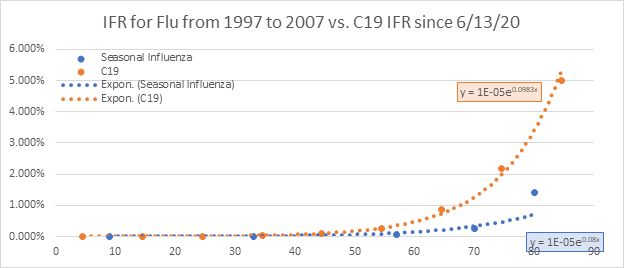
2) My analyst Alex put together this chart, using CDC data, showing the U.S. infection fatality rate ("IFR," not to be confused with the case fatality rate) by age cohort for COVID (since mid-June) versus the flu (average over the past decade):
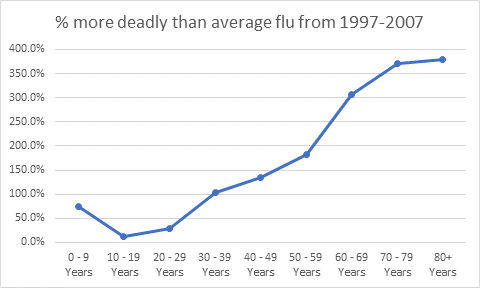
Alex then took the same data and divided the IFR for the two viruses for each age cohort – you can see that COVID is much less deadly than the flu for those under 30, and about the same for those aged 30 to 39, but then becomes much more deadly as people get older:
3) The fact that young people are at such low risk is why I think it's worth reopening our schools everywhere except where there's a clear outbreak – a hugely contentious issue, as this front-page story in today's NYT highlights: In San Francisco, Virus Is Contained but Schools Are Still Closed. Excerpt:
Many medical experts in the Bay Area also are frustrated with the district's failure to reopen. While it is impossible for the foreseeable future to completely eliminate the risk of transmission in schools, they say, the risk is relatively low in areas where the virus is contained, especially in elementary schools, and can be reduced even more by safety measures like mask requirements and good ventilation.
San Francisco currently has 4.7 daily new cases per 100,000 people, a little more than half the rate of new cases in New York City. The share of coronavirus tests coming back positive averaged 0.89% for the week ending Oct. 22, lower than New York City's average of 1.8% for that week.
Experts say they are seeing evidence of significant mental and physical problems among children who are out of school, including weight gain and increased rates of depression, anxiety, drug overdoses and suicidal thoughts among adolescents.
Among all children aged 10 to 18 who were treated at the emergency department of UCSF Benioff Children's Hospital Oakland, across the bay from San Francisco, the percentage who screened positive for suicidal thoughts rose to 16% in September from 6% in March, according to Dr. Jacqueline Grupp-Phelan, the Chief of Pediatric Emergency Medicine at the University of California San Francisco.
"We really, absolutely, have to consider that the cure might be worse than the disease," Dr. Grupp-Phelan said.
4) Here's an interview with Jay Bhattacharya, one of the authors of The Great Barrington Declaration: A Sensible and Compassionate Anti-COVID Strategy. Excerpt:
The Declaration reads:
As infectious disease epidemiologists and public health scientists we have grave concerns about the damaging physical and mental health impacts of the prevailing COVID-19 policies, and recommend an approach we call Focused Protection.
Coming from both the left and right, and around the world, we have devoted our careers to protecting people. Current lockdown policies are producing devastating effects on short and long-term public health. The results (to name a few) include lower childhood vaccination rates, worsening cardiovascular disease outcomes, fewer cancer screenings, and deteriorating mental health – leading to greater excess mortality in years to come, with the working class and younger members of society carrying the heaviest burden. Keeping students out of school is a grave injustice.
Keeping these measures in place until a vaccine is available will cause irreparable damage, with the underprivileged disproportionately harmed.
Fortunately, our understanding of the virus is growing. We know that vulnerability to death from COVID-19 is more than a thousand-fold higher in the old and infirm than the young. Indeed, for children, COVID-19 is less dangerous than many other harms, including influenza.
As immunity builds in the population, the risk of infection to all – including the vulnerable – falls. We know that all populations will eventually reach herd immunity – i.e., the point at which the rate of new infections is stable – and that this can be assisted by (but is not dependent upon) a vaccine. Our goal should therefore be to minimize mortality and social harm until we reach herd immunity.
The most compassionate approach that balances the risks and benefits of reaching herd immunity, is to allow those who are at minimal risk of death to live their lives normally to build up immunity to the virus through natural infection, while better protecting those who are at highest risk. We call this Focused Protection.
Adopting measures to protect the vulnerable should be the central aim of public health responses to COVID-19. By way of example, nursing homes should use staff with acquired immunity and perform frequent PCR testing of other staff and all visitors. Staff rotation should be minimized. Retired people living at home should have groceries and other essentials delivered to their home. When possible, they should meet family members outside rather than inside. A comprehensive and detailed list of measures, including approaches to multi-generational households, can be implemented, and is well within the scope and capability of public health professionals.
Those who are not vulnerable should immediately be allowed to resume life as normal. Simple hygiene measures, such as hand washing and staying home when sick should be practiced by everyone to reduce the herd immunity threshold. Schools and universities should be open for in-person teaching. Extracurricular activities, such as sports, should be resumed. Young low-risk adults should work normally, rather than from home.
Restaurants and other businesses should open. Arts, music, sports, and other cultural activities should resume. People who are more at risk may participate if they wish, while society as a whole enjoys the protection conferred upon the vulnerable by those who have built up herd immunity.
5) Of course, it's not just COVID fatalities that matter. This article on the front page of today's WSJ is one of the reasons even low-risk-of-death people (like me) are rightly afraid of COVID: the long-term effects suffered by a certain percentage of people (even though it's not clear whether they're worse than the flu/pneumonia – I'm looking into this): Doctors Begin to Crack COVID's Mysterious Long-Term Effects. Excerpt:
Nearly a year into the global coronavirus pandemic, scientists, doctors, and patients are beginning to unlock a puzzling phenomenon: For many patients, including young ones who never required hospitalization, COVID-19 has a devastating second act.
Many are dealing with symptoms weeks or months after they were expected to recover, often with puzzling new complications that can affect the entire body – severe fatigue, cognitive issues and memory lapses, digestive problems, erratic heart rates, headaches, dizziness, fluctuating blood pressure, even hair loss.
What is surprising to doctors is that many such cases involve people whose original cases weren't the most serious, undermining the assumption that patients with mild COVID-19 recover within two weeks. Doctors call the condition "post-acute COVID" or "chronic COVID," and sufferers often refer to themselves as "long haulers" or "long-COVID" patients.
"Usually, the patients with bad disease are most likely to have persistent symptoms, but COVID doesn't work like that," said Trisha Greenhalgh, professor of primary care at the University of Oxford and the lead author of an August BMJ study that was among the first to define chronic COVID patients as those with symptoms lasting more than 12 weeks and spanning multiple organ systems.
For many such patients, she said, "the disease itself is not that bad," but symptoms like memory lapses and rapid heart rate sometimes persist for months.
6) Here's a fascinating chart in The Economist that puts the current outbreak in perspective by estimating what the actual number of cases were in each of the five European countries earlier this year versus today:

7) Far more important than cases are hospitalizations. This chart from the FT shows hospitalizations per 100,000 people in 12 European countries. Interestingly (and consistent with the herd immunity threshold theory), in the countries hit hardest earlier this year, the resurgences have been less than half of their prior peaks (with the exception of Belgium, which I need to look into):

8) This is super smart – like what China did in Wuhan: Over 2.5 million Slovaks take part on first day of nationwide COVID-19 testing. Excerpt:
Nearly half of Slovakia's entire population took COVID-19 swabs on Saturday, the first day of two-day nationwide testing the government hopes will help reverse a fast rise in infections without a hard lockdown.
The scheme, a first in a country of comparable size, is being watched by other nations looking for ways to slow the virus spread and avoid overwhelming their health systems.
Defense Minister Jaroslav Nad said on Sunday 2.58 million Slovaks took the test on Saturday, and 25,850 or 1% tested positive and must go into quarantine.
The European Union country has 5.5 million people and aims to test as many as possible, except for children under 10.
More than 40,000 medics and support teams of soldiers, police, administrative workers and volunteers staffed around 5,000 sites to administer the antigen swab tests.
The testing was free and voluntary, but the government will impose a lockdown on those who do not participate, including a ban on going to work.
Best regards,
Whitney