

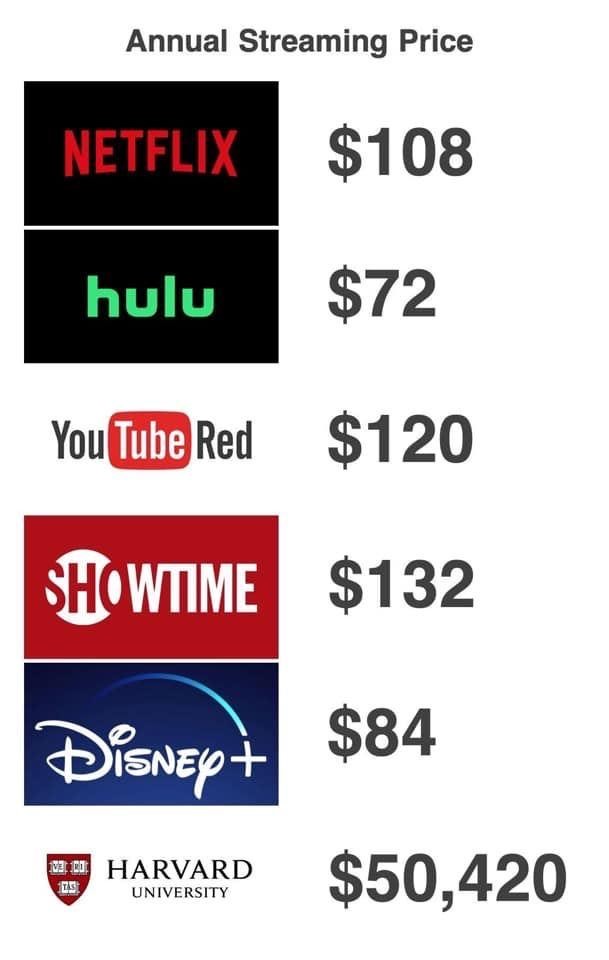
Joel Litman's presentation; Fracking Firms Fail, Rewarding Executives and Raising Climate Fears; Robinhood Has Lured Young Traders; TikTok Takes on Crypto With Dogecoin Soaring; Annual streaming prices
1) If you've been reading my daily e-mail for long, you know I don't consider myself a value or growth investor. I'm a "make-money investor."
Last fall, I met a Cambridge, Massachusetts professor who's lectured at Wharton, Harvard, and the world's top CFA societies. His name is Joel Litman, and he's brilliant.
He first caught my attention because he has an incredible track record as an investor, but he takes a completely different approach to the markets than I do.
In short, he's a forensic accountant whose work has been so accurate that he's been profiled by CNBC, Forbes, and Barron's.
His analysis has led to incredible returns, like...
- 1,566% on Skechers
- 445% on Hanesbrands
- 846% on Middleby
- 643% on Facebook
- 878% on Liz Claiborne
And now, Joel just launched his latest project. It's a way to zero in on companies with legitimate 1,000% upside.
These are normal, publicly traded U.S. stocks. No cryptocurrencies, options, currency trading, or anything complicated.
He recently put together a brand-new presentation in which he explains the full story – you can watch it right here. It's definitely worth checking out...
2) Kudos to the New York Times for exposing this total disgrace on its front page today: Fracking Firms Fail, Rewarding Executives and Raising Climate Fears. Excerpt:
Oil and gas companies in the United States are hurtling toward bankruptcy at a pace not seen in years, driven under by a global price war and a pandemic that has slashed demand. And in the wake of this economic carnage is a potential environmental disaster – unprofitable wells that will be abandoned or left untended, even as they continue leaking planet-warming pollutants, and a costly bill for taxpayers to clean it all up.
Still, as these businesses collapse, millions of dollars have flowed to executive compensation.
Whiting Petroleum, a major shale driller in North Dakota that sought bankruptcy protection in April, approved almost $15 million in cash bonuses for its top executives six days before its bankruptcy filing. Chesapeake Energy, a shale pioneer, declared bankruptcy last month, just weeks after it paid $25 million in bonuses to a group of executives. And Diamond Offshore Drilling secured a $9.7 million tax refund under the COVID-19 stimulus bill Congress passed in March, before filing to reorganize in bankruptcy court the next month. Then it won approval from a bankruptcy judge to pay its executives the same amount, as cash incentives.
"It seems outrageous that these executives pay themselves before filing for bankruptcy," said Kathy Hipple, an analyst at the Institute for Energy Economics and Financial Analysis and a finance professor at Bard College. "These are the same managers who ran these companies into bankruptcy to begin with," she said.
3) Another important story in the New York Times last week exposes how trading app Robinhood has turned investing into a gambling game in which countless inexperienced investors are getting incinerated: Robinhood Has Lured Young Traders, Sometimes With Devastating Results.
Hopefully this will lead the U.S. Securities and Exchange Commission ("SEC") to look into some of Robinhood's most abusive practices, like coaching novices to lie about their experience so they can trade options. Excerpt:
Millions of young Americans have begun investing in recent years through Robinhood, which was founded in 2013 with a sales pitch of no trading fees or account minimums. The ease of trading has turned it into a cultural phenomenon and a Silicon Valley darling, with the start-up climbing to an $8.3 billion valuation. It has been one of the tech industry's biggest growth stories in the recent market turmoil.
But at least part of Robinhood's success appears to have been built on a Silicon Valley playbook of behavioral nudges and push notifications, which has drawn inexperienced investors into the riskiest trading, according to an analysis of industry data and legal filings, as well as interviews with nine current and former Robinhood employees and more than a dozen customers. And the more that customers engaged in such behavior, the better it was for the company, the data shows.
More than at any other retail brokerage firm, Robinhood's users trade the riskiest products and at the fastest pace, according to an analysis of new filings from nine brokerage firms by the research firm Alphacution for the New York Times.
In the first three months of 2020, Robinhood users traded nine times as many shares as E-Trade customers, and 40 times as many shares as Charles Schwab customers, per dollar in the average customer account in the most recent quarter. They also bought and sold 88 times as many risky options contracts as Schwab customers, relative to the average account size, according to the analysis.
4) Speaking of naïve speculators, this is so ridiculous... TikTok Takes on Crypto With Dogecoin Soaring 40% in 24 Hours. Excerpt:
As TikTok users spend more time at home, their priorities appear to have shifted from whipping up the perfect Dalgona coffee to manipulating the crypto market. Enter, the Dogecoin Challenge.
Dogecoin is a cryptocurrency jokingly established in December 2013 that features the bygone Doge meme as its logo. Among the latest in an endless series of TikTok trends, users are encouraged to invest in the currency, acting under the assumption that there is serious money to be made if the coin's price hits $1. It currently sits at $0.0039.
According to OnChainFX, a site that tracks cryptocurrencies, Dogecoin has surged by over 40% in the last 24 hours, but even the owner of the Dogecoin Twitter account is warning investors to be cautious, tweeting: "Be mindful of the intentions people have when they direct you to buy things. None of them are in the spot to be financially advising." The token's market capitalization has reached almost $500 million.
5) This is funny – and sums up the dilemma facing colleges and universities these days...
Best regards,
Whitney