

Klarman/Baupost second-quarter letter; Coronavirus update; We may be in the 8th inning; Economic recovery may be stalling; SEC investigating Kodak
1) Seth Klarman has compiled one of the best track records of all time over the past three decades as the founder and CEO of hedge fund Baupost Group.
In addition to being a great investor (and philanthropist), he's a brilliant writer and teacher, which is why his timeless 1991 classic, Margin of Safety: Risk-Averse Value Investing Strategies for the Thoughtful Investor, was one of the first investing books I ever read (the cheapest used copy sells for $790 on Amazon, but PDFs of it can be found on the web). It's also why I've read every one of his annual letters since 1992.
You can appreciate, therefore, why I was so excited when a friend sent me this link to his second-quarter letter, which didn't disappoint. It's filled with great insights. Excerpt:
Central banks, led by the Fed, continue to be the predominant driver of financial markets. By holding down interest rates, they influence investors to bid up the prices of securities, irrespective of the economic backdrop. By maintaining these seemingly never-ending policies and willfully ignoring developing bubbles, the Fed has engineered a strong market recovery even as the unemployment rate tests Great Depression levels. The Fed balance sheet grows larger and larger, and the annual U.S. budget deficit approaches a level triple its previous ignominious record high. Investors are being infantilized by the relentless Federal Reserve activity. It's as if the Fed considers them foolish children, unable to rationally set the prices of securities so it must intervene. When the market has a tantrum, the benevolent Fed has a soothing yet enabling response. As with the 30-year-olds still living in their parents' basements, we can only wonder whether the markets will ever be expected to make it on their own.
Investing lies at the intersection of economics and psychology. That crossroads is particularly challenging to navigate right now because investor psychology is surprisingly ebullient even though business fundamentals are often dreadful (albeit in some cases improving off of unfathomable lows). Investors are besotted with the idea that the economy is "opening up," as if anyone believed we would never again come out of our homes. As the economy began to rebound off the lows in Q2, investors exuberantly chose to celebrate the beginning of a return to normalcy with buy orders, irrespective of valuation. There is little evidence of thought as to whether the price of a security already reflects current and projected future news flow, or whether the opening up of the economy might be premature, a sign not of strength, but of impatience, lack of resolve, and poor judgment...
Here is our list, ranked according to our level of conviction that the suggested changes will occur. A few of these ideas are clearly more conjecture than evidence-based at this time:
- Acceleration of the digitalization of the U.S. and global economies
- New ways of working, learning, and providing healthcare
- Partial reversal of globalization and the development of an American industrial policy
- Reckoning with the life and death implications of inequality
- Real Estate becomes more challenged as an asset class with deteriorating fundamentals for retail, hotel, and possibly office properties
- COVID-19 forces humanity to reorganize its priorities and better prepare for risk
- "The Fauci Effect" – renewed confidence in experts, science, and truth, and a desire to serve society
- Declining dominance of capital over labor
Klarman discusses each of these in detail in his letter.
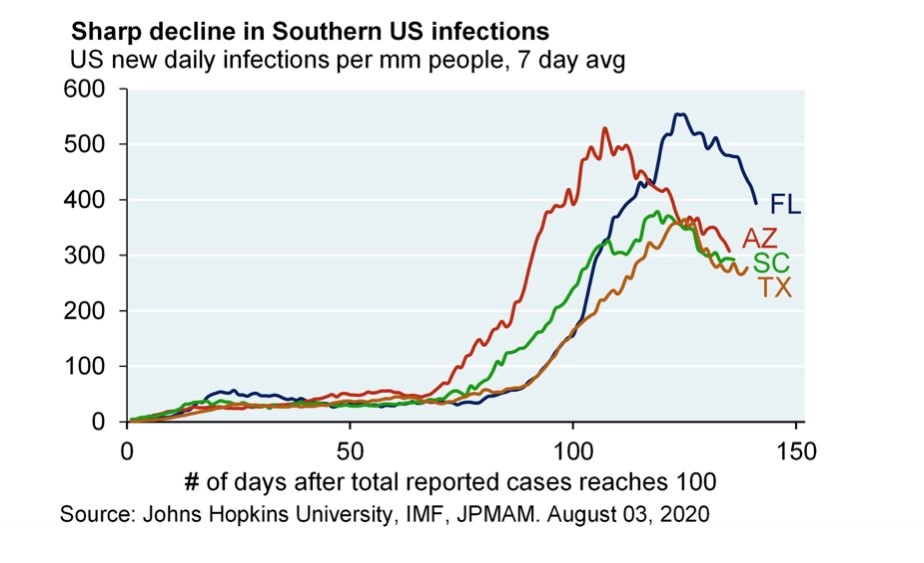
2) As Adam Patinkin of hedge fund David Capital Partners predicted last month (see my July 15 e-mail), the hard-hit states in the South and West are getting the coronavirus under control, as you can see in these two graphics:

(If you wish to join my coronavirus e-mail list, simply send a blank e-mail to: cv-subscribe@mailer.kasecapital.com)
3) Every summer for the past 15 years, I've co-hosted with an Italian friend a two-day Value Investing Seminar in the beautiful town of Trani, located on the Adriatic coast in the Puglia region (about a three-hour drive east of Naples).
I love the beautiful, historic country and its wonderful people, so it broke my heart to see Italy's terrible suffering in the early stages of the pandemic – and I was equally happy to see this New York Times article: How Italy Turned Around Its Coronavirus Calamity. Excerpt:
When the coronavirus erupted in the West, Italy was the nightmarish epicenter, a place to avoid at all costs and a shorthand in the United States and much of Europe for uncontrolled contagion.
"You look at what's going on with Italy," President Trump told reporters on March 17. "We don't want to be in a position like that." Joseph R. Biden Jr., the presumptive Democratic nominee, used Italy's overwhelmed hospitals as evidence for his opposition to Medicare for All at a presidential debate. "It is not working in Italy right now," he said.
Fast forward a few months, and the United States has suffered tens of thousands more deaths than any country in the world. European states that once looked smugly at Italy are facing new flare-ups. Some are imposing fresh restrictions and weighing whether to lock down again.
Prime Minister Boris Johnson of Britain on Friday announced a delay to a planned easing of measures in England as the infection rate there rose. Even Germany, lauded for its efficient response and rigorous contact tracing, has warned that lax behavior is prompting a surge in cases.
And Italy? Its hospitals are basically empty of COVID-19 patients. Daily deaths attributed to the virus in Lombardy, the northern region that bore the brunt of the pandemic, hover around zero. The number of new daily cases has plummeted to "one of the lowest in Europe and the world," said Giovanni Rezza, director of the infective illness department at the National Institute of Health. "We have been very prudent."
And lucky. Today, despite a tiny uptick in cases this week, Italians are cautiously optimistic that they have the virus in check — even as Italy's leading health experts warn that complacency remains the jet fuel of the pandemic. They are aware that the picture can change at any moment.
How Italy has gone from being a global pariah to a model — however imperfect — of viral containment holds fresh lessons for the rest of the world, including the United States, where the virus, never under control, now rages across the country.
After a stumbling start, Italy has consolidated, or at least maintained, the rewards of a tough nationwide lockdown through a mix of vigilance and painfully gained medical expertise.
Its government has been guided by scientific and technical committees. Local doctors, hospitals and health officials collect more than 20 indicators on the virus daily and send them to regional authorities, who then forward them to the National Institute of Health.
The result is a weekly X-ray of the country's health upon which policy decisions are based. That is a long way from the state of panic, and near collapse, that hit Italy in March.
4) After reading the article, I e-mailed Adam Patinkin the following:
This article fails to even mention the obvious answer for Northern Italy – it reached effective herd immunity (albeit at a terrible cost). But what do I tell my friends in Southern Italy? They didn't get hit at all, so should they continue socially distancing to keep it that way? Or start French kissing everyone to get it over with, since they're destined to get whacked, just like Arizona, Florida, Texas, and Southern California? If you were the czar of Southern Italy, what would your strategy be? Serious question...
Adam gave me permission to share his reply (which echoed what I heard from my colleague Enrique Abeyta and analyst Alex Griese):
The same approach applies to Italy and to everywhere else on earth. Honestly, the policy response is not hard once you accept that (1) this is mitigation not suppression, (2) we have a clear understanding of who is vulnerable and who is not, and (3) 30%-40% of the population will be infected (with disease break point at 15%-20%) regardless of what we do.
If you are vulnerable (old, diabetes, obese, etc.) – take every precaution. Test frequently. Have pulse oximeters to detect if 02 levels are falling. Do all you can to minimize person-to-person contact – and to keep fit and healthy.
Everyone else who is healthy and under age 65 – live your normal lives while practicing moderate social distancing (to minimize initial viral loads and therefore health outcome risk). Re-open schools. Re-start youth sports. Get back to life.
Policies: Do every event possible outside – schools, fitness classes, restaurants, etc. Encourage the population to exercise outside and get sun (to lower obesity and reduce vitamin D deficiency). This should be a call to arms for citizens to get healthy! Also a call to arms that every business should have policies in place allowing employees to stay home if/when they are sick with no penalty.
Another policy: Governments should set up recovery locations for (1) isolating people with COVID who don't have enough room to self-isolate at home and (2) for people recovering from COVID who don't need to be in hospital anymore.
No need to test anyone without symptoms in the normal population. If you are a health care worker or if you work in nursing homes, you should be tested frequently. And anyone with symptoms should be tested. Contact tracing is not necessary and should be stopped. No travel bans. No quarantining the healthy. Mask wearing or lack thereof is irrelevant.
In short – quarantine and protect those at-risk, while everyone else lives their lives with moderate/sensible precautions in place.
Adam, Enrique, and Alex all believe that we're in the 8th inning of the pandemic here. I'm cautiously optimistic that they're right!
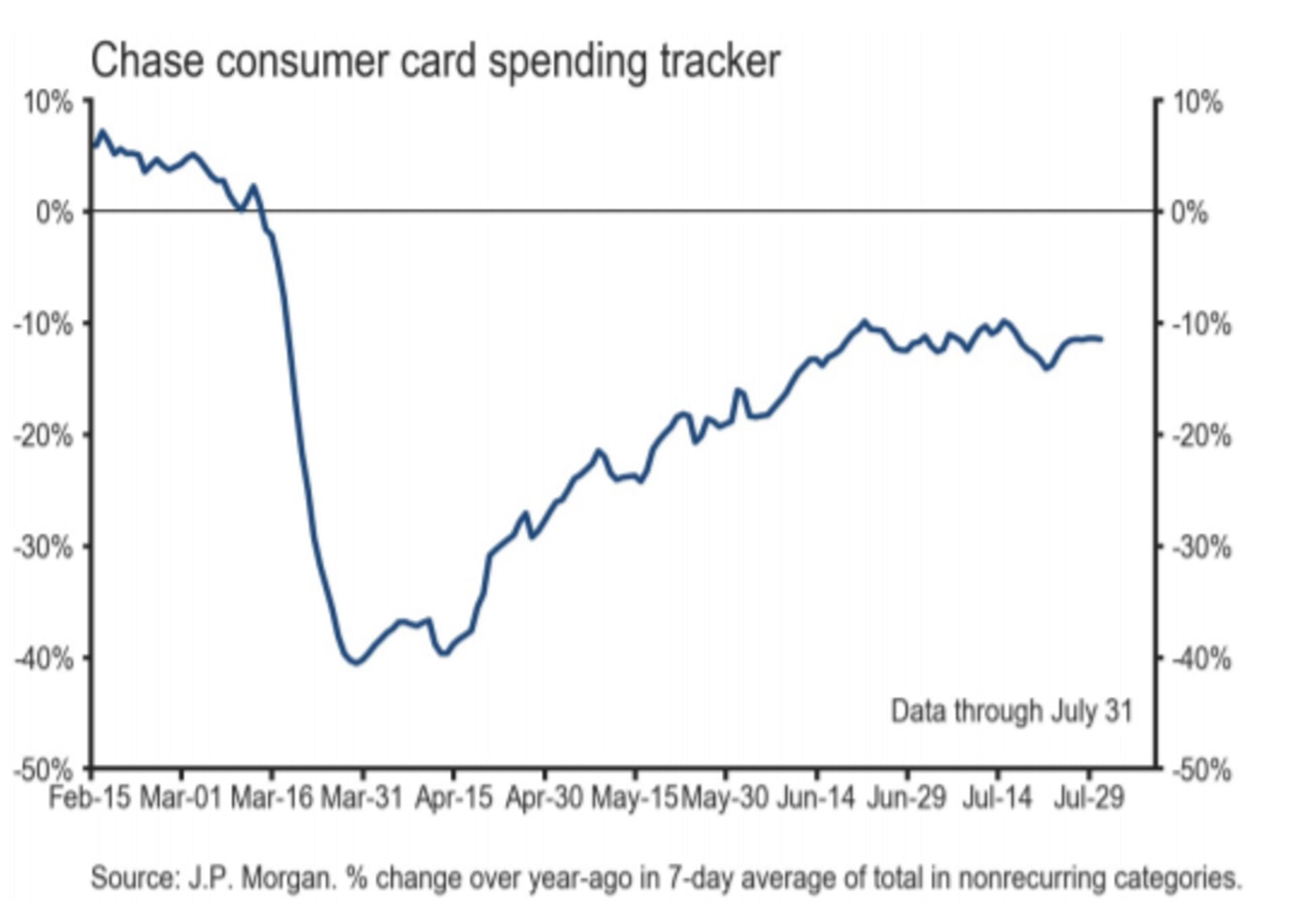
5) Even if they are however, in the short term, the economy has clearly stalled out.
Here's one more piece of evidence for this: Credit card data from JPMorgan Chase shows the economic recovery may be stalling.
6) Following up on Monday's e-mail, it's good to see the U.S. Securities and Exchange Commission ("SEC") looking into this cesspool: Kodak Loan Disclosure and Stock Surge Under SEC Investigation. Excerpt:
The Securities and Exchange Commission is investigating the circumstances around Eastman Kodak's (KODK) announcement of a $765 million government loan to make drugs at its U.S. factories, according to people familiar with the matter.
News of the loan last week caused Kodak's shares to rise as high as $60, before falling to about $15 on Monday due to a dilution in the shares. Amid the heightened volatility, trading volume has surged. The price spike briefly produced a potential windfall for company executives who owned stock-option grants, some of which were granted on July 27, the day before the loan was officially announced.
The SEC's investigation is at an early stage and might not produce allegations of wrongdoing by the company or any individuals, the people familiar with the matter said. Among the areas being probed by regulators: how Kodak controlled disclosure of the loan, word of which began to emerge on July 27, causing Kodak's stock price to rise 25% that day.
The Wall Street Journal reported last week that Kodak had shared information about an agreement between the company and the Trump administration with media outlets before the public announcement. Some media companies then published that information before deleting it following a request from the company...
The SEC is also expected to examine the stock options granted to executives on July 27, the people said. The option grants instantly became profitable, at least on paper, after Kodak's loan became public.
On Monday, Sen. Elizabeth Warren (D., Mass.) asked the SEC to probe whether any illicit trading occurred before the loan announcement. In a letter to SEC Chairman Jay Clayton, Ms. Warren wrote she was concerned about stock purchases by Kodak directors last month, "at a time when Kodak and the Trump administration were negotiating the deal in secret."
Best regards,
Whitney