

Melvin Capital lost 53% in January; Aristides letter; The good guys in the GameStop story?; Don't be tempted to bottom-fish; 10-year-old makes 5,000% on GameStop; Robinhood: The Silicon Valley Start-Up That Caused Wall Street Chaos
1) Hedge funds' January returns are starting to trickle in...
And as you would expect in light of what happened during the month to heavily shorted stocks like GameStop (GME), long-short funds took a beating – likely none more so than Gabe Plotkin's Melvin Capital, which needed a $2.75 billion lifeline to survive after it lost more than half of its value: Melvin Capital Lost 53% in January, Hurt by GameStop, Other Bets. Don't shed any tears for Plotkin, however... I estimate he made at least $400 million in 2020 alone!
2) In contrast, Aristides Capital, run by my friend Chris Brown, was only down 3.6% despite having a significant short book. In his January letter (shared with permission), Chris shares some wise thoughts on what happened and how he navigated it. Excerpt:
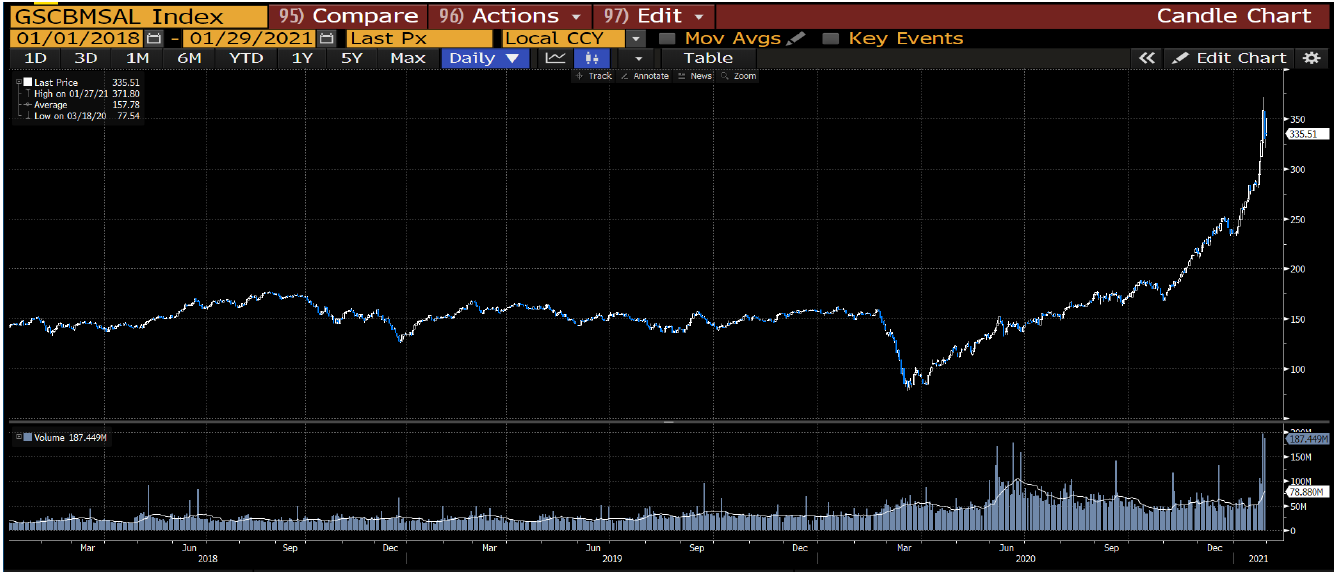
In case you haven't been as riveted to the market's movements as we have, the worst crisis since August 2007 just struck fundamental equity long-short hedge funds in late January. I'll try to briefly explain what happened. Here is the chart of the Goldman Most Shorted Rolling Index ("GSCBMSAL"), a basket of the 50 most heavily shorted stocks in the Russell 3000 index with a market cap of at least $1 billion:
The moon-rocket at the far right of the chart is a +58.15% move from the beginning of 2021 (21 trading days ago) through this Wednesday, which represented the violent climax of a 97% move higher since the end of October, and a 379% gain since the March lows.
It's not surprising that there is a great deal of speculation in the market at present, given that households literally have an extra $1 trillion sitting in bank and money market accounts compared to this time last year, but the sheer magnitude of the flows into certain highly-shorted stocks has been stunning. Online investment idea communities like Reddit's WallStreetBets have given investors a chance to collectively "focus their energy" on certain stocks and sectors.
Among their favorite recent plays, as you've probably heard by now, was a push to buy stock and call options to create a short squeeze in GameStop (GME).
GameStop is a legacy videogame retailer whose stock attracted an exceptionally high short interest – over 140% of its float – from hedge funds betting on the collapse of its physical retail business in a global pandemic. Most important among them was a $12 billion firm named Melvin Capital, which is known for taking unusually large and concentrated short positions. At some point, beginning on or around January 13, investors broadened their focus from just making GameStop go up, to trying to make all of Melvin Capital's known short positions go up – including Chinese online education fraud GSX Techedu (GSX), unfortunately a favorite short of ours as well.
While we realized early on what was happening, and reduced our exposure to GSX as a result, we kept on a substantial portion of our position, as (1) we like GSX as a short; even if 70% of its revenue weren't fraudulent, the stock was trading at 12x this year's revenue with net margins of negative 20%, and (2) most of our position was structured as put spreads, meaning the most we could lose on those positions was 100%, rather than the 200%+ loss a straight short would have incurred. Fortunately, we traded around this move fairly successfully, and managed to only lose 35 bps in GSX, even though the stock doubled.
3) Before you start idolizing the "colorful rebels" who "represent the democratization of finance the revenge against the fat cats," read this: The good guys in the GameStop story? It's the hedge funds and short sellers. Excerpt:
The GameStop speculators are not merely in a frenzy about one stock. Their goal is to destroy the traders who link stock prices to fair value. To suggest a political analogy, they are not just blindly devoted to their candidate; they deny the legitimacy of the opposition party. They are not just acting within the system; they want to overthrow the system. It's as though – just imagine – a rabble gripped by conspiracy theories were to attack the rules of democracy itself. The name "GameStop" is apt.
4) My 25-stock "short squeeze bubble basket" that I identified (and called the top of) in Wednesday's e-mail fell 15% on Thursday and Friday.
Do not be tempted to bottom-fish these stocks.
Mark my words: as my analyst Kevin DeCamp and I predicted in Thursday's e-mail, as a group, they will fall 30% within a month, 50% within three months, and 80% within a year from their closing prices last Wednesday.
5) If you own any of these stocks, do what this kid did and sell (I love this story)! From the New York Times: A 10-Year-Old GameStop Investor Cashed In. His Return? Over 5,000%. Excerpt:
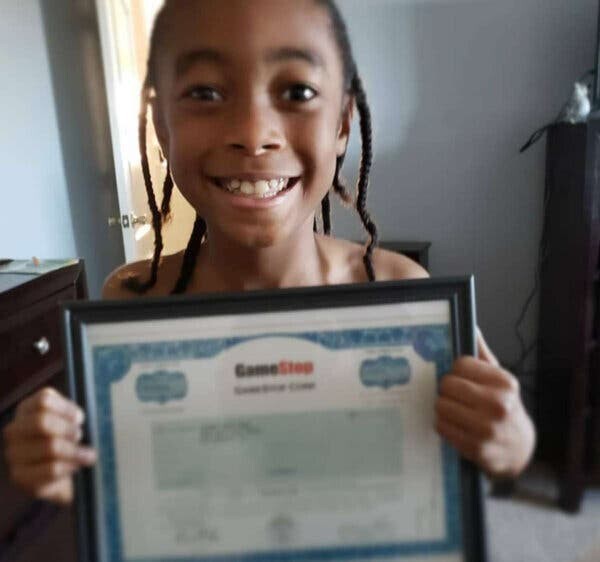
As amateur investors banded together this week to squeeze Wall Street hedge funds by sending GameStop's stock prices to dizzying heights, some novice traders, like 10-year-old Jaydyn Carr of San Antonio, have seen their long-term investments pay off.In December 2019, Jaydyn, then 8, was buying discounted games at GameStop and wishing for an Xbox One. Spying a way to use her son's enthusiasm for video games to teach him about investing, Jaydyn's mother, Nina Carr, decided to invest in 10 shares of GameStop at $6.19 a share for a Kwanzaa gift.
Ms. Carr handed her son a certificate she created from an online template to explain to him that he was the owner of a tiny part of GameStop. She told him the gift was in keeping with the spirit of ujamaa, or cooperative economics, one of the seven principles of Kwanzaa.
She added alerts on her phone and computer to track the stock's progress. Over the past few months, she noticed it steadily rise. But on Wednesday, to the shock of Ms. Carr and her son, the value of GameStop shares surged, soaring 1,700% since December after millions of small investors, many spurred on by social media, came together to put a squeeze on at least two hedge funds that had bet GameStop's shares would collapse.
"All of a sudden, I heard 'ding, ding, ding, ding, ding,'" Ms. Carr, 31, referring to the stock alerts, said in an interview on Friday. "I grabbed my phone, and I was looking at it, and it said $351. I was shocked: 'I bought this thing at $6,' I thought, 'there's no way this can be right.'"
Ms. Carr, a nutritionist, quickly pulled her son out of virtual learning and asked him what he wanted to do. "I was trying to explain to him that this was unusual," she told mySanAntonio.com, a segment of the San Antonio Express-News. "I asked him, 'Do you want to stay or sell?'"
Jaydyn decided to sell his shares, earning $3,200 – a return of more than 5,000% on an investment of about $60.
Over the weekend, we learned it wasn't their decision... They ran out of money! Here's a New York Times article about it: The Silicon Valley Start-Up That Caused Wall Street Chaos. Excerpt:
One institution that tripped up Robinhood this past week is a clearinghouse called the Depository Trust & Clearing Corporation. Owned by its member financial institutions including Robinhood, the D.T.C.C. clears and settles most stock trading, essentially making sure that the money and the shares end up in the right hands. (Options trades are cleared by another entity.)
But the D.T.C.C.'s role is more than just clerical. Clearinghouses are supposed to help insulate a particular market from extreme risks, by making sure that if a single financial player goes broke, it doesn't create contagion. To do its job, the D.T.C.C. requires its members to keep a cushion of cash that can be put toward stabilizing the system if needed. And when stocks are swinging wildly or there's a flurry of trading, the size of the cushion it demands from each member – known as a margin call – can grow on short notice.
That's what happened on Thursday morning. The D.T.C.C. notified its member firms that the total cushion, which was then $26 billion, needed to grow to $33.5 billion – within hours. Because Robinhood customers were responsible for so much trading, Robinhood was responsible for footing a significant portion of the bill.
The D.T.C.C.'s demand is not negotiable. A firm that can't meet its margin call is effectively out of the stock trading business because D.T.C.C. won't clear its trades any more. "If you can't clear a trade, you can't trade a trade," said Robert Greifeld, the former chief executive of Nasdaq and current chairman of Virtu Financial. "You're off the island. You're banished."
For veteran players like Citadel Securities and JPMorgan Chase, generating additional hundreds of millions of dollars on short notice was not a problem. But for a start-up like Robinhood, it was a mad scramble.
While it cobbled together the needed cash from its credit line and investors, Robinhood limited customers from buying GameStop, AMC and other shares. Allowing its investors to sell these volatile stocks – but not buy them – reduced its risk level and helped it meet requirements for additional cash, Robinhood said in its blog post.
Ultimately, the company succeeded in pulling together roughly $1 billion from some of its existing investors, including the venture firms Sequoia Capital and Ribbit Capital. As a sweetener, Robinhood issued special shares to those investors that will give them a better deal when the company goes public, as early as this year.
But the quick deal left more than one observer scratching their heads.
"How does an online broker find itself in need of an overnight infusion of a billion dollars?" asked Roger McNamee, a longtime investor who co-founded the private-equity firm Elevation Partners. "There's something about this that says somebody is really scared about what's going on."
McNamee is right: regulators need to take a much closer look at Robinhood (and any other broker that restricted trading) and take steps to protect investors from the travesty that took place last week.
Best regards,
Whitney