

My analysis of Apple; Doug Kass on 'Apple as a metaphor for the market'; When to call off a wedding
1) Tech giant Apple (AAPL) is an insanely great, wildly profitable company. That said, its free cash flow ("FCF," or operating cash flow minus capital expenditures) has declined by 16% over the past four years – from a peak of $70 billion in the year ending September 30, 2015 to $59 billion in the year ending September 30, 2019.
This is in sharp contrast to the 71% growth in FCF by Google parent Alphabet (GOOGL). This chart shows the data for both companies:
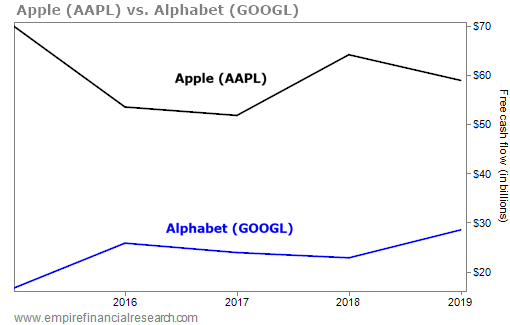
Note that for each year, Apple ends on September 30 and Alphabet ends December 31 (except 2019, where its trailing 12 months ends on September 30).
Yes, Apple's earnings per share ("EPS") are up 29% over this period... but that's almost entirely because the company has bought back 20% of its outstanding shares by spending an astonishing $248 billion of stock over the past five years – $145 billion in the past two years alone. Thus, we can see that to create the illusion of growth, Apple had to spend nearly all of the $298 billion of FCF that it generated over that period. Alphabet didn't.
Both of these stocks have roughly tripled over the past five years and currently trade near all-time highs – but I'd argue that Alphabet deserved to, while Apple didn't. And I definitely think that Alphabet's stock will outperform Apple's going forward. (For more on this, see my article from July 2018: Why I like Alphabet more than Apple – and Buffett doesn't, and updated thoughts in my May 1 e-mail.)
2) My friend Doug Kass of Seabreeze Partners shares my skepticism of Apple and gave me permission to share this article he wrote...
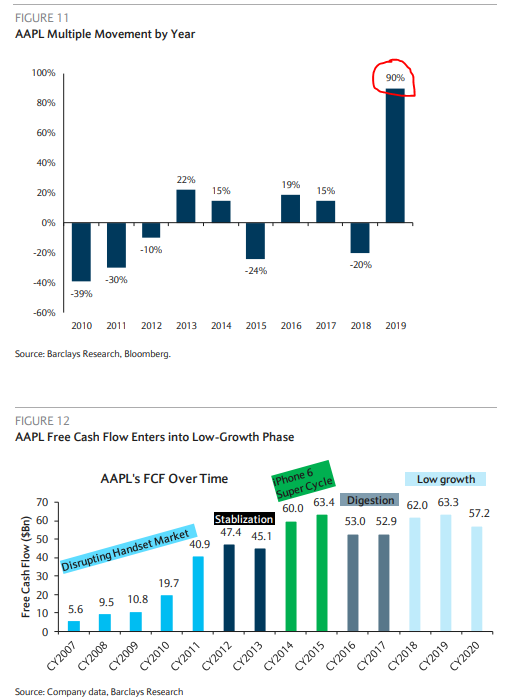
Apple's shares are a metaphor for the market (and how liquidity and the machines and algos can impact our markets). In the last 12 months nearly the entire move in the stock was embraced by a P/E multiple expansion of 90% (see Figure 11, below). The multiple expansion was not driven by accelerating growth. Indeed, cash flow (and revenue) have been stagnant for five years (see Figure 12, below).
This is also what has happened to the S&P Index. Limited revenue growth, no operating income growth, some growth in EPS (only driven by buybacks and the resultant share count shrinkage). And then a massive P/E multiple expansion – even in the face of the aforementioned slowing in revenue and operating income growth we have multiples and a number of traditional metrics at or near historic highs.
We are somewhere in an advancing and maturing new normal or investment backdrop that many, including myself, find disquieting. Remember, it is normal for multiples to expand when growth expands or when companies are at trough earnings, but the market realizes normalized earnings are higher and gives credit for that.
Apple's 90% P/E multiple expansion last year absent revenue or cash flow growth for five years is an extreme example but there is a similar phenomenon, though not as extreme, for the markets – massive multiple expansion (and to high levels of absolute multiple as well on peak earnings no less), without sales or operating income growth...
a company like Apple can end up with a market cap that is now as large as the entire market capitalization of the total Australian equity market!
To be clear my point is about the entire U.S. equity market, not just Apple.
Apple is a symptom, not the cause.
3) Some final thoughts regarding my 12 questions to ask before you marry someone (which I summarized in a recent e-mail)...
Falling in love is a wonderful feeling, but the associated passion, romance, and swirl of emotions can lead to a terrible decision – marrying the wrong person – which is often the greatest calamity that can befall someone.
Thus, right up until your wedding, you need to be on the lookout for warning flags and be willing to call things off.
A close friend of mine who is now twice divorced confessed to me that in both cases, after she got engaged but before the wedding, she knew she was making a mistake. Nevertheless, she went ahead for both practical and emotional reasons. Regarding the former, it would have been very expensive and disruptive to cancel the wedding because everyone had booked their flights... the bridesmaids had bought their dresses... the venue, food, and flowers had been paid for... etc.
But an even bigger reason, she now realizes, is that she was suffering from commitment bias. In investing, it means that once you've "committed" to a stock by buying it – especially if you then write or talk about it publicly – your natural inclination is to block out any new, disconfirming information. It can lead to big losses... so, to offset this, you must make a conscious effort to not only be open to, but actively seek out information that would cause you to change your mind. (I wrote in depth about this in my December 6 e-mail.)
The same is true for a romantic relationship – up to the point of marriage, at least (after that, I strongly suggest that you do not actively seek out disconfirming information!). The key period of time is often between the engagement and the wedding because it's then that your betrothed, thinking the deal is sealed, might let down his or her guard and show his or her true colors.
This is exactly what happened to another one of my friends. I met his girlfriend, whom he'd known for years and who seemed great. Then, a few months later, he shared the happy news that they'd gotten engaged and set a date for the wedding.
A couple of months before the big day, I called him to ask about the agenda for the weekend so I could schedule my flights accordingly.
I was surprised when he instead said, "Whitney, I'm having second thoughts..."
"Why?" I asked.
"Two things. First, a few weeks after we got engaged, she told me the diamond in the engagement ring I'd bought her wasn't big enough."
"Uh oh," I said. "What else?"
"When I told her that I'm providing financial support to my parents, who aren't doing so well, she made it clear that she didn't want me to continue doing so."
"Wow," I said. "I'm sure that she has many great traits, and of course nobody's perfect, but either one of those two things would be instant deal-killers for me..."
Sure enough, a week later he told me he'd called off the marriage. He was of course upset by the whole experience, but I told him, "You should be grateful that she showed you this side of herself before you got married and had kids with her."
As Maya Angelou once said, "When someone shows you who they are, believe them the first time."
It was the right call. Now, a couple of years later, he's engaged again – and couldn't be happier.
It's hard to break off an engagement, but being in a bad marriage is so much worse!
Best regards,
Whitney