

My big event on Tuesday; Doug Kass is short Apple and Bill Ackman is short the 30-year Treasury; Excerpts from the missive I sent to my Ukraine e-mail list yesterday
1) On August 8, at 7 p.m. Eastern time, I'm forecasting a global event unlike anything else I've ever predicted...
I've made other predictions involving single stocks, market sectors, or the economy as a whole, but this prediction could disrupt much more than just the stock market.
If I'm right, nations will be upended... and trillions of dollars in national budgets will be redirected.
You could also see a rare and enormous buying opportunity for certain stocks.
During the special event on Tuesday, I'll tell you everything in full – including:
- My big prediction
- How I put my life on the line gathering information to make this prediction
- How wildly unpopular predictions like this have been the most profitable in history
- The five exact steps you can make to potentially profit from the event I'm forecasting
The event is completely free to attend – just go to this page on August 8 at 7 p.m. Eastern time for full access. See you then!
2) Speaking of bold predictions, two of my friends just came out with their own...
First, up is Doug Kass of Seabreeze Partners, outlining why he has made Apple (AAPL) his largest short position.
I would never short such an incredible business, but I think Doug is right that Apple isn't a buy – and those who are overexposed to it (like Warren Buffett) might want to bank some profits. Here's the excerpt from his recent missive...
Trade of the Week – Short Apple ($190.89)
- Apple is my largest individual short position
- Earnings growth is slowing, at the services component, in particular, and the marginal benefits from zero interest rates – and a low share price – of buying back equity is now diminished
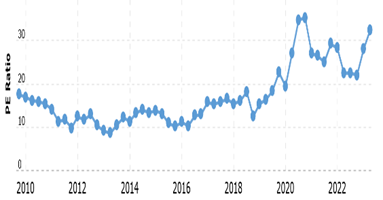
- Apple's P/E ratio has risen from 10x in 2019 to almost 30x today
- Who is left to buy Apple?
Apple is the world's most beloved company and stock. The company's weighting in the S&P 500 has swelled to 7.6%, the biggest of any one stock in the history of the benchmark index.
I am in wonderment that Apple trades at such an inflated price-to-earnings ratio given its limited organic growth prospects and diminishing cash pile.
I am also in wonderment that Berkshire Hathaway (BRK-B) owns 916 million shares worth $175 billion, and accounts for nearly half of the company's $375 billion equity portfolio. Margin of safety, Warren?
The valuation reset higher in price-to-earnings multiples at Apple (and for the broader markets) speaks volumes about the current stock market, and what has happened in the economy with low interest rates and how capital was deployed. Sadly, low rates mean capital goes to the financial/asset economy as opposed to the real productive economy.
Note Apple's net cash as a percent of market cap. It has plummeted over the last 10 years from 35% down to only 2%! There is a numerator and a denominator issue.
As far as the numerator goes, the company has gone from debt free and cash rich to now carrying a fair bit of debt. The debt was issued when the cost of debt was quite low, and the cash proceeds could be redeployed into buying back stock. To Apple's credit, using their cash flow along with the financial engineering, they have retired a fair bit of stock, which appeals to The Oracle of Omaha.
But now it seems like the jig is up on the scheme. With the stock price where it is, it takes a lot more cash to retire a share. With rates where they are today (compared to March 2022 when rates were basically zero!), it is less attractive to sell debt to do this. With the multiple where it is and the interest one can generate from cash on the balance sheet, the math becomes even less compelling.
There are now diminishing marginal returns to the debt issuing and aggressive buyback scheme that has been such a powerful tool for the equity performance of Apple's stock. To be fair, I guess they can keep going – with still high internal generation of excess cash – and sell debt at higher rates, and turn themselves into a levered entity, but with the multiple where it is, this is more of an act of desperation as opposed to wise and real value creation.
I remain surprised Berkshire/Buffett still owns so much stock here given the math doesn't work like it once did. For a company that increases earnings per share by buying back stock, a high P/E multiple can work against you. It seems that the best they can do now is run in place to stand still.
As far as the high P/E multiple is concerned, this is where it gets interesting. Apple's growth has slowed substantially. The last reported quarter, they shrunk 3%, with the benefit of a fair bit of inflation. Their wildly hyped "growth engine" of services sharply decelerated to only 5% year over year growth, down from 17% in the same quarter last year. It will eventually match the growth rate in their handset installed base, which seems close to zero – and it could be worse depending on how some of these lawsuits play out regarding the high fees they charge for their app store.
They don't innovate. They just invest in buying back stock. Because of this, there is no new growth engine to drive future growth. The first new product in years, their version of the Meta's (META) Facebook goggles that nobody seems to want, are finally coming to market about 15 years after the category came into existence (Facebook acquired Oculus Rift in 2014, and Oculus had been around for years prior to that developing the product).
Interest rates are also higher now, by a fair bit, which should also depress stock multiples.
Yet, with all of this going on – higher interest rates, slowing to negative growth, no innovation, buyback math substantially diminished – their P/E multiple (chart below) has expanded to around the highest it's ever been, and much higher than it was when the company was actually a pretty decent grower. The most recent almost 50% jump in the stock, with all these negatives going on, is due entirely to multiple expansion. This speaks volumes about the market, which is really only five to eight companies.
Nvidia (NVDA) at least to their credit, innovates and had a huge upside surprise. Apple did or does neither. It just goes up I guess, and the same can be said about five to seven other companies, to which I say better lucky than good.
Apple's Cash Positioning Is Dwindling

While Apple's Valuation Is Inflating
Bottom Line
Things for Apple are about the worst they've ever been for the company in the last 10 years – growth, balance sheet, share buyback mechanics, view of future ability to grow due to lack of innovation, and a very saturated and mature core market – yet the stock has now returned to the peak P/E multiple it had during the COVID rip, and we know how that ended...
At least during COVID, the company was growing quite robustly, just like every other stay-at-home company, plus rates were 0%. Then, although Apple's stock price and multiple were silly, they were a lot less silly than GameStop (GME) and Peloton (PTON), for example.
It appears that all the GME and PTON money has now crowded into Apple and five to seven other stocks. The professionals have followed right along, once again, and a viscous cycle has been created between the groups of chasers at each end of the barbell.
It is a mania again, of a different sort.
This one really is perplexing though because there is no real identifiable proximate cause. It just sort of happened, without a clear and obvious growth catalyst, and is confined somewhat narrowly. Now, along with select others, right back to the P/E it had during peak Covid insanity, with virtually everything working against it except for the most important and unidentifiable thing evidently working for it.
Doug also added this morning, following Apple's earnings release yesterday after the close: "There was nothing in Apple's earnings report that changed my view on the stock."
Thank you, Doug!
3) Next up is my college buddy Bill Ackman of Pershing Square Capital Management, who tweeted that he is "short in size" the U.S. 30-year Treasury note – betting that the interest rate on it will rise from today's level of 4.32% to at least 5.5%.
Here's his argument:
I have been surprised how low U.S. long-term rates have remained in light of structural changes that are likely to lead to higher levels of long-term inflation including de-globalization, higher defense costs, the energy transition, growing entitlements, and the greater bargaining power of workers. As a result, I would be very surprised if we don't find ourselves in a world with persistent ~3% inflation.
From a supply/demand perspective, long-term Treasurys (T) also look overbought. With $32 trillion of debt and large deficits as far as the eye can see and higher refi rates, an increasing supply of T is assured. When you couple new issuance with QT, it is hard to imagine how the market absorbs such a large increase in supply without materially higher rates.
I have also been puzzled as to why the @USTreasury hasn't been financing our government in the longer part of the curve in light of materially lower long-term rates. This does not look like prudent term management in my opinion.
Then consider China's (and other countries') desire to decouple financially from the U.S., YCC ending in Japan increasing the relative appeal of Yen bonds vs. T for the largest foreign owner of T, and growing concerns about US governance, fiscal responsibility, and political divisiveness recently referenced in Fitch's downgrade.
So if long-term inflation is 3% instead of 2% and history holds, then we could see the 30-year T yield = 3% + 0.5% (the real rate) + 2% (term premium) or 5.5%, and it can happen soon. There are many times in history where the bond market reprices the long end of the curve in a matter of weeks, and this seems like one of those times.
That's why we are short in size the 30-year T – first as a hedge on the impact of higher LT rates on stocks, and second because we believe it is a high probability standalone bet. There are few macro investments that still offer reasonably probable asymmetric payoffs and this is one of them.
The best hedges are the ones you would invest in anyway even if you didn't need the hedge. This fits that bill, and also I think we need the hedge.
As background, here's a chart of the 30-year Treasury rate going back to 1977:

I agree with Bill 100% on inflation. I've been saying for months that, while we've beaten it, it isn't likely to get to the Fed's 2% target. But so what? We can thrive with 3% to 4% inflation.
As for the impact on long-term rates, I don't have as strong a feeling. But I sure wouldn't bet against Bill given that his last two macro investments were grand slams – first, turning a $27 million bet on credit-default swaps into $2.6 billion in a few weeks when COVID hit, and then making more than $1 billion betting on rising inflation.
4) I continue to be quite a bit more optimistic about Ukraine's prospects for driving Russian forces out of their country sooner than almost anyone expects.
For more on this, here are the first three items in the missive I sent to my Ukraine e-mail list yesterday (if you wish to be added to it, simply send a blank e-mail to: ukraine-subscribe@mailer.kasecapital.com)...
a) Here's the usual misleading gloom-and-doom from the New York Times: Ukrainian Troops Trained by the West Stumble in Battle. Excerpt:
The first several weeks of Ukraine's long-awaited counteroffensive have not been kind to the Ukrainian troops who were trained and armed by the United States and its allies.
Equipped with advanced American weapons and heralded as the vanguard of a major assault, the troops became bogged down in dense Russian minefields under constant fire from artillery and helicopter gunships. Units got lost. One unit delayed a nighttime attack until dawn, losing its advantage. Another fared so badly that commanders yanked it off the battlefield altogether.
Now the Western-trained Ukrainian brigades are trying to turn things around, U.S. officials and independent analysts say. Ukrainian military commanders have changed tactics, focusing on wearing down the Russian forces with artillery and long-range missiles instead of plunging into minefields under fire. A troop surge is underway in the country's south, with a second wave of Western-trained forces launching mostly small-scale attacks to punch through Russian lines.
But early results have been mixed. While Ukrainian troops have retaken a few villages, they have yet to make the kinds of sweeping gains that characterized their successes in the strategically important cities of Kherson and Kharkiv last fall. The complicated training in Western maneuvers has given the Ukrainians scant solace in the face of barrage after barrage of Russian artillery.
The article makes it seem like all of the equipment and training from the West has been next to useless, which is ridiculous.
Worse, it seems like it's the Ukrainians' fault that the counteroffensive hasn't resulted in a breakthrough yet, when in reality the fact that we've dithered and dawdled in providing F-16s has resulted in Ukraine not having desperately needed air cover, allowing Russian attack helicopters to operate with impunity.
I recall an article from a few weeks ago that interviewed an American army veteran who was fighting in Ukraine as a Legionnaire. He said, "Our worst day in Afghanistan was better than our best day in Ukraine" because they had plenty of ammo, air support, perfect information from satellites and AWACs, rescue helicopters and field surgical hospitals if they were hit, etc.
I think if you substituted fully trained American soldiers for Ukrainian ones, the counteroffensive over the past month or two would look pretty much the same.
The Ukrainian soldiers have been incredibly smart and brave, which is a major reason why Ukraine has VASTLY exceeded all expectations over the past 525 days, so I'm really sick of this "blame the victim" gloom-and-doom nonsense I'm reading in the mainstream media!
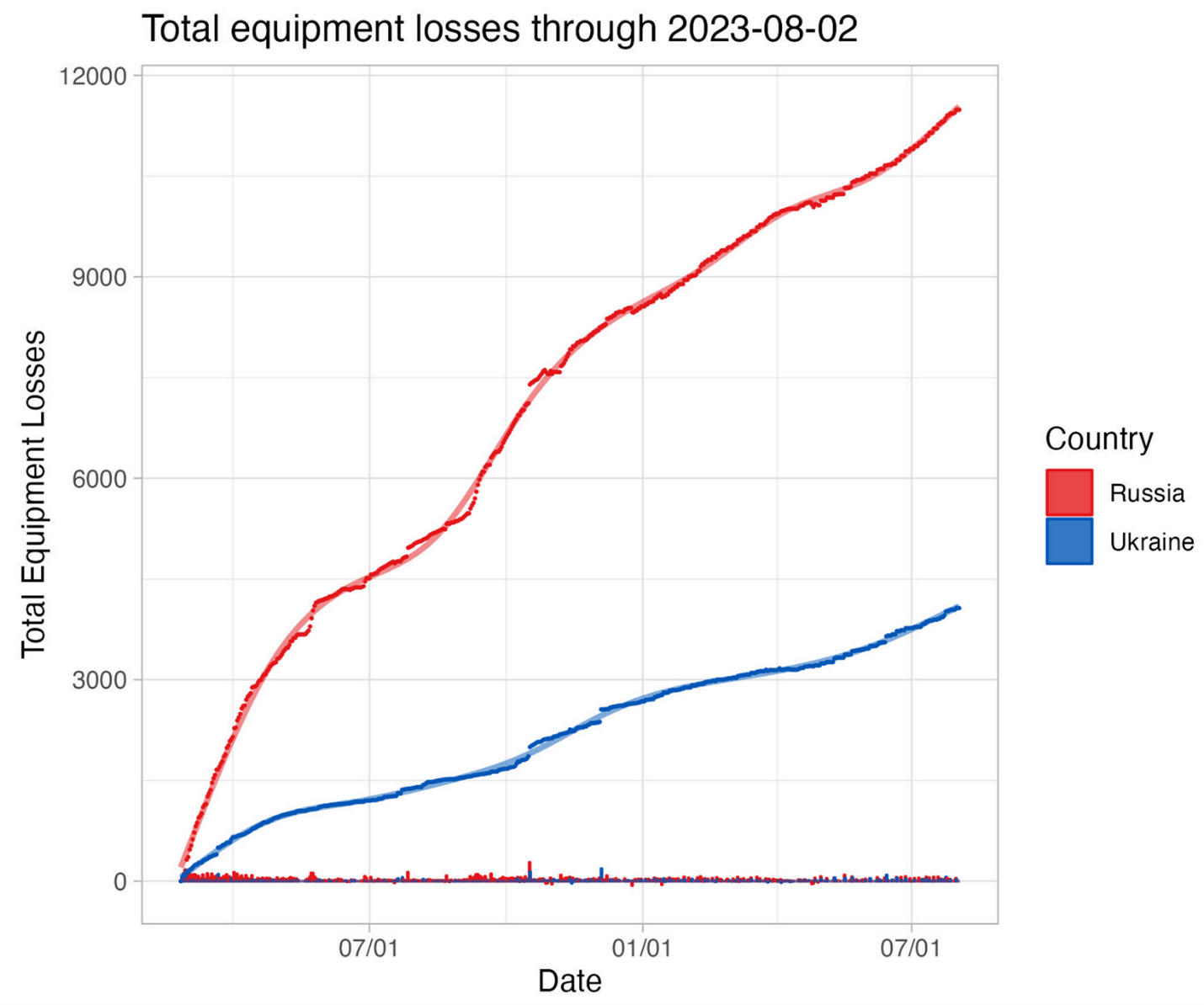
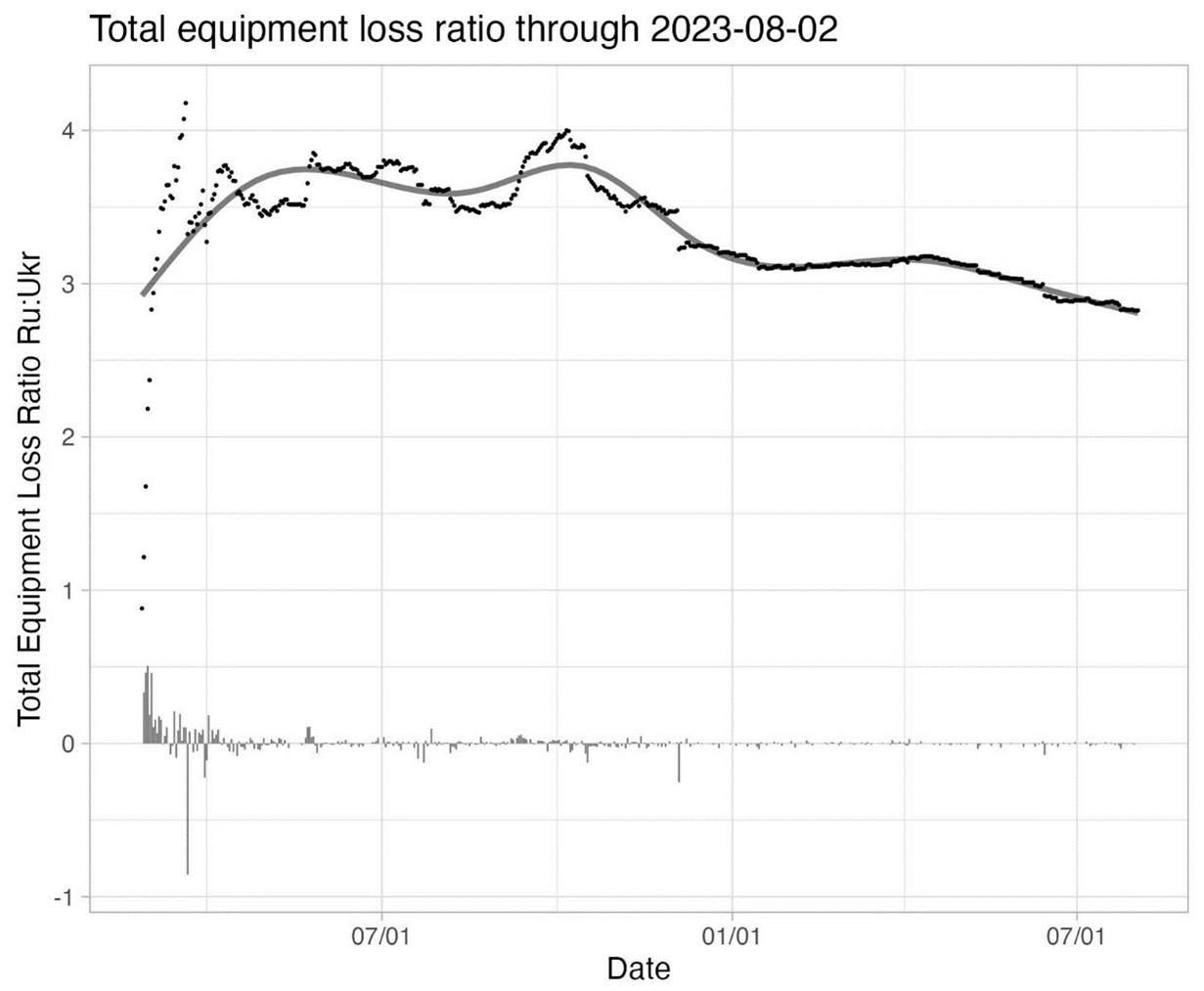
b) The other main problem with the NYT article is that, as usual, there is almost no mention of the situation on the Russian side – which is REALLY bad. Take a look at this blog post, which does the best job I've seen of showing each side's equipment losses and the 3-4 to one ratio in Ukraine's favor that has remained fairly consistent over time (declining a bit recently as Ukraine has gone on the offensive – but keep in mind that it should be 3-to-1 in Russia's favor, given they're on defense and had eight months to dig in):
c) This Time article is the best I've read on the current status of both sides' forces – noteworthy in particular because it highlights Ukraine's "many structural advantages" and Russian forces' woes: How the Ukraine Counteroffensive Can Still Succeed. Excerpts:
The situation in Ukraine still favors Kyiv despite the limited progress made in the counteroffensive so far.
Ukrainian forces attempted a limited mechanized penetration of prepared Russian defenses in the south in early to mid-June, but failed to break through the Russian lines. They then switched to slower and more careful operations while disrupting Russian rear areas with long-range precision strikes. Ukraine began the next, reportedly main, phase of its counteroffensive on July 26 with a determined drive to penetrate Russian lines in western Zaporizhia Oblast.
It's far too soon to evaluate the outcome of that effort, which is underway as of the time of this writing, but it is vital to manage expectations. Ukrainian forces are fighting now to break through the first line of long-prepared Russian defenses. Several lines lie behind it, stretching for many miles. Ukrainian progress will very likely alternate periods of notable tactical advances with periods, possibly long periods, of pause and some setbacks.
Much as we might hope that the road to the Sea of Azov will simply open for Ukrainian forces the odds are high that fighting will remain hard, casualties high, and frustration will be a constant companion. All of which is normal in war.
But the Ukrainian counteroffensive can succeed in any of several ways.
First, the current Ukrainian mechanized breakthrough could succeed, and the Ukrainians could exploit it deeply enough to unhinge part or all of the Russian lines.
Second, Russian forces, already suffering serious morale and other systemic problems, could break under the pressure and begin to withdraw in a controlled or uncontrolled fashion. Third, a steady pressure and interdiction campaign supported by major efforts such as the one now underway can generate gaps in the Russian lines that Ukrainian forces can exploit at first locally, but then for deeper penetrations. The first and second possibilities are relatively unlikely but possible.
The third is the most probable path to Ukrainian success.
It will be slower and more gradual than the other two – and slower than Ukraine's Western backers desire and expect. It depends on the West providing Ukraine with a constant flow of equipment likely over many months so that Ukraine can maintain its pressure until the Russian forces offer the kinds of frontline cracks the Ukrainians can exploit. It is not primarily a matter of attrition.
The slow pace of the pressure campaign Ukraine had been using before July 26 is designed to minimize Ukrainian losses. It is not primarily oriented towards attriting Russians either, but rather towards steadily forcing the Russians out of their prepared defensive positions in ways that the Ukrainians can take advantage of to make operationally significant advances. It is still maneuver warfare rather than attritional warfare, just at a slower pace. It therefore requires patience, but it can succeed.
The Ukrainians have been successful with such an approach both in Kherson and in the Kharkiv counteroffensive. The rapid collapse of Russian positions around Kharkiv in October 2022 was the result of months of steady Ukrainian pressure on the ground and in the rear.
Ukrainian forces stopped determined Russian advances around Izyum in southeastern Kharkiv Oblast and then launched their own limited counterattacks in mid-September 2022. They targeted Russian logistics hubs and concentration areas behind the front lines for months before launching their decisive effort. That effort caught the Russians by surprise, leading to the sudden collapse of Russian defenses and rapid, dramatic Ukrainian gains.
A similar approach in Kherson did not achieve surprise and so did not generate such a large-scale rapid Russian collapse, but it still liberated a large and heavily defended area. A similar approach in southern Ukraine now can offer similar prospects for success.
Ukraine has reportedly committed the main body of the forces it had prepared for counteroffensive operations, although it is not clear what proportion of those forces are actively engaged in combat. Ukraine retains the initiative and benefits from the many advantages discussed below.
Its counteroffensive could nevertheless fail. The Russians might prove more resilient than they seem. The Ukrainians might be unable to develop the tactical skills they need to overcome well-prepared Russian defenses. The West might fall short of providing Ukraine the equipment and support it needs in time. The last is the only thing fully under the West's control. As long as Ukraine still has a serious prospect of liberating strategically vital areas, which it still does, the West's task is to ensure that Ukraine has what it needs to succeed.
Russia's Problems
Reasons for confidence in the possibility of significant Ukrainian successes are closely tied to a number of fundamental challenges inherent to the Russian position in Ukraine and the Russian military. These cannot be resolved in 2023, so the opportunities they offer Ukraine are not fleeting.
At the strategic level, the geometry of the theater favors Ukraine.
At the strategic and operational levels, the lack of Russian reserves forces difficult and complex choices on the Russian military command in the face of Ukrainian counteroffensives.
And at the tactical level the way the Russians are conducting defensive operations puts much greater pressure on Russian combat units than the lack of regular or large-scale movements on the map would suggest.
All these problems are exacerbated by fundamental flaws in the Russian military itself...
Ukraine's Changing Approach
The Ukrainians are also adapting their counteroffensive efforts. They began counteroffensive operations on June 4 and attempted to make several penetrations through prepared Russian defenses in the south using Western-provided equipment.
Those counteroffensives were limited in scale, involving a fraction of the brigades the Ukrainians had prepared and equipped especially for the counteroffensive, and limited in duration. They were largely unsuccessful, generating limited gains accompanied by losses that the Ukrainians rightly judged to be unacceptably high. Ukrainian forces had mainly abandoned that approach by mid-to-late June, shifting instead to much smaller attacks conducted primarily by light infantry, often at night and unaccompanied by mechanized vehicles.
They have made limited gains in the south using this approach in the ensuing weeks at much lower losses in personnel and equipment before resuming major counteroffensive operations on July 26.
This shift in tactics was part of a larger shift in focus away from seeking a dramatic and rapid mechanized penetration back to the kind of slow and protracted pressure campaign that had succeeded in liberating western Kherson Oblast in November 2022.
Ukrainian forces have been attacking Russian supply points, convoys, and headquarters throughout the south for months. They have continued and expanded this campaign in conjunction with the shift to small but constant attacks on the front line with the likely aim of pressuring Russian forces systemically.
The complaints from Russian soldiers and the milbloggers who speak for them about conditions on the front lines in the south in the face of even these relatively small-scale Ukrainian attacks suggest that the pressure is having an effect.
Russian troops are clearly not finding it a simple task to fend off continuous or nearly continuous limited Ukrainian infantry attacks for the reasons outlined above. The better Russian commanders, some of them likely responsible for the improvement in the performance of Russian troops in the south, have apparently begun to complain to Gerasimov about the inadequate support their troops are getting.
Those complaints reached a boiling point when Gerasimov fired Major General Ivan Popov, commander of the 58th Combined Arms Army and the officer responsible for holding western Zaporizhia Oblast, and that commander sent around a scathing audio recording criticizing the Russian high command that made its way rapidly and predictably onto Telegram.
Rumors of other commanders complaining and being fired rapidly followed. Those rumors have died down for the moment, and these firings and complaints are unlikely to generate major short-term changes in the Russians' ability to continue holding their lines, but they serve to show at a minimum the strain Russian forces feel even under the limited front-line pressure they now face.
Ukrainian forces are also clearly working to improve their ability to conduct combined arms operations (by integrating infantry, armor, artillery, and engineering assets – particularly, in this case, mine clearing systems) and appear to be testing small units in combat periodically. They have requested and seem to be receiving additional mine-clearing equipment as well as cluster munitions, which can help them clear trenchlines more rapidly and at lower cost in casualties and equipment.
Ukraine's struggles to use Western vehicles effectively in mechanized penetration battles are disappointing but should not be too surprising in retrospect.
The counteroffensive brigades that received the Western kit were largely new units and lacked the skills that Ukraine's experienced brigades have developed over many months of combat. The Western equipment itself differs from the Soviet-era vehicles that Ukrainians are used to, and it is understandable that Ukrainian soldiers struggled to use it optimally on their first attempts in combat against a foe that had prepared itself well.
The Ukrainians are learning the ins-and-outs of their new systems, however, and figuring out how to integrate them as the newly formed counteroffensive units get combat experience. Ukrainian performance in the field is therefore likely to improve over time.
The Russians, on the other hand, likely generated their peak performance at the start of the counteroffensive. That is when they had been fully prepared, relatively rested, fully supplied, and ready to fight. As the fight goes on and those Russian units are not relieved they are becoming tired, starting to struggle with supplies, and may be becoming demoralized. The Russian performance will thus likely degrade unless the Russians can bring significant reinforcements to bear...
Conclusion
Ukraine is still very much in the game, and the many structural advantages it has offer good reason to expect that Ukrainian forces will liberate vital lands and the people living on them if only the West holds firm in its support.
Best regards,
Whitney
P.S. I welcome your feedback at WTDfeedback@empirefinancialresearch.com.