

My definition of freedom; How to double the vaccine pace; U.S. Calls for Pause on Johnson & Johnson Vaccine After Clotting Cases; Feedback from yesterday's e-mail; Thinking about risk; Getting vaccinated is a no-brainer
I continue to closely follow the pandemic, sending lengthy e-mails to my coronavirus e-mail list roughly once a week. If you'd like to receive them, simply send a blank e-mail to: cv-subscribe@mailer.kasecapital.com.
On Monday, I sent an e-mail to my coronavirus e-mail list strongly calling on folks to get vaccinated. I concluded:
I think those who focus on their freedom not to get vaccinated are thinking about it backwards. Forgive my bluntness, but that's not freedom in my book – that's needlessly endangering yourself, your friends and family, and everyone else you come into contact with. Plus, the millions of people who opt out hurt their country by prolonging this terrible pandemic.
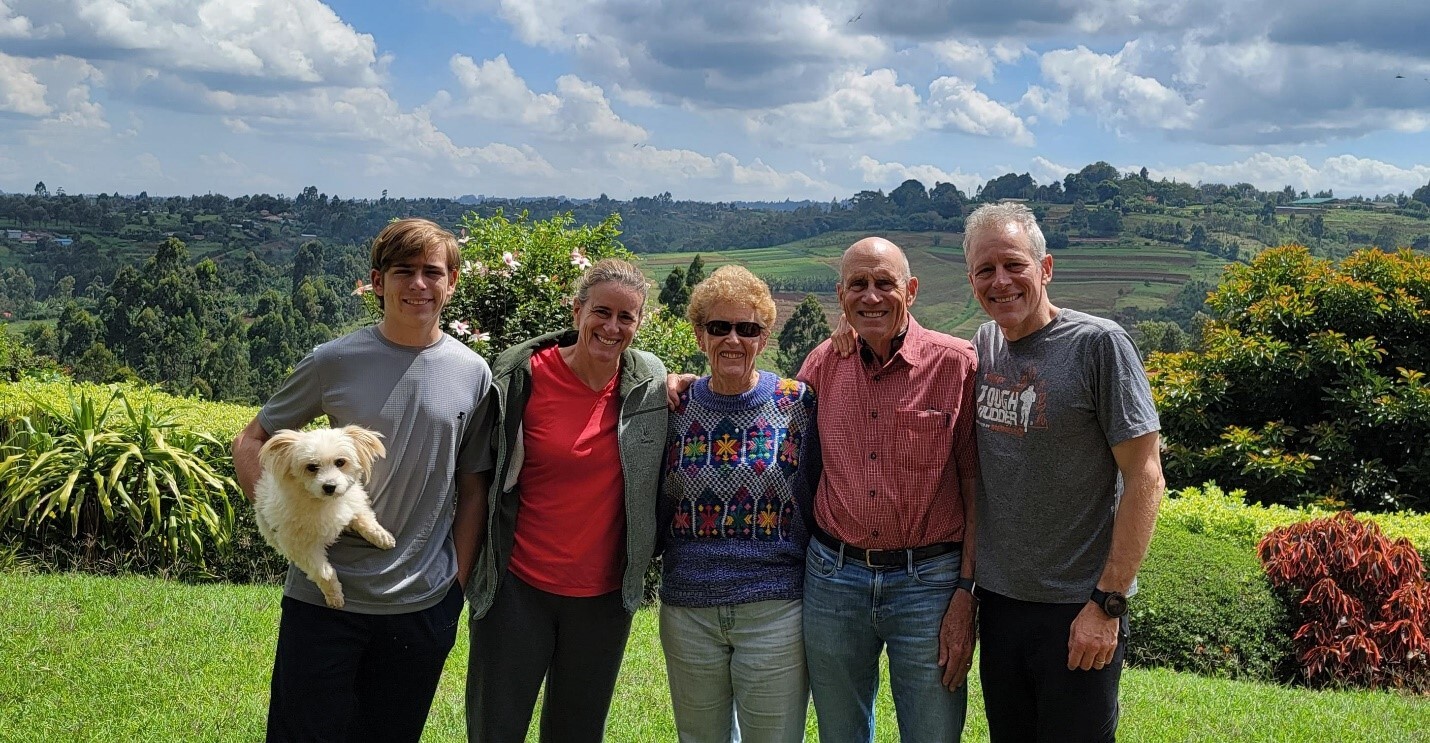
You want to know what freedom is? A friend in Cape Town, South Africa, e-mailed me on Saturday morning, inviting me to come visit him. Long story short, a few hours later I'd booked my flight for the next day (with a one-day layover in Nairobi to see my parents, sister, and nephew). Being vaccinated gave me this freedom.
Then, this morning, shortly after my parents picked me up at the airport, the idea popped into my head: "Why don't you guys come to Cape Town as well, and let's all spend the week together?!" They booked their flights within the hour. Again, being vaccinated gave them this freedom.
In short, getting vaccinated doesn't impinge on your freedom – it enhances it in countless ways!
Once you're vaccinated, you can return to normal life – go out, safely see friends and family, and maybe even do something spontaneous and wonderful!
Speaking of which, here's a picture of me with my parents, sister, and nephew on Monday morning:
Here's an excerpt from the follow-up e-mail I sent yesterday...
1) I got more feedback (both positive and negative) from yesterday's e-mail than any I've ever sent. People sure have strong feelings about getting vaccinated!
But before I get to that, I want to share yesterday's column from New York Times columnist David Leonhardt in its entirety because it's so important, especially now that the Johnson & Johnson (JNJ) vaccine has been paused. He lays out a compelling case for what I've been arguing for TWO MONTHS – that we should be prioritizing first doses for as many people as possible, as the U.K. has done so successfully:
How to double the vaccine pace
The development of the COVID-19 vaccines happened with great urgency, for obvious reasons.
One of the timesaving techniques by Moderna (MRNA) and Pfizer (PFE) involved scheduling the two vaccine doses fairly close together – just three or four weeks apart – during the research trials. The companies did not test multiple gaps between the two shots to see which was the most effective. They each chose a short gap to finish the trials as quickly as possible.
The decision made a lot of sense. It allowed the U.S. mass vaccination program to start in December, rather than pushing it back a few months. Many lives have been saved as a result.
But the approach means that nobody knows what is the most effective gap between the two shots. Maybe it really is three to four weeks. Maybe a longer delay is just as effective (or, for that matter, even more effective).
And the short delay does come with a large downside.
The U.S. is choosing to give millions of people a second shot while making millions of others wait for their first. That's happening even though a single shot provides a high degree of protection even as a more severe, contagious coronavirus variant is sweeping the country. Both cases and hospitalizations have risen in recent days, and deaths have stopped declining.
In response, a growing number of medical experts are calling on the Biden administration or governors to change policy and prioritize first doses:
- "We've missed a window, and people have died," Sarah Cobey of the University of Chicago told my colleague Carl Zimmer.
- "Getting as many people as possible a vax dose is now urgent," Dr. Atul Gawande, the surgeon and medical writer, tweeted.
- "We need to get more people vaccinated," Dr. Ezekiel Emanuel of the University of Pennsylvania told me.
In a USA Today op-ed, Emanuel, Govind Persad, and Dr. William Parker argue that spreading out the first and second shots would be both more equitable and more efficient. It's more equitable because working-class, Black, and Latino communities all have lower vaccination rates, which means that first shots disproportionately now go to the less privileged and second shots go to the more privileged. It's more efficient because a delay in second shots would allow the country to double the number of people who receive a first shot in coming weeks.
Doing so could prevent other states from experiencing the current misery in Michigan, where a severe outbreak fueled by the B.1.1.7 variant has overwhelmed hospitals. In much of the South and the West, the variant is not yet as widespread.
Britain's better results
The biggest worry about a longer delay between shots is that it may allow a new variant to develop in people while they are waiting for their second shot and do not yet have full protection. Dr. Anthony Fauci, the top Biden administration adviser, opposes a longer delay largely because of this possibility.
But it remains only a theoretical possibility, as Dr. Catherine Schuster-Bruce, a British health care writer, has noted. There is no data showing that variants are more likely to develop in people who have received only one shot, just as there is no data showing that a three- or four-week gap between shots is ideal.
There is real-world evidence – from Britain – showing large benefits from maximizing the number of people who get one shot.
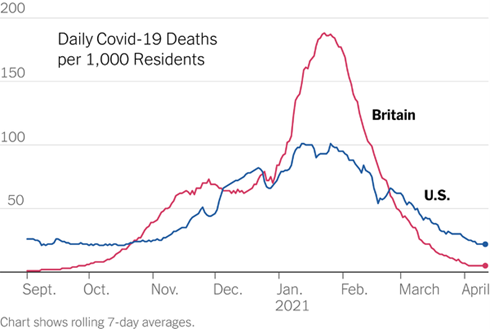
Britain and the U.S. have now given a roughly similar number of total shots per capita. The difference is that Britain has deliberately delayed second shots, by up to 12 weeks. The results are impressive.
Despite being the country where the B.1.1.7 variant was first detected, Britain now has the pandemic under better control than the U.S. does. Both cases and deaths have fallen more sharply, highlighting the power of a single vaccine dose. "The levels of antibodies after the first shot are sky-high," Dr. Robert Wachter of the University of California, San Francisco, told me.
Britain's experience also offers some comfort that delaying second shots will not spur variants: There have been no reports of dangerous new variants emerging since vaccinations began, Emanuel noted. (B.1.1.7 sprung up much earlier.) If anything, Britain's "one-jab" strategy may be making variants less likely. "There are fewer infected people in which variants can arise," Cobey said.
England's top medical official, Dr. Chris Whitty, has called the possibility that delaying second shots would lead to new variants a "real worry but quite a small real worry."
'Follow the science'
A few weeks ago, I was concerned that changing to a different vaccination schedule might not be worth the confusion and uncertainty it could cause. But I find the latest arguments to be strong. The costs of switching are almost all hypothetical. The benefits are concrete.
President Biden and his aides are fond of saying that they "follow the science" when setting COVID policy. Their current definition of the science, however, is quite narrow. It revolves almost completely around the Moderna and Pfizer trials, which didn't test what the ideal gap between shots was. Their definition ignores the mountain of real-world evidence about the strength of a single shot.
In the meantime, about 140 million American adults – more than half – still have not received a shot. The country has made a deliberate choice not to reduce that number as quickly as possible.
2) This news is very unfortunate: U.S. Calls for Pause on Johnson & Johnson Vaccine After Clotting Cases. Excerpt:
Federal health agencies on Tuesday will call for an immediate pause in use of Johnson & Johnson's single-dose coronavirus vaccine after six recipients in the United States developed a rare disorder involving blood clots within about two weeks of vaccination, officials briefed on the decision said.
All six recipients were women between the ages of 18 and 48. One woman died and a second woman in Nebraska has been hospitalized in critical condition, the officials said.
Nearly 7 million people in the United States have received Johnson & Johnson shots so far, and roughly nine million more doses have been shipped out to the states, according to data from the Centers for Disease Control and Prevention.
Assuming no further cases emerge, however, I hope regulators quickly allow the resumption of the J&J vaccine (and ditto for European regulators and the AstraZeneca (AZN) vaccine, which has also been linked to blood clots). The reason is simple math: the blood clots appear to be incredibly rare – less than one in a million (six cases out of 7 million shots), resulting in only one death.
Let's compare these numbers to a conservative back-of-the-envelope estimate of what would have happened in the absence of the J&J vaccine...
Seven million people would not have been vaccinated in the past two months. Over that period, cases have averaged roughly 65,000 per day. Since the actual number of people infected with COVID is multiples of cases, I'm going to estimate 200,000 infections per day. There are 209 million Americans over age 18, so that means roughly one in 1,000 adults was getting infected with COVID every day since the J&J vaccine launched. That means 7 million vaccinations prevented roughly 5,000 infections (in trials, it was 72% effective in the U.S.), maybe 250 hospitalizations, and 10 to 20 deaths every single day.
Now compare those numbers to six people in total who got blood clots, one of whom died and another got very sick.
Conclusion: The government is right to temporarily halt J&J vaccinations so it can quickly evaluate the blood clot risk. But unless many more cases and deaths emerge, we should quickly resume using this highly effective, single-dose vaccine.
3) The feedback from yesterday's e-mail tended to be from one extreme or the other. On the positive front, I received many nice e-mails like these:
- "I wish I could confer on you an honorary degree in public health. Thank you SO much. (from a former state health department director)"
- "Great piece, glad you are willing to take on the vaccine skeptics. I am reminded of the controversy over mandating seatbelts in cars back when I was in high school, when some folks claimed a requirement to use seat belts abrogated their freedom. However, I believe almost everyone now uses seatbelts and many lives have been saved and serious injuries avoided because we are required to buckle-up! Keep up your good work!"
- "Regarding requirements helmets or seatbelts, I feel requiring vaccinations is more like requiring you not drive drunk. A helmet or a seatbelt saves your life, driving sober saves your life and others'. You may want the freedom to kill yourself, but not to kill others."
- "I analogize Covid to stage 1 skin cancer (similar death, some after-effects) – except I ask them to imagine if stage 1 skin cancer can be caught like the common cold and if it goes bad you'll never see your kids/grandkids in person again. So you're telling me you'd be fine with that? And to transmit to other people? No! You'd be getting vaccinated. Well, I say that but at end of day this seems increasingly politically intransigent in nature. As someone who used to consider myself center-right, there is a huge swath of our population where logic seems to no make sense anymore and it feels like it increasingly comes down to that, which is a bigger problem. Good for you for putting yourself out there to say it, although I suspect the intended audience has heard it and somehow managed to mentally filter it somehow."
But many readers didn't like what I wrote:
- "A seat belt and a helmet are NOT injected into my body. A covid vaccine was approved for emergency use with the best info at the time. It was not authorized by the FDA."
- "The difference in definition of freedom is PRECISELY the difference between Democrats and Republicans. All good people. Just different views of what risks/rewards people are willing to take, and whether that should be voluntary or not."
- "This is a horrendous take Whitney. Dividing society up between the vaccinated and unvaccinated is a horrible, horrible idea. It's completely OK to be afraid of a virus that mostly effects elderly and vulnerable people. But if you don't like the idea of being injected with new experimental vaccines then you're a crazy anti-vaxxer conspiracy theorist... We're headed toward having a social credit score like in China. I guess we should all just accept this."
Lastly, a few readers pointed out my propensity to take risks, so who am I to criticize others if they choose to do the same:
- "I agree with your take on vaccine freedom. I do have a question for you. You have commented in recent weekly that we need to be patient for a few more months and not let up too early. But you seem to be travelling a lot. From what I've read it's unclear if the current vaccines protect against the South African variant of the virus. But you seem to be comfortable going to South Africa? It seems irresponsible to travel to South Africa at this point in time. There is a risk that you could bring more of this variant to the U.S. and it seems very inconsistent with your desire for people to show patience. How do you reconcile this? Am I missing something about the variant or the vaccine?"
- "Your own chances of being in a serious accident during a mountain climb are dramatically higher than by not being vaccinated. We all worry about you more when you depart on such trips than when you walk outside NYC."
- "Did you travel during Covid and prior to the vaccine? Wasn't that freedom? Or was it stupidity?"
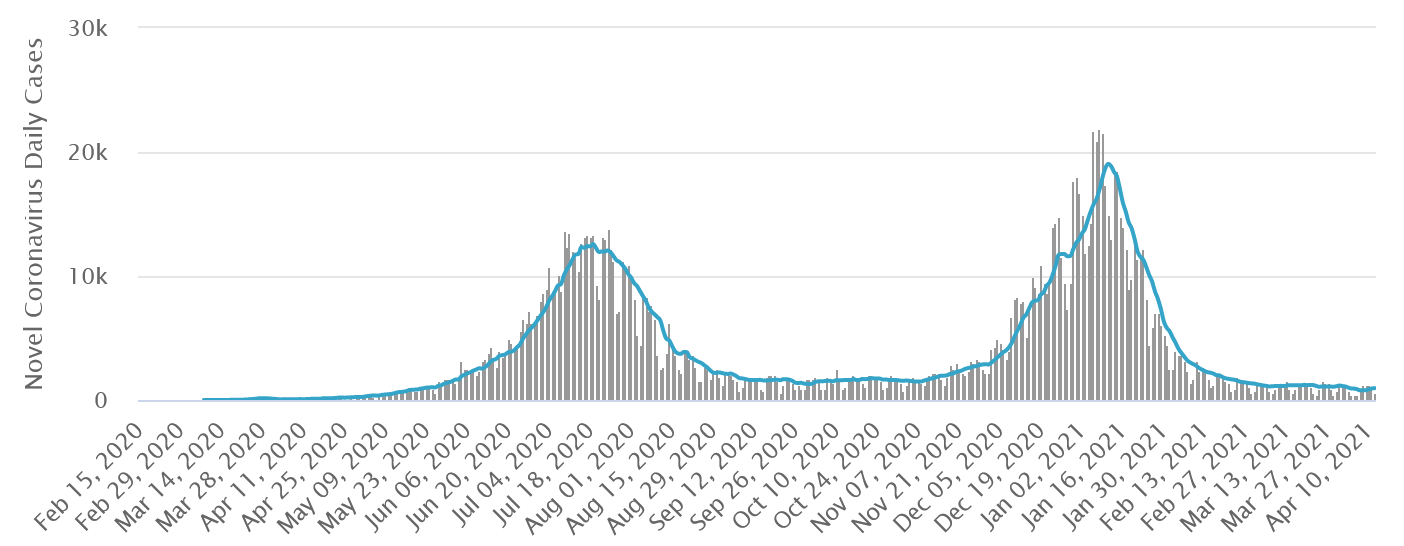
My response: First, COVID has dropped to almost zero here in South Africa:
More broadly, it's true that, throughout the pandemic, I've been willing to take some degree of risk of catching COVID by, for example, volunteering at the Samaritan's Purse field hospital, flying around the country to climb and ski, going to Kenya for three weeks around the holidays, playing tennis regularly, etc.
Over the past year, pretty much every person on Earth has had to balance risk and reward. Every time you stepped out of your house or had contact with another human being, you were taking some degree of risk of catching COVID. Obviously, the more traveling, the more contact with others (especially indoors), the more risk.
Every person is going to have a different answer to these tough, constant questions, depending on their tolerance for risk, the downside if they got COVID (age, health, comorbidities, access to healthcare), and how much they value going out, spending time with friends and family, traveling, and engaging in various activities.
Because I: a) have a high tolerance for risk... b) am not likely to be hospitalized much less die if I get COVID... and c) place a very high value on seeing friends and family and engaging in all of my favorite activities, I chose to take a moderate degree of risk throughout the pandemic.
So, I have no quarrel with anyone who carefully evaluates the risk-reward equation and makes a rational decision to take a certain amount of risk.
My problem is with people who are irrational. For example, it's complete madness to refuse to wear a mask – not because there's huge reward (it probably only slightly reduces your chances of getting infected), but because the cost is so low. On a scale of 0-10, the reward is perhaps only a 3, but the risk is 0.
Similarly, the people I see crowded into indoor bars and clubs before they've been vaccinated aren't thinking very clearly because the reward is small (they could easily socialize outdoors in a smaller group) relative to the very high risk of getting infected. A level-five risk makes no sense if the reward is 2.
Which brings me to my final point about getting vaccinated: Yes, there's some risk, both of things we know about (feeling crappy the next day, a microscopic chance of a blood clot, etc.) as well as things we don't know about (the vaccines are so new that we can't rule out some sort of adverse long-term outcome).
But as of today, according to Bloomberg's vaccine tracker:
More than 814 million doses have been administered across 152 countries. The latest rate was roughly 18.3 million doses a day.
In the U.S., 192 million doses have been given so far. In the last week, an average of 3.38 million doses per day were administered.
So it's not like someone getting vaccinated today is the proverbial guinea pig.
Thus, while there's lots of conjecture and speculation, nearly all of the evidence is that the vaccines are extremely safe. Let's call it a level-two risk.
As for the reward, nearly all of the evidence is that the vaccines are extremely effective in reducing the likelihood of catching COVID, spreading it, and getting sick from it. The reward is clearly a 10.
In conclusion, the risk-reward equation here is so favorable that I view getting vaccinated as the ultimate no-brainer.
Best regards,
Whitney