

My interview; Short report on Triterras; Andrew Left's Citron Capital ends 2020 up 155%; Muddy Waters Pulls Off Big Gains; Get a COVID-19 vaccine ASAP if you qualify
1) I did a 40-minute interview recently with Siddharth Singhai, CIO of IronHold Capital, for his Leaders in Business and Investing podcast. You can listen to it here or watch the video of it here.
In it, we discussed my forthcoming book, The Art of Playing Defense, current events, rational investing, and what it means to be a defensive investor.
2) Justin Hughes of hedge fund Phase 2 Partners just released a bearish report on blockchain trade finance company Triterras: Is Triterras (TRIT) the Wirecard of Blockchain?
Triterras went public by merging with a special purpose acquisition company ("SPAC") in November and currently sports a nearly $1 billion market cap. Justin makes a compelling case that nearly all of the trading on the company's platform is with related parties, among many other red flags.
I haven't done the work on Triterras personally, but I have no doubt that Justin's analysis is correct, given his more than two-decades-long track record doing long-short investing in the financial-services sector. I first met him when he spoke at my shorting conference in May 2018, where he pitched online trading platform Plus500 (PLUS.L), which subsequently declined by 66%.
3) Speaking of activist short-sellers with great long-term records, congratulations to my friend Andrew Left of Citron Research, whose insightful reports I've highlighted many times in my daily e-mails. He released his 2020 annual letter last week, in which he disclosed that his Citron Capital fund was up a remarkable 202% gross and 155% net. Excerpt:
One year ago, in the Citron Capital 2019 annual letter, we noted that Citron would never opine on the state of the market or specific asset classes as we understood our role as reacting to market conditions rather than predicting them. While Citron prides itself on understanding market conditions, I did not realize how prophetic this investment directive would become.
In a market whose movement has become increasingly more dependent on psychology and less about business, we maintain our focus on not predicting economic, political, or scientific events; rather we focus on how to capitalize on investors' reactions to these events...
Short People Got No Reason
Our 2020 short book can be highlighted more not by what we were short, but rather what we were NOT short. As promised in 2019, we stayed away from story stocks and were not short Tesla or any of the high short interest story names that became detached from any underlying financial metrics. Our largest contributor on the short side was Inovio, which became a multi-billion-dollar company despite using the exact same deceptive playbook (verbatim) that it has used for five high profile viruses over the past 10 years.
One of our biggest losers on the short side was GSX, a complete stock fraud that decided to go parabolic. Luckily, our respect for the markets and its irrationality allowed this to be a loss and not a game changer.
The highlight of the year for Citron concerned a company we were not even short – The Bankruptcy of Mallinckrodt. As our readers know, Mallinckrodt was the personification of the worst corporate America has to offer. We are proud of the years of work we put into that name.
4) A hat tip as well to another activist short-selling friend, Carson Block of Muddy Waters, who was up 15% in a brutal year for short sellers according to this Institutional Investor article: In Tough Year for Short Sellers, Muddy Waters Pulls Off Big Gains. Excerpt:
Carson Block, the founder of Muddy Waters Capital, likes to talk about what a screwed up year 2020 was – on many levels. But even as most short sellers gasped for life, Muddy Waters ended the year up a net 15%, according to an investor.
It was the fifth year Muddy Waters' hedge fund posted a double-digit gain, which launched in 2016 and has managed such performance during one of the longest bull markets on record. The fund has produced an annualized return of roughly 19% – and that's after a 2.5% management fee and a 30% performance fee. Muddy Waters' gains came during a year when the broader market, as measured by the Standard and Poor's 500 Index, ended the year with an 18.4% gain.
Muddy Waters' returns far outdo those of most short-biased hedge funds. This year, the strategy had lost 47.59% through November, according to the HFRX Equity Hedge: Short Bias Index.
I've written – most recently on December 9 – about Carson's campaign against Chinese online-education provider GSX Techedu (GSX). It's been unsuccessful so far, but Carson hasn't changed his view. Here's more from Institutional Investor:
GSX's ability to fight off short sellers is a new pattern in Chinese stocks, said Block.
"Ten years ago, when I began doing this, the Chinese guys were really unsophisticated in the market," he recalled. After Muddy Waters put out a short on a Chinese company, "they would just be like deer in the headlights getting run over."
"Things are really different now. I mean these guys are among the most sophisticated players in the market in terms of understanding the technicals," he said.
So far Muddy Waters has lost money on its GSX short. "But we hope to make it back when it collapses," Block added. He's not predicting when that will happen, though.
5) If you or a loved one qualifies to get vaccinated for COVID-19, it's critical that this happens immediately. (If you have doubts, watch this video by NYU marketing professor Scott Galloway, which I included as item No. 3 in my January 8 e-mail. Start watching at 1:07:57.)
We need to protect our most vulnerable citizens and get to herd immunity as quickly as possible because we are facing a "nightmare scenario." Here is a summary of the situation from Wednesday's New York Times Coronavirus Briefing newsletter:
As Americans focus their attention on the fallout from the Capitol siege and the debate over another presidential impeachment, the pandemic is reaching what only a few months ago was considered a nightmare scenario.
Yesterday's death count – at least 4,406 people – set another daily record, and represents at least 1,597 more people than those killed in the Sept. 11 attacks. The U.S. death toll, already the highest in the world by a wide margin, is soaring toward 400,000 – only one month after the country crossed the 300,000 threshold.
From the beginning, the country's coronavirus strategy relied heavily on quickly making a vaccine. Multiple candidates were developed in record time, and if given out quickly, could rein in the pandemic and save thousands of lives. But so far the rollout has been slow, and riddled with challenges.
After the federal government yesterday abruptly reversed course and cleared vaccinations for people over 65 and adults with certain medical conditions, states have been scrambling to meet a surge in demand for doses.
Local officials have struggled to set up phone and online sign-up systems. Many of the oldest Americans, who are most vulnerable to the disease, are encountering byzantine online registration sites, error messages, and crashing servers. Appointments are snatched up as soon as they become available, and some in the highest priority group have only managed to book their shots weeks from now.
As of this morning, the federal government has delivered almost 30 million doses, and more than 10 million have been administered. The Trump administration originally said that 20 million Americans would be vaccinated by Jan. 1.
I can only speak for New York, but I know six people who got the first dose of the vaccine this week: a friend's parents on Sunday, my in-laws on Wednesday, and a friend and his wife yesterday.
After receiving the shot, my friend wrote last night:
Thanks to your push, my wife and I braved the needle today and got our first dose of the Pfizer vaccine. We will go back for the needed second dose on February 5. We did it at the Javits Center in New York City, which was the only place for 50 miles around that had a reservation before April so we drove 40 miles into the city.
It took me two hours to register and get an appointment, but we were in and out of the Javits Center in only an hour. It was a beautiful day, the site was well organized (with 150 National Guard troops), the staff were very helpful and knowledgeable, the parking was easy, and the shot didn't hurt at all. No side effects as of five hours later, and none expected. Worthy to do in my opinion.
They are predicting MAJOR demand and sell outs, so if you qualify I'd go sooner than later. Javits has capacity for thousands of people a day, but so far they're only doing hundreds.
If you live in or near NYC, my wife used this website to set up the appointments (you can also try this one).
Don't delay – slots are filling up fast! And be persistent – it can be a headache, as this article in yesterday's NYT highlights: The Maddening Red Tape Facing Older People Who Want the Vaccine.
Best regards,
Whitney
P.S. While the NYT says, "the rollout has been slow," that's only relative to the Trump administration's initial promises, which were overly optimistic.
In fairness, other than a few small countries like Israel, Bahrain, and the United Arab Emirates, we're actually doing well so far in terms of vaccinations per capita, as you can see in this chart from Our World in Data:
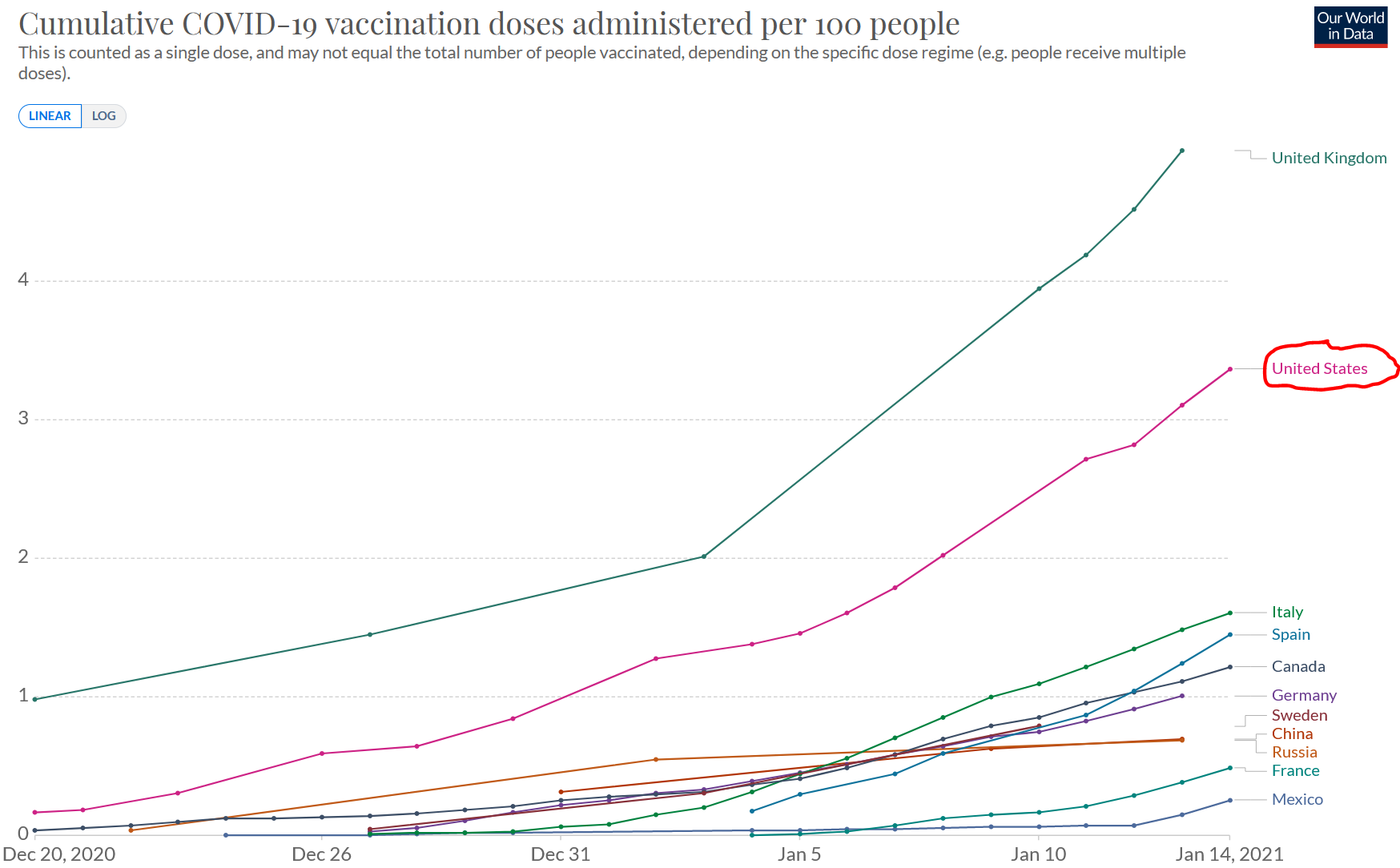
That said, we're only in the first inning... so we all need to work together to get the maximum number of shots in arms fast.