

My interview with China Business News; Jerome Powell's Big Problem Just Got Even More Complicated; My view on inflation; Companies Quiet Diversity and Sustainability Talk Amid Culture War Boycotts; WeWork Faces More Turmoil; I didn't slow down yesterday
1) I did a 10-minute video interview last week with China Business News, which just posted it here (open it in Google Chrome to translate the text).
In it, I answered questions about why I'm bullish on stocks, especially regional banks, for the rest of this year... why I think the Fed will cut rates... why I admire Nvidia (NVDA) but am cautious about its valuation... when to sell a stock... and what I think of ChatGPT.
2) Speaking of the Fed, this article on the front page of today's Wall Street Journal highlights the conflicting economic data that makes its job so hard: Jerome Powell's Big Problem Just Got Even More Complicated. Excerpt:
Federal Reserve Chair Jerome Powell finds himself in a place no central banker wants to be: working to avert a credit crunch, which calls for looser monetary policy, while fighting high inflation, which demands the opposite.
Strains in the banking industry, which followed the collapse of three midsize lenders this spring, help explain why some central bank officials are leaning toward holding interest rates steady at their meeting this week – even though the economy and inflation haven't slowed as much as they expected.
Fed officials don't think a crisis is imminent, attributing recent troubles to idiosyncrasies at the three banks. But current and former central bankers say if stresses worsen, the Fed will face a more difficult trade off. Powell and his colleagues would have to choose between focusing on failing banks or high inflation.
"They're between a rock and a hard place. It's a very, very tough situation," said Raghuram Rajan, a former governor of the Reserve Bank of India. "You're damned if you raise rates significantly more and put even more pressure on the banks, but you're damned if you don't" and inflation accelerates.
My view is that the Fed should stop worrying about inflation, abandon its 2% target, and be happy with 3%-4% inflation as the new normal going forward.
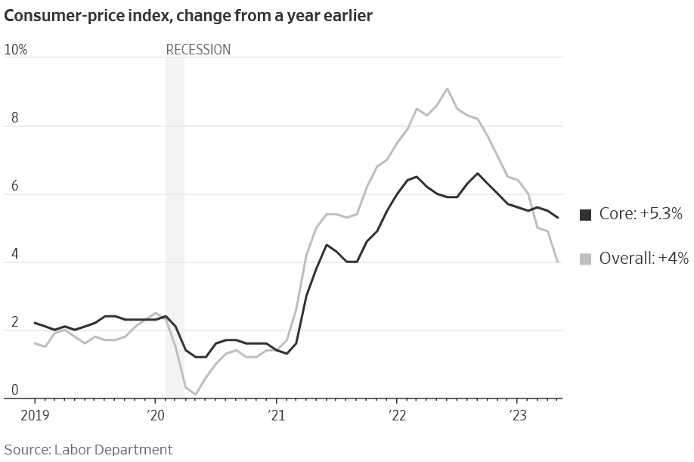
We're almost there, as evidenced by this morning's inflation report, which showed a further decline to 4% in May, the lowest level in two years and the 11th consecutive month of deceleration, the longest such streak since 1921: CPI Report Shows Inflation Has Been Cut in Half From Last Year's Peak. Excerpt:
May inflation was around half of last year's peak but remained far above what Federal Reserve officials would like to see.
The consumer-price index rose 4% in May from a year earlier, the Labor Department said Tuesday, well below the recent peak of 9.1% last June and down from April's 4.9% increase.
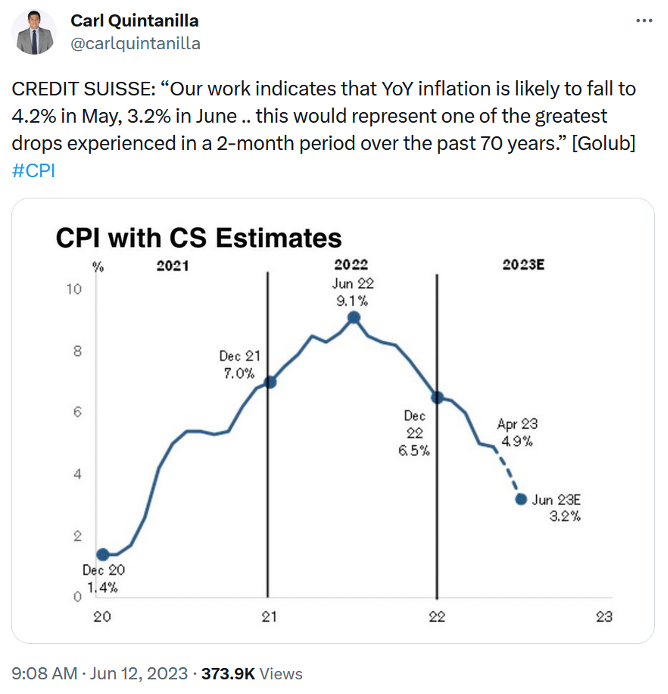
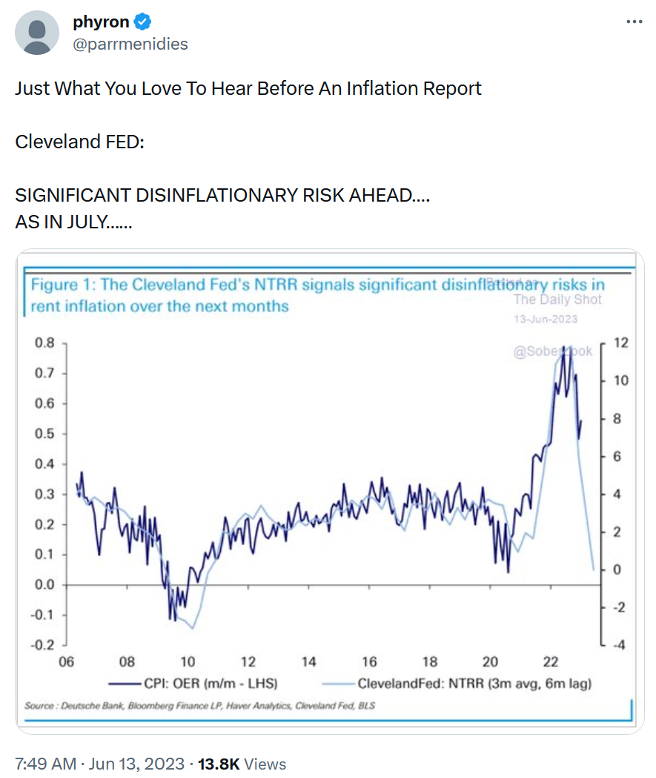
Projections are the inflation should continue to fall, as these two tweets show:
With this morning's report, it's almost certain (futures markets say 96.4%) that the Fed will pause its unprecedented rate hikes – the sharpness of which can be seen in this chart from the WSJ article above:
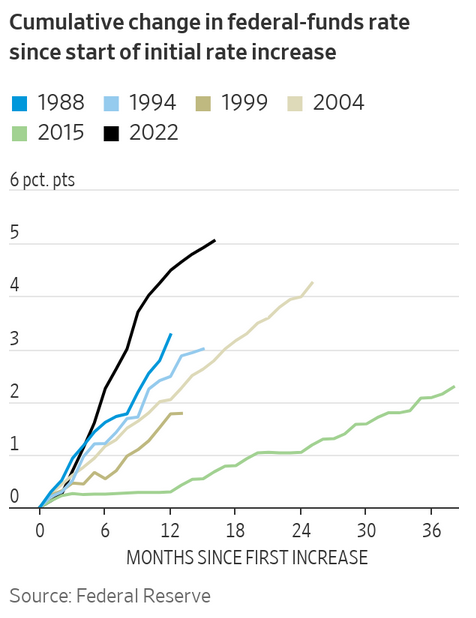
This has caused turmoil in the banking sector that has led to a credit crunch, so I think the Fed is wise to pause and continue to believe that not only will there be no more hikes, but that the Fed will cut rates by 0.25% at least once and maybe twice by the end of the year, which would likely provide a real boost for stocks.
3) This front-page story in today's WSJ echoes what I wrote on May 24 and June 7 about the fallout from the Bud Light debacle – companies are running scared: Companies Quiet Diversity and Sustainability Talk Amid Culture War Boycotts. Excerpt:
Companies' mentions of green and social initiatives during earnings calls have fallen off sharply in recent quarters, reversing a more boastful approach taken over the past few years amid intensifying pressure from some investors and conservative activists...
Finance chiefs and other executives have significantly quieted down in public settings about their environmental and employee diversity efforts as opposition has mounted from a confluence of interests: investors who want companies to focus on their operations, not the social good, and conservative groups and political leaders who have seized on corporate support of such causes to rally "anti-woke" constituents – for example, calling for boycotts of brands that advertise their support of the LGBT community in the wake of recent disputes with Target and Bud Light.
"The easiest thing to do is just to stay out of the conversation and emphasize other facets of business that are going to be perceived as less controversial and more core to the traditional metrics of the business," said Jason Jay, senior lecturer of sustainability at Massachusetts Institute of Technology.
Executives at U.S.-listed companies mentioned "environmental, social and governance," "ESG," "diversity, equity and inclusion," "DEI" or "sustainability" on 575 earnings calls from April 1 to June 5, down 31% from the same period last year, according to data from financial-research platform AlphaSense.
4) This story from the front page of the business section of today's New York Times highlights the turmoil at WeWork (WE), which is about to collapse for a second time: WeWork Faces More Turmoil After Its Chief Executive Departs. Excerpt:
Sandeep Mathrani was supposed to be WeWork's savior.
A real estate executive, he became the chief executive of the troubled office space company in 2020 after a failed initial public offering pushed it to the brink of collapse. He instilled discipline and order on a business that had grown fast and chaotically under its co-founder Adam Neumann.
Instead of building a company that would "elevate the world's consciousness" as Mr. Neumann had wanted, Mr. Mathrani focused on the staid details of running a real estate company. He steered WeWork through the pandemic, got its landlords to accept less rent, took the company public and oversaw a financial restructuring, completed last month, that cut the company's debt.
But just weeks after the restructuring, the company said on May 16 that Mr. Mathrani would step down, and that no permanent successor was lined up. Wall Street analysts who had recently met with him were stunned – one analyst wrote in a research note that the executive was "abandoning ship." A couple of weeks later, WeWork's chief financial officer, who had joined last June, departed, too.
The turmoil raises fresh questions about the viability of WeWork, which has spent billions of dollars building a business that has never come close to breaking even – and must now compete with the flood of cheap office deals that have become available since working from home shrank demand for commercial real estate.
Investors have all but given up on a WeWork turnaround. The stock is trading around $0.20, down more than 95% from October 2021 when it secured a stock market listing through a merger.
I saw NYU marketing professor Scott Galloway interview Mathrani at his Pivot conference in February 2022 and was impressed, writing at the time:
After all the scorn I heaped on this company back then, I have to admit I was predisposed to hate the stock, which closed yesterday at $7.18, just above its all-time low, giving it a market cap of around $5.5 billion.
After hearing Mathrani, however, while I'm still not persuaded the stock is a good buy, I'd never short it. He's that impressive. He has done a remarkable job saving a company I was certain was headed for bankruptcy.
While I was wrong to say the stock was a bad short, at least I didn't recommend it! It's a good reminder of the truth of what Warren Buffett once said:
When a management with a reputation for brilliance tackles a business with a reputation for bad economics, it is the reputation of the business that remains intact.
5) Thanks to the many readers who sent good wishes that my scalp heals quickly from the five-centimeter gash I put in it during a Tough Mudder race on Sunday, which required seven staples to close up (see my Facebook post here).
Many urged me to take it easy for a few days, but of course I didn't. I ran five miles with my running group at 9 a.m. yesterday, played tennis with a friend at 10 a.m., and had a doubles match last night at 8:30 p.m. (which we finally won after blowing two match points and saving one in the match tiebreaker!).
Fortunately, all this activity didn't affect my wound, which is healing nicely...
Best regards,
Whitney
P.S. I welcome your feedback at WTDfeedback@empirefinancialresearch.com.