

My presentation on The Art of Short Selling; Trump's Chaos Trades; The similar appeal of Trump and Warren; I'm not attacking the rich, nor am I a socialist; Americans Now Need at Least $500,000 a Year to Enter Top 1%; Our tax system is actually not very progressive; The Triumph of Injustice; For the first time, workers are paying a higher tax rate than investors and owners
1) I'm giving a presentation followed by a Q&A session at 6 p.m. on Monday, October 21, in New York City at an event hosted by the CFA Society of New York, entitled "The Art of Short Selling."
If you'd like to attend, click here to register and use discount code "ValueInvesting" to save $15 off the regular non-member price of $55.
2) This Vanity Fair story is being widely circulated... 'There Is Definite Hanky-Panky Going On': The Fantastically Profitable Mystery of the Trump Chaos Trades. Excerpt:
The president's talk can move markets – and it's made some futures traders billions. Did they know what he was going to say before he said it?
Traders in the Chicago pits have been watching these kinds of wagers with an increasing mixture of shock and awe since the start of the Trump presidency. They are used to rapid fluctuations in the S&P 500 Index; volatility is common, of course. But the precision and timing of these trades, and the vast amount of money being made as a result of them, make the traders wonder if all this is on the level. Are the people behind these trades incredibly lucky, or do they have access to information that other people don't have about, say, Trump's or Beijing's latest thinking on the trade war or any other of a number of ways that Trump is able to move the markets through his tweeting or slips of the tongue? Essentially, do they have inside information?
But there's a lot of skepticism, which I tend to share – though regulators should definitely take a look to put this to rest... Analysts Have a Few Problems With Trump 'Chaos Trades' Article. Excerpt:
While the idea Donald Trump's White House might have leaked market-moving news isn't crazy, a new magazine story suggesting traders made billions of dollars front-running geopolitical events failed to pass the smell test among Wall Street professionals.
Analysts and investors who spoke to Bloomberg News were mostly skeptical of a Vanity Fair article titled "The Fantastically Profitable Mystery of the Trump Chaos Trades" that raises the possibility traders did more than get lucky buying S&P 500 futures right before big market swings. While nothing is impossible, experts who examined the story said any implication that people traded on inside information fell short of being proven.
3) The PredictIt betting site has President Trump and Senator Elizabeth Warren as the most likely candidates to win in 2020, at 40% and 30%, respectively.
Though they're polar opposites in almost every way, I think they share one important similarity: They're both D.C. outsiders promising to shake up what enrages millions of Americans across the political spectrum – a belief that in recent decades, a corrupt status quo has emerged that further enriches the uber-wealthy and shafts average folks.
I happen to share this belief. As a one-percenter myself, I have extensive personal experience with how well the system works for the wealthiest Americans.
Our income and wealth are growing pretty much every year. Our neighborhoods (the insulated bubbles we live in) are safe. We have access to the best doctors and hospitals in the world. Our kids attend fabulous K-12 schools and have multiple advantages getting into the most elite universities.
In summary – please don't take this the wrong way, I'm simply stating a fact – the one-percenters (and especially the uber-wealthy one-basis-pointers) have it great in this country.
The problem is, what about everybody else? The story for them is that, by and large, they've been struggling mightily for decades without much to show for it.
4) Before I continue, I want to say up front that some of my readers may view what I've written below as an attack on the rich and think that I'm some sort of socialist.
Please...
I went to Harvard Business School, ran a hedge fund for nearly two decades, count many very rich people among my closest friends and, by any objective standard, am wealthy myself. In short, I have impeccable capitalist credentials.
I am merely sharing some interesting new data/research that I think any sensible person should consider when thinking about this country's wealth and income, how it's distributed, and our current tax system.
Regardless of who wins the next presidential election, we are going to have to make some tough choices. In the first 11 months of this fiscal year, during a booming economy when the federal government would normally be expected to run small deficits or even a surplus, the U.S. budget deficit instead widened to $1.1 trillion, a 19% increase over the same period last year. If you agree with me that this is unsustainable and Congress isn't likely to pass big spending cuts, then it logically follows that the federal government is going to have to collect more in taxes.
Highlighting new data showing that the very wealthiest Americans – in particular, multibillionaires – have seen the greatest increases in wealth and the biggest declines in tax rates is not an attack on them. I know a couple dozen billionaires – a few are among my closest friends – and, in general, they're high-grade, philanthropic people.
But it's complete madness to have the lowest tax rates for the very wealthiest people who've ever walked the face of the Earth...
5) Let's start with the 2017 data that the IRS released this week, covered in this Bloomberg story: Americans Now Need at Least $500,000 a Year to Enter Top 1%. It showed that to be in the top 1%, you needed more than $515,000 of income in 2017. Even after factoring in inflation, that figure was up 7.2% from 2016. The story continued...
Since 2011, when Occupy Wall Street protesters rallied under the slogan "We are the 99%," the income threshold for the top 1% is up an inflation-adjusted 33%. That outpaces all other groups except for those that are even wealthier...
The median taxpayer, at the 50th percentile, has seen income rise 20% since 2011.
Though inequity is rising, the story also highlighted how progressive our tax system appears to be:
Though the rich in the U.S. are doing well, they also pay the greatest share of taxes. The top 1% earned 21% of the country's income, and paid 38.5% of federal individual income taxes. The top 1% paid a greater share of income tax to the U.S. Treasury than the bottom 90% combined (29.9%).
6) "Appears to be" are the key words, however, because in reality, our tax system is far less progressive than most people think.
While federal income taxes are indeed progressive, there are many other types of taxes, some of which are highly regressive, like sales, property, and state and local income taxes.
Two University of California, Berkeley economists, Emmanuel Saez and Gabriel Zucman, have just released a full analysis in their new book, The Triumph of Injustice: How the Rich Dodge Taxes and How to Make Them Pay.
In this New York Times op-ed, How to Tax Our Way Back to Justice, Saez and Zucman start by showing that over the last 47 years, wealth inequality has widened dramatically. Low- and moderate-income Americans have seen their wealth stagnate, while every segment of upper-income adults have done much better – and the richer you are, the better you've done.
For example, the bottom half of earners have seen their wealth rise over nearly a half century by a mere 50%, or 0.87% annually (inflation-adjusted). Meanwhile, the top half saw their wealth increase by 3.5 times – and the richest 400 Americans (all worth at least $2 billion, according to Forbes) saw an increase of 24.4 times, from $276 million to $6.7 billion.

But our progressive tax system surely helps mitigate this, right? Not a chance. As you can see in the right column of the chart above, the total tax rate has gone up for the bottom 90% of Americans and down sharply for the top 10% (with the biggest declines for the very richest).
In other words, our tax system has exacerbated income and wealth inequality, rather than ameliorating it.
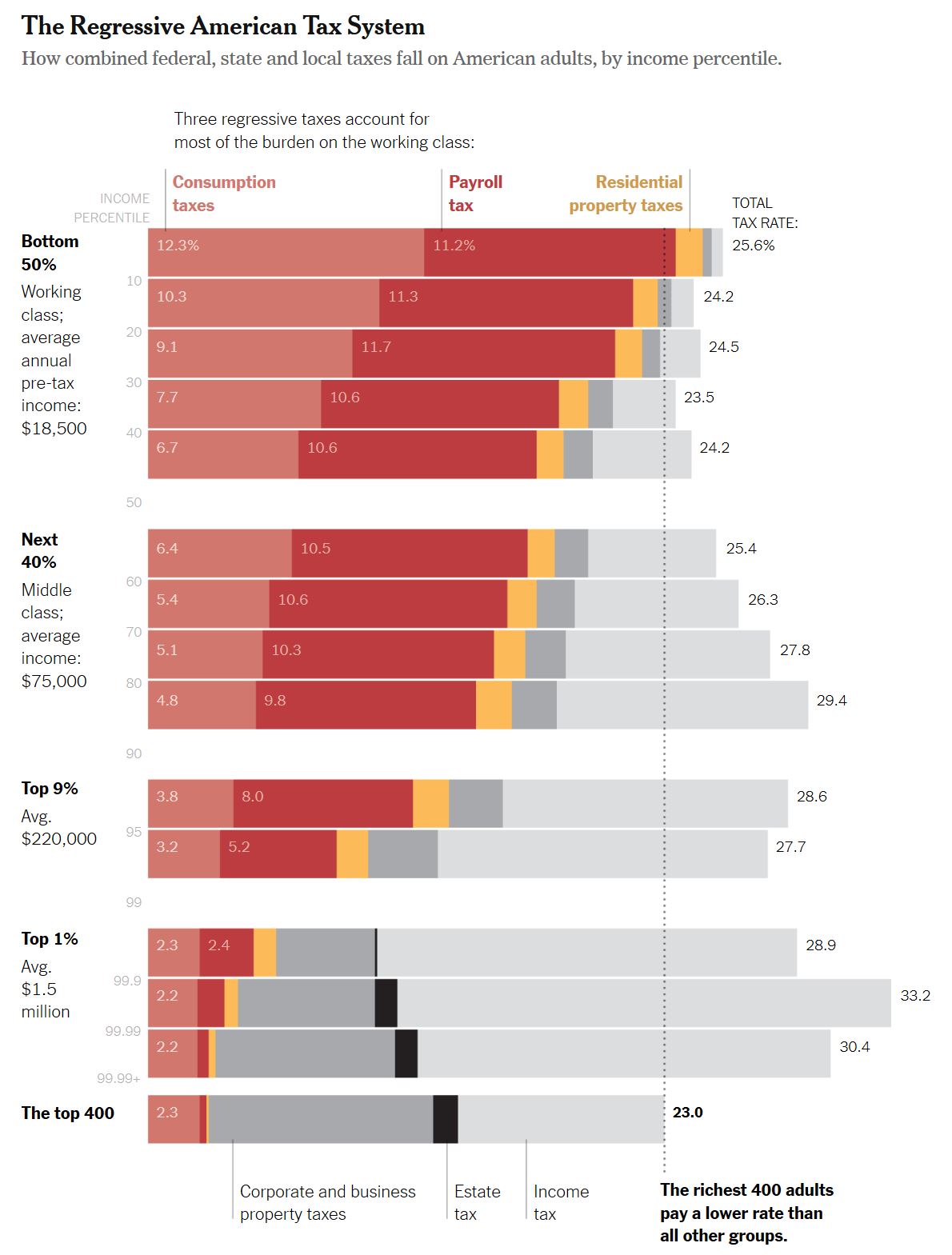
The economists' second chart shows the state of taxation today. There are three big takeaways:
- It's regressive at the bottom – the poorest 10% pay a higher tax rate than any of the five deciles above them.
- It's mostly somewhat progressive from the 30th percentile to the 99.9th percentile.
- It's wildly regressive for the 400 wealthiest Americans, who pay the lowest tax rate of any group, at a mere 23%. (The average tax burden is 28%.)
7) Here's a Washington Post article that captures other elements of Saez and Zucman's findings: For the first time, workers are paying a higher tax rate than investors and owners. Excerpt:
Most Americans have to work to earn a living. But the rich are different: They get most of their income not from labor but from what they own – companies, stocks, real estate and the like.
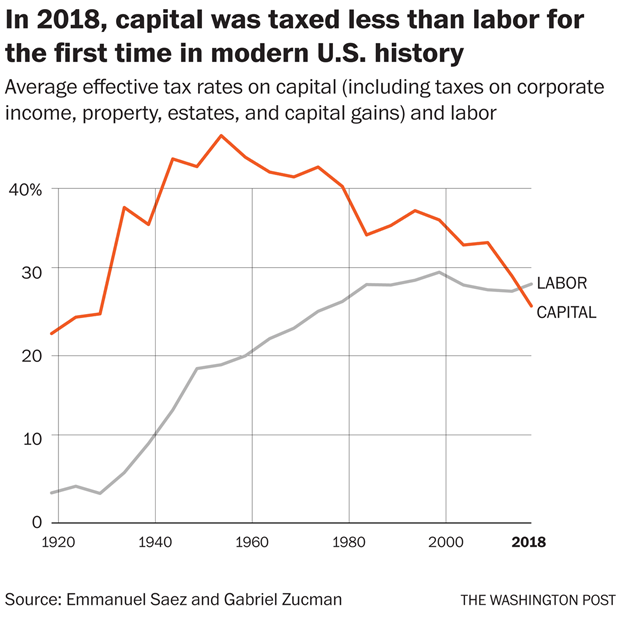
These income-generating assets are what economists call capital. And because capital is heavily concentrated among the rich, the U.S. government taxed earnings derived from capital at a higher rate than earnings made through labor for the entirety of the 20th century.
But that's no longer the case, according to economists Emmanuel Saez and Gabriel Zucman of the University of California at Berkeley. In their new book, The Triumph of Injustice: How the Rich Dodge Taxes and How to Make Them Pay, they present data showing that in 2018, labor income was taxed at a higher rate than capital income for the first time in modern U.S. history.
Saez and Zucman contend that, rather than boost investment in American workers, falling tax rates on capital simply have served to fatten the wallets of corporations and their shareholders. "Less capital taxation means that the wealthy – who derive most of their income from capital – can mechanically accumulate more. This feeds a snowball effect: wealth generates income, income that is easily saved at a high rate when capital taxes are low; this saving adds to the existing stock of wealth, which in turn generates more income, and so on."
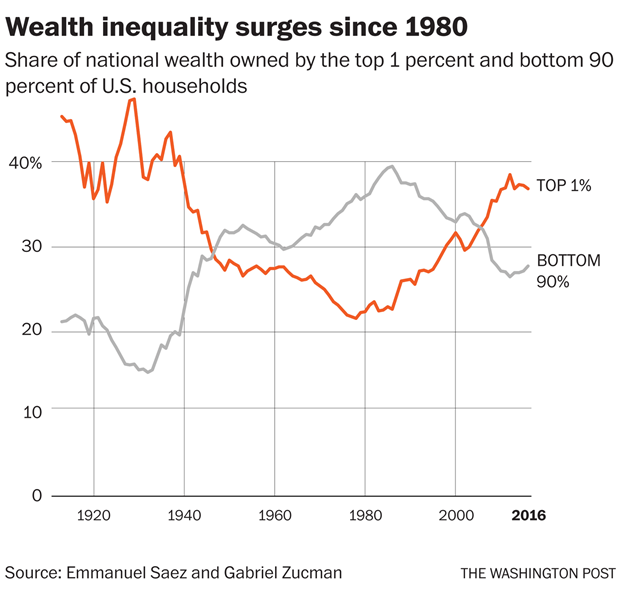
One piece of evidence supporting this argument is the recent surge in wealth inequality. "Since 1980," Saez and Zucman write, "the top 1% and the bottom 90% have exchanged their slices of the total wealth pie: what the bottom 90% has lost, the top 1% has gained."
Best regards,
Whitney