

Pandemic and vaccine news is astounding; Vaccine alarmism; Side effects; Why we should be prioritizing first doses
I continue to closely follow the pandemic, sending lengthy e-mails to my coronavirus e-mail list roughly once a week. If you'd like to receive them, simply send a blank e-mail to: cv-subscribe@mailer.kasecapital.com.
Below is an excerpt from the e-mail I sent to my readers yesterday (you can read the entire e-mail here)...
1) The Biden administration doesn't want to talk about all of the good news about the pandemic because it worries that Americans will rip off their masks, stop social distancing, etc., which could lead to a fourth wave.
It's not an unreasonable concern – Americans should still exercise caution for another couple of months. But I'm increasingly optimistic that we will be close to normal by this summer and almost completely back to normal by the time school starts in the fall because the news regarding the pandemic has gone from excellent to astounding.
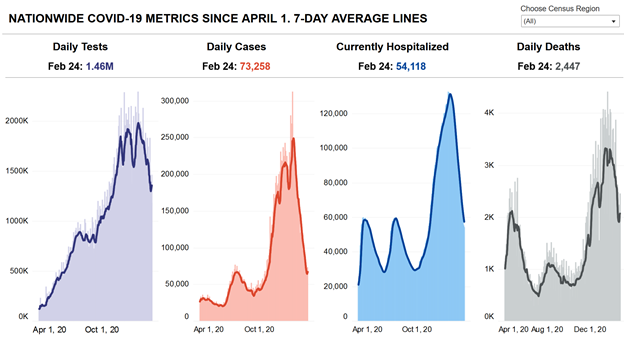
Let's start with my usual dashboard, which shows that every metric isn't just declining, but is in freefall! As you can see from the charts below (source), cases, hospitalizations, and average daily deaths are plunging – they're now down 73%, 59%, and 38%, respectively, from their peaks only five weeks ago:
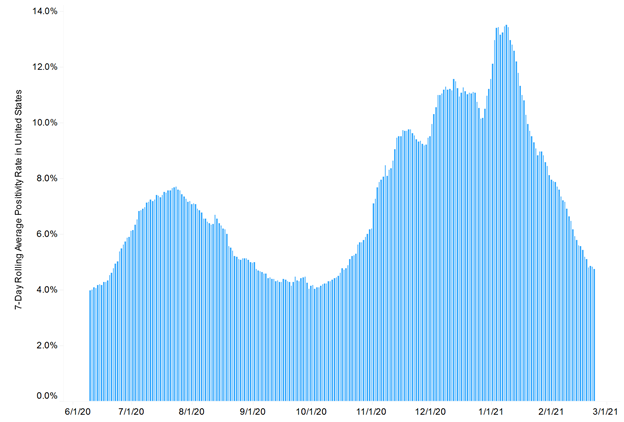
The positivity rate is also falling rapidly, down by 65% from 13.6% a month ago to 4.8% today (source):
(If you click the source links above, you can see all of this data by state, plus here are the data for New York City.)
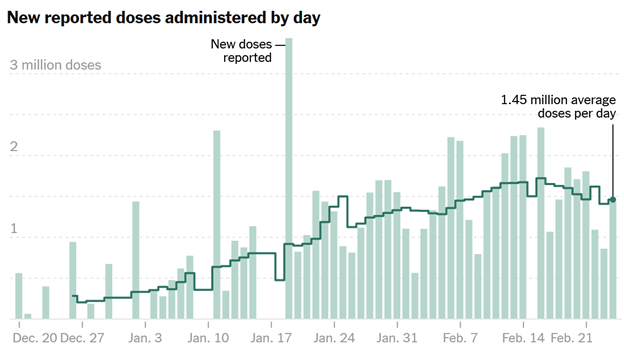
In a slight setback, the number of vaccinations per day has declined from 1.7 million to 1.45 million (source), due to adverse weather and vaccine shortages (which will soon be addressed – see below):
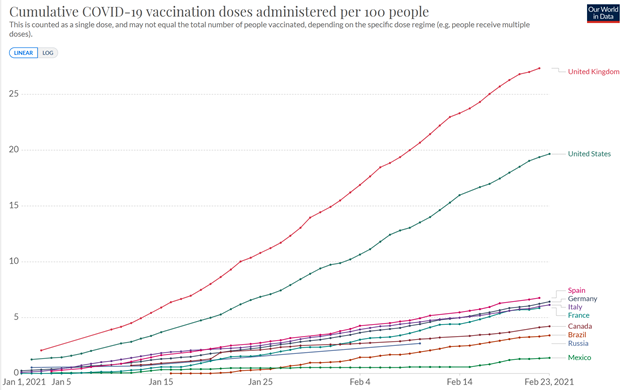
As a result, we're at nearly 20 doses per 100 Americans (source):
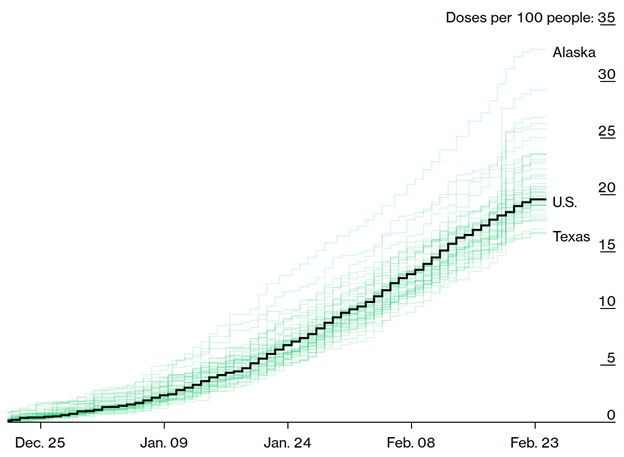
13.6% of Americans have received one shot and 6.2% have received two, led by Alaska at 21% and 12%, with Utah dead last at 11.4% and 4.8% (source).
We continue to be among the world leaders in vaccinating our population, trailing only the U.K. among major countries (I don't include Israel or UAE because their populations are only slightly larger than NYC) (source):
2) The news regarding vaccines is equally astounding. Let's start with this: Vaccine makers Pfizer and Moderna pledge massive boost to U.S. supply after sluggish rollout. Excerpt:
Drug companies told lawmakers Tuesday they project a major increase in vaccine deliveries that will result in 140 million more doses over the next five weeks, saying they have solved manufacturing challenges and are in a position to overcome scarcity that has hampered the nation's fight against the coronavirus.
The news broke this morning about the new Johnson & Johnson (JNJ) vaccine, which will likely receive U.S. approval on Saturday: New analyses show Johnson & Johnson's one-dose vaccine works well. Excerpt:
The one-shot coronavirus vaccine made by Johnson & Johnson provides strong protection against severe disease and death from COVID-19, and may reduce the spread of the virus by vaccinated people, according to new analyses posted online by the Food and Drug Administration on Wednesday.
The vaccine had a 72% overall efficacy rate in the United States and 64% in South Africa, where a highly contagious variant emerged in the fall and is now driving most cases. The efficacy in South Africa was seven points higher than earlier data released by the company.
The vaccine also showed 86% efficacy against severe forms of COVID-19 in the United States, and 82% against severe disease in South Africa. That means that a vaccinated person has a far lower risk of being hospitalized or dying from COVID-19.
The analyses confirmed that Americans are likely to benefit soon from a third effective coronavirus vaccine developed in under a year, as demand for inoculations greatly outstrips supply. The F.D.A. could authorize the vaccine as early as Saturday, depending on a vote of its vaccine advisory panel on Friday after it discusses the newly released documents.
"With a J&J vaccine, we'll be able to accelerate the vaccine rollout for our country and for the world," said Dan Barouch, a virologist at Beth Israel Deaconess Medical Center in Boston who led much of the early research on the vaccine last year.
Johnson & Johnson's vaccine can be stored at normal refrigeration temperatures for at least three months, making its distribution considerably easier than the authorized vaccines made by Moderna and Pfizer-BioNTech, which require two doses and must be stored at frigid temperatures.
And here's great news about another vaccine (note this, which I discuss below: "separate studies of the Pfizer vaccine offered tantalizing new evidence that a single shot may be reducing the spread of the virus"): Early data offers hope on AstraZeneca's vaccine. Excerpt:
The first studies of Britain's mass inoculation program showed strong evidence on Monday that the coronavirus vaccines were working as intended, offering among the clearest signs yet that the vaccines slash the rate of COVID-19 hospital admissions and may be reducing transmission of the virus.
A single dose of either the AstraZeneca vaccine or the one made by Pfizer could avert most coronavirus-related hospitalizations, the British studies found, though researchers said it was too early to give precise estimates of the effect.
The findings on the AstraZeneca shot, the first to emerge outside of clinical trials, represented the strongest signal yet of the effectiveness of a vaccine that much of the world is relying on to end the pandemic.
And separate studies of the Pfizer vaccine offered tantalizing new evidence that a single shot may be reducing the spread of the virus, showing that it prevents not only symptomatic cases of COVID-19 but also asymptomatic infections.
The findings reinforced and went beyond studies out of Israel, which has also reported that the vaccine developed by Pfizer and BioNTech offered significant protection from the virus in real-world settings, and not only in the clinical trials held last year. No other large nation is inoculating people as quickly as Britain, and it was the first country in the world to authorize and begin using both the Pfizer shot and the one developed by AstraZeneca and the University of Oxford.
The studies released on Monday – two on the Pfizer shot and one on it and the AstraZeneca injection – showed both vaccines were effective against the more infectious coronavirus variant that has taken hold in Britain and spread around the world.
"Both of these are working spectacularly well," said Aziz Sheikh, a professor at the University of Edinburgh who helped run a study of Scottish vaccinations.
The news from Israel, which leads the world in vaccinating its citizens, continues to be incredible: Pfizer-BioNTech Shot Stops COVID Spread, Israeli Study Shows. Excerpt:
The Pfizer and BioNTech COVID-19 vaccine appeared to stop the vast majority of recipients in Israel becoming infected, providing the first real-world indication that the immunization will curb transmission of the coronavirus.
The vaccine, which is being rolled out in a national immunization program that began Dec. 20, was 89.4% effective at preventing laboratory-confirmed infections, according to a copy of a draft publication that was posted on Twitter and confirmed by a person familiar with the work. The companies worked with Israel's Health Ministry on the preliminary observational analysis, which wasn't peer-reviewed. Some scientists disputed its accuracy.
The results, also reported in Der Spiegel, are the latest in a series of positive data to emerge out of Israel, which has given more COVID vaccines per capita than anywhere else in the world. Almost half of the population has had at least one dose of vaccine. Separately, Israeli authorities on Saturday said the Pfizer-BioNTech shot was 99% effective at preventing deaths from the virus.
3) Regarding side effects from getting vaccinated, what I've heard mirrors this e-mail I received from a friend:
Anecdotally, I'm hearing that the immune response is more pronounced in younger, healthier people, which makes sense intuitively.
My 80-year-old dad felt nothing the day after receiving the Pfizer vaccine. He is in good shape for his age... definitely top quartile, maybe decile. His girlfriend, who is in her late-70s, but is top 1% to 2% of fitness at her age cohort, felt it much more, though still not as bad as my younger friends, who've been knocked on their asses by both shots.
4) In light of all this good news about how effective vaccines are, it's especially important not to engage in "vaccine alarmism," which David Leonhardt of the New York Times discusses here:
If you're a regular reader of this newsletter, you're probably familiar with the idea of vaccine alarmism. It goes something like this:
The coronavirus vaccines aren't 100% effective. Vaccinated people may still be contagious. And the virus variants may make everything worse. So don't change your behavior even if you get a shot.
Much of this message has some basis in truth, but it is fundamentally misleading. The evidence so far suggests that a full dose of the vaccine – with the appropriate waiting period after the second shot – effectively eliminates the risk of COVID-19 death, nearly eliminates the risk of hospitalization and drastically reduces a person's ability to infect somebody else. All of that is also true about the virus' new variants.
Yet the alarmism continues. And now we are seeing its real-world costs: Many people don't want to get the vaccine partly because it sounds so ineffectual.
5) Following up on my letters to President Joe Biden and New York Governor Andrew Cuomo, urging them to prioritize using scarce vaccines to give more people their first shot rather than others their second, here's a simple way to think about it:
Imagine you have four doses for your four grandparents, with four more doses coming in two months. How would you allocate the initial doses (assuming your grandparents are roughly the same age and health)?
Give two lucky grandparents two doses each, leaving the other two unprotected, or give all four the first dose immediately?
The answer is obvious...
The Centers for Disease Control and Prevention ("CDC") is studying this (but moving far too slowly!): CDC Advisers Weigh Second-Shot Delay to Quicken Vaccine Uptake. Excerpt:
U.S. public health advisers are weighing recommendations for extending the interval between the first and second doses of COVID-19 vaccines, a potential strategy for quickly getting protection to more people amid the spread of new variants.
A working group of the Centers for Disease Control and Prevention's Advisory Committee on Immunization Practices has debated the idea, according to a person familiar with the discussions. It hasn't been decided if the full committee will take up the issue and provide official guidance, the person said. Jose Romero, chairman of the committee and Arkansas health secretary, declined to comment because the deliberations are confidential.
U.S. health officials have rejected a dose-stretching policy adopted by the U.K. that allows up to 12 weeks between COVID shots. Most drugmakers have concurred, saying that policies should follow the protocols used in the shots' testing, in which the intervals were set at three or four weeks. As dangerous variants threaten to boost U.S. cases in coming weeks, however, some states are asking what they can do to widen protection...
Both the CDC and the FDA have moderated their stance on the issue. Shortly after Biden took office, the agencies said that waiting up to six weeks between shots is acceptable in special circumstances.
Here's further evidence for my proposal (and what the U.K. is doing): Single dose of Pfizer, Moderna COVID vaccine nearly as effective as two: study. Excerpt:
Single doses of the Pfizer and Moderna vaccines are more than 92% effective in preventing COVID-19 illness after two weeks, Canadian researchers are saying.
The FDA's own data show that a single shot of the BioNTech-Pfizer vaccine is 92.6% effective after two weeks, and a single Moderna jab is 92.1% effective, the researchers note in the New England Journal of Medicine.
Getting that second shot of Pfizer's vaccine hikes the efficacy only marginally, to 94%, according to a separate study based on real-world data from Israel's vaccination program.
And so the prescribed second doses should be given instead to those in priority groups who are still waiting for their first shot, "given the current vaccine shortage," the researchers urge.
Here's a good article about the debate: Why Delaying the Second COVID Vaccine Shot Is Messy. Excerpt:
5. What are the risks of spacing out doses?
They're medical, theoretical, and social. The medical risk is that the first dose almost certainly won't be as protective as two doses. Spacing out doses extends the period when people – most of whom have been chosen to get vaccines quickly at this point for reasons of vulnerability – will have suboptimal protection until they get their second dose. The theoretical risk is that a weak response to the virus in millions of people who have received just one dose would foster the emergence of new variants that could evade vaccine-induced antibodies. This would undermine a year's work to develop safe and effective vaccines. And the social risk is that mixed messages on the topic – from governments, regulators, professional groups and drugmakers – will make it more difficult to communicate with the public on vaccines that are already controversial, and shunned by some.
6. What are the benefits?
Data collected by AstraZeneca show that pacing out doses by eight to 12 weeks may actually be the efficacy "sweet spot," Mene Pangalos, the drugmaker's executive vice president for biopharmaceutical research and development, told a U.K. government panel. The U.K. drugs regulator has recommended the AstraZeneca vaccine be administered within an interval of up to 12 weeks. The World Health Organization says that, although there is some data to support that interval for the AstraZeneca vaccine, there is no scientific evidence to stretch the second dose of the Pfizer-BioNTech vaccine to 12 weeks.
Click here to read my entire e-mail, which includes the following:
- An old joke about how "the Lord will save me"
- Huge racial disparities in vaccinations
- Can a Vaccinated Person Still Spread the Coronavirus?
- The massive differences in mobility among countries (and resulting economic effect) due to government lockdowns and behavior of citizens
Best regards,
Whitney