

Pandemic update; Don't allow anyone to poison your brain; I Have A Few Questions; Inside AMC's Crazy, Bonkers, Upside-Down Year of Apes, Memes and Shorts; Trump SPAC deal leads to fraud lawsuit; Greetings from the Masai Mara
1) As expected, the pandemic – and, in particular, the omicron variant – continues to dominate headlines.
I covered all of the latest developments in yesterday's e-mail to my coronavirus list, which you can read here (to subscribe, simply send a blank e-mail to: cv-subscribe@mailer.kasecapital.com). Excerpt:
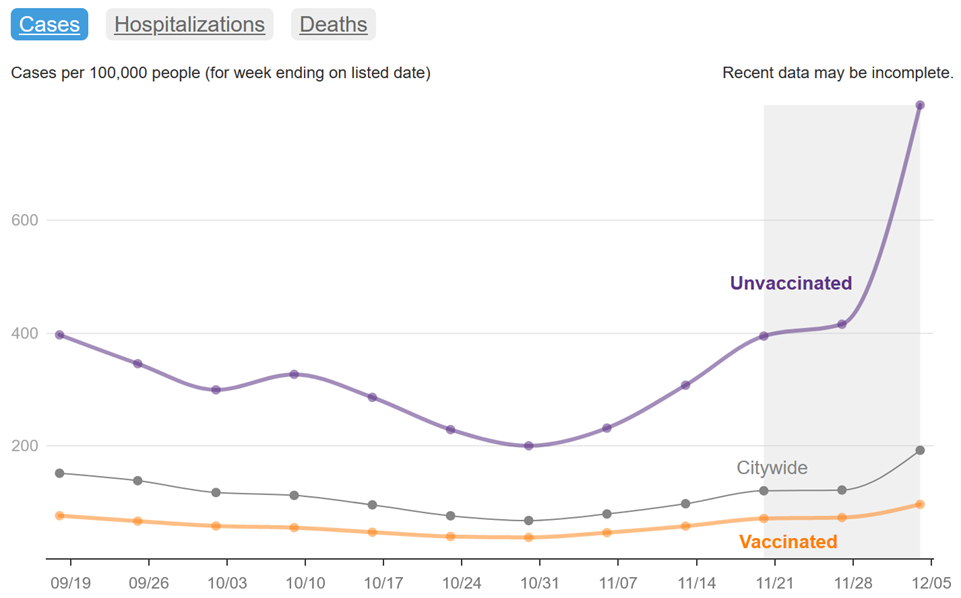
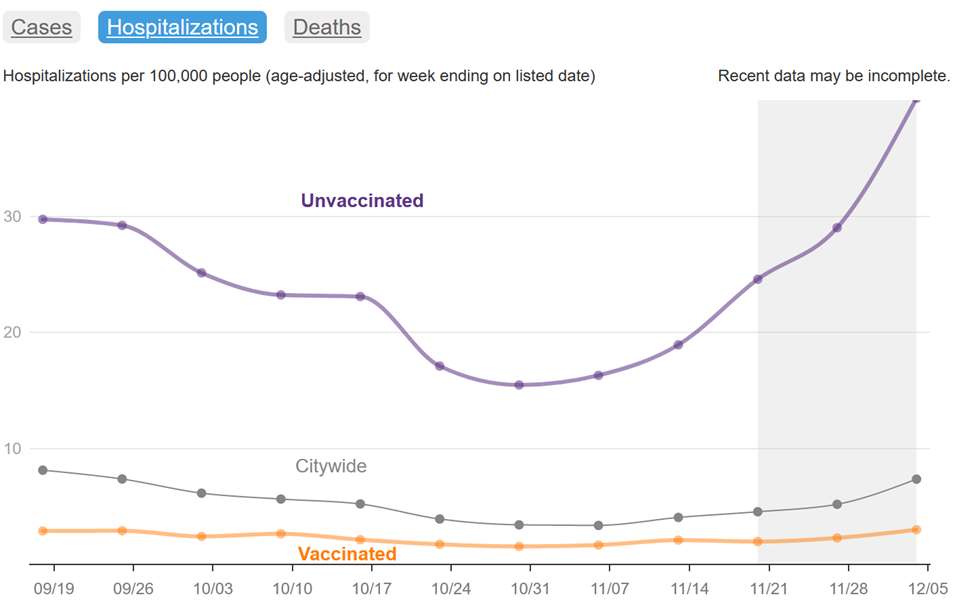
While the vaccines aren't as effective against the omicron variant as they were against delta, they are still highly effective in both preventing infection (especially for those who are fully vaccinated, defined as three doses, not two) and, most importantly, serious illness. Here's the data on cases and hospitalizations in NYC for the vaxxed and unvaxxed (source):
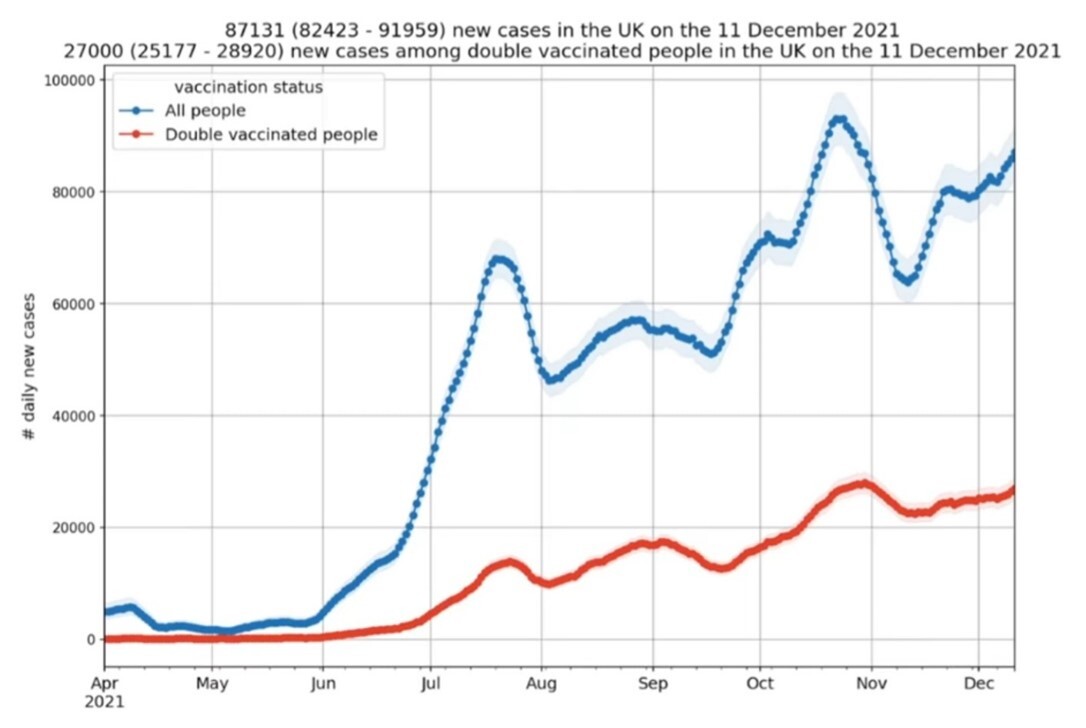
And here's data for new cases in the U.K. for everyone versus those who are double vaxxed (source):
So my advice is even more emphatic than ever: a) if you're not vaxxed, get vaxxed; and b) if you're not boosted, get boosted – RIGHT NOW!
Here are other topics I covered in my e-mail:
- mRNA vaccines are best against omicron
- Two types of natural immunity, one bogus, the other legit
- NYC and U.K. updates
- South Africa is peaking
- Is omicron less severe?
I also just sent out this quick update, with my thoughts about a recent super spreader event in Norway...
A quick e-mail from my phone (from a game drive in the Masai Mara)...
A few thoughts on this Bloomberg story:
- I've been hearing/reading about similar stories on South Africa, London, and NYC.
- I'd be very curious to know what vaccine these folks had taken. Given that the story refers to second doses, I'm assuming either Moderna or Pfizer (likely the latter because it's more common in Europe). This would also be consistent with research showing that the Pfizer vaccine's ability to prevent infection drops to 30% after six months. This underscores the importance of getting a third shot!
- VERY importantly, while being double vaxxed didn't protect most folks from infection, it was highly effective in preventing serious illness (zero hospitalizations among 80 people who caught the virus).
- This story underscores how much more contagious omicron is, but doesn't help answer the million-dollar question: is it less severe? In other words, are the mild symptoms we're seeing around the world among those who are infected with omicron due to the variant being less severe or the fact that there now far more people who are vaccinated and/or had a prior infection relative to the delta wave last summer? I'm cautiously optimistic that the former is the case, but there's evidence for both sides right now...
A Christmas Covid Story
A Christmas party in Norway provides a cautionary tale about the spread of omicron and the risks of infection faced by twice-vaccinated people.
Of 111 attendees who participated in a survey, about 80 came down with Covid infections, according to the Norwegian Institute of Public Health. At the time 17 were specifically confirmed as having caught the omicron strain, and the institute said it's safe to assume most people who were at the restaurant who got Covid were infected with the highly mutated variant. As many as 60% of those infected have since been confirmed with omicron.
The incident reveals a disturbing sign: Most of the participants had received a second vaccine dose sometime between May and November, and they were fairly young, most between 30 and 50. And more than 60 other people who visited the restaurant on the same evening, in late November, also got infected.
The Norwegian health institute said it's well-known that indoor events such as parties heighten the risk of contagion, especially when people sing or speak at loud volumes.
Still, the symptoms were relatively benign. More than 70% of the cases had cough, lethargy, a headache and sore throat, and more than half had fever. No hospital admissions were reported.
The lightness of those infections may paradoxically explain why omicron might pose a risk: A strain that's less severe in most people may be underestimated by the majority of the population. Yet it may be deadly for a small minority, especially if it spreads so fast. Tedros Adhanom Ghebreyesus, the head of the World Health Organization, has said he's concerned that many people are dismissing the new strain as mild.
As researchers study every clue about how transmissible and severe the omicron variant is, this Christmas party in Oslo gives a clear signal it may spread faster and be more resistant to vaccines than many people assume. If that's true, countries may need to step up their booster campaigns, as evidence has been building that third shots can help prevent transmission.

2) This was the lead item in yesterday's e-mail to my coronavirus list, which I want to highlight because I think the lesson is equally important for investors:
I'm very careful not to download malware onto my computer. Only terrible things can result from giving a malevolent person access to it.
This may seem obvious but, based on many e-mails I receive, quite a few of my readers have allowed their brains to become infected with malware by exposing themselves to rampant mis/disinformation and kooky conspiracy theories.
The eventual outcome is typically the same for both your computer and your brain: they get turned to mush.
My readers send me some of the nuttiest articles and videos, so I have to be very careful not to let this rubbish infect my brain. So, before I start reading or watching anything, I check its source and, if necessary, Google the author. If it's from known crackpots by Robert F. Kennedy Jr. or Alex Berenson, or far-right or far-left conspiracy websites, I instantly delete it.
This isn't black or white, of course – there's a lot of gray. It's important to be open to new ideas and different perspectives – but, as I've seen (and, to some extent, experienced) again and again, it's equally important not to allow anyone to poison your brain.
Although it's admittedly hard to compare one degree of infinity to another, I think it's likely that there's even more garbage out there related to investing than the pandemic. Among the things I do to protect my brain when it comes to thinking rationally about investing are:
- I focus my reading on credible business news sources, starting with the Wall Street Journal, Bloomberg, and the New York Times
- I never watch financial TV (though I occasionally watch video clips of interesting guests – for example, when CNBC's Becky Quick interviews Warren Buffett)
- I almost never read message board posts (unless they're carefully curated, as they are on, say, Value Investors Club)
3) Along these lines, blogger and venture capitalist Morgan Housel posted a good list of questions to ask yourself to keep an open mind: I Have A Few Questions. Excerpt:
Who has the right answers but I ignore because they're not articulate?
What do I desperately want to be true, so much that I think it's true when it's clearly not?
What do I think is true but is actually just good marketing?
What looks unsustainable but is actually a new trend we haven't accepted yet?
What has been true for decades that will stop working, but will drag along stubborn adherents because it had such a long track record of success?
Who do I think is smart but is actually full of it?
What do I ignore because it's too painful to accept?
Which of my current views would change if my incentives were different?
What are we ignoring today that will seem shockingly obvious in a year?
How much have things outside of my control contributed to things I take credit for?
How do I know if I'm being patient (a skill) or stubborn (a flaw)? They're hard to tell apart without hindsight.
4) For a perfect example of what investors shouldn't do, look no further than this in-depth story that the WSJ published over the weekend on the saga of movie theater operator AMC Entertainment (AMC): Inside AMC's Crazy, Bonkers, Upside-Down Year of Apes, Memes, and Shorts. Excerpt:
The AMC rescue and takeover sprang from a serendipitous gathering of mostly amateur investors sharing tips on the Internet. Their mass participation was empowered by Robinhood, Webull, and other apps that for many users made online trading cheap, easy and as thrilling as a night at the casino.
At the start of the year, these traders went from niche social group to a market force, making investment decisions not guided by research reports from Wall Street banks, but by what online pals and personalities were saying.
AMC and videogame retailer GameStop (GME) emerged as crowd favorites. Many of these amateur investors believed buying the stocks amounted to a populist revolt against finance predators who had bet on the companies' fall. Some swore they would never sell their shares.
"It was the 99% against the 1%. It was us going against the hedge funds," said Katherine Larsen, a 40-year-old bartender from Oceanside, Calif. She put her life savings into AMC stock.
"I love the movies, we used to go every week. It was a huge thing for us to fight, and I knew there was a bunch of people coming together for this battle," she said. "I wanted to be in this war for sure."
Ms. Larsen and other AMC shareholders call themselves the apes, a reference to the 2011 film Rise of the Planet of the Apes, an installment of the movie franchise that showed how a raucous mob of primates came to brutally dominate mankind. The apes made AMC their personal cause, hiring planes to tow promotional banners over Hollywood and renting billboards in Las Vegas and New York's Times Square, all paid for with crowdsourced funds.
In trying to keep AMC alive, Chief Executive Officer Adam Aron embraced the ape movement. He adopted some of its ideas, accepting cryptocurrencies such as bitcoin and Dogecoin for movie tickets and screening mixed-martial arts matches from Ultimate Fighting Championship. He also surrendered to the apes on one of AMC's biggest decisions.
Just look at what the insiders are doing:
Two days later, Mr. Aron disclosed that he was selling roughly $53 million worth of his shares. So far this year, AMC directors and senior executives have sold more than $80 million in company stock.
It breaks my heart to read how so many people are getting sucked into this stock, where they are almost certain to take big losses, especially since they're mostly folks who can least afford it. It's clear that they know nothing about the company and wouldn't know the difference between net income and net debt.
Forgive me if that sounds "elitist," but I'd have the same reaction if a bunch of folks were running around doing surgery on one another... Investing successfully over the long run is hard, and if you don't know what you're doing, you're going to get clobbered!
5) Speaking of stocks sure to incinerate investors, and following up on my December 8 and 15 e-mails, I'm even more convinced that the SEC is going to block the merger of the Digital World Acquisition (DWAC) SPAC with Trump Media & Technology after this revelation: Trump SPAC deal leads to fraud lawsuit. Excerpt:
The complaint suggests that conversations between Orlando and Trump began months before DWAC went public, which could violate federal securities law.
6) Greetings from the Masai Mara game reserve in Kenya!
We flew into Nairobi on Saturday morning and connected directly to a flight out here, where we're spending three days at the beautiful Mara Serena Safari Lodge, going on game drives twice a day to see the wildlife. Here are some pictures (I've posted additional ones on Facebook here and here):

I also posted five short videos of hippos, elephants, a hyena, lions, and cheetahs.
Best regards,
Whitney
P.S. I welcome your feedback at WTDfeedback@empirefinancialresearch.com.