

Porter Stansberry and I debate the coronavirus crisis and how to respond to it; Survey results; My best friend is selling masks, toilet paper, gloves, cleaning wipes, paper towels, etc. (and you can support Robin Hood); Cost of masks
1) Porter Stansberry, my longtime friend and business partner (Empire Financial Research is jointly owned by me and Stansberry Research), penned a powerful essay last week: "The 'Big Lie' Behind COVID-19."
In it, he makes an argument that's getting a lot of traction these days (and one I shared only five weeks ago!): that the federal and many state governments have massively overreacted to the coronavirus, needlessly crushing our economy and taking away our rights.
The core of this argument is that: a) far more people have had the virus than anyone knows... b) the "real mortality rate is probably somewhere closer to the regular flu"... and c) "these shutdown orders did virtually nothing to stop the spread of the disease or to reduce its lethality in the population."
Therefore, we should "allow everyone who can manage the virus to get exposed. As quickly as possible. After all, the sooner the herd immunity we need develops naturally, the safer we will all be."
For all of our sakes, I hope Porter is right – that this terrible scourge isn't nearly as bad as we think, so we can quickly change course and almost all of us can go back to our pre-coronavirus normal lives. How I long for this!
Unfortunately, however, I think Porter is dead wrong. And I use that term deliberately because I think, if we and the rest of the world adopt Porter's recommendations to strive as quickly as possible for herd immunity, at least 200,000 Americans and millions (perhaps tens of millions) of additional people around the world will die in the next year – and even more over time.
Again, I hope I'm wrong and Porter is right. But I don't think so...
2) Here's a link to the first of a what I expect to be a handful of e-mails in which I will explain exactly why, which I sent to my coronavirus e-mail list last night (to join the 4,100-plus people on it, simply send a blank e-mail to: cv-subscribe@mailer.kasecapital.com). Excerpt:
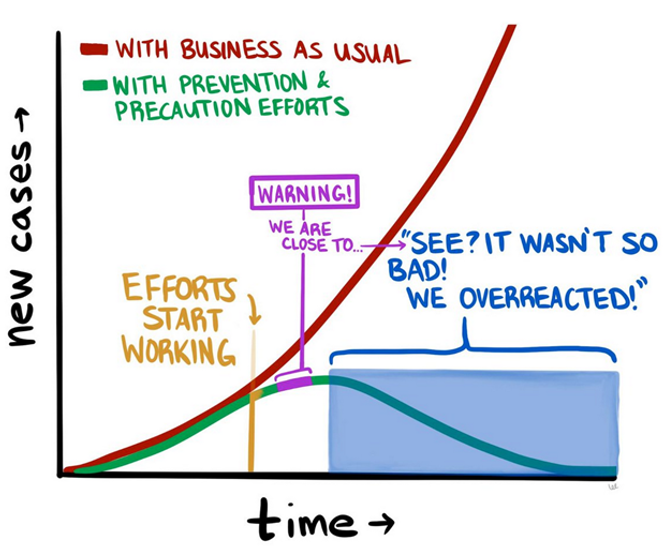
If I were to summarize the mistake I think Porter is making, it's captured by this graphic:
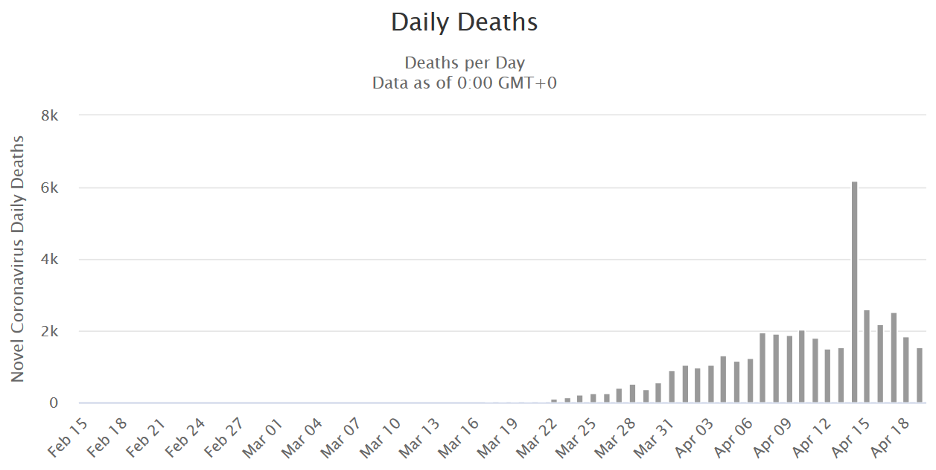
In other words, he's looking at the expected number of deaths in the U.S. this year – the consensus is currently around 60,000. We're currently at 40,533, up 1,539 in the past day, down from 2,528 two days ago, and around the lowest number in the past two weeks, as you can see here:
Porter points out that this is within the range of flu deaths (which have ranged from 12,447 to 61,099 over the past nine years, average of 37,463), but that's because of the lockdowns and social distancing that he decries. You can't have it both ways. Porter and I both agree that the number of deaths will be around 50,000 this year, but if we did as Porter suggests, my number would be 250,000 minimum!
In the U.S., as of this moment, there are 763,832 cases, meaning people have tested positive, of 0.23% of the population (328.2 million). So when Porter writes: "it's apparent already that at least 5 times more people have been infected than are reflected in the number of "confirmed cases"... and the real number may be much, much greater than that," the 5 times estimate isn't bold – that would translate into 1.16% of Americans actually having had COVID-19, which I think is low. But 1.16% doesn't support his argument.
So maybe he's referring to a hotspot like NYC (pop 8.4 million). Here we have 129,788 cases (17% of the U.S. and 5.4% of the world – yikes!), meaning 1.55% of the entire city's population has tested positive. Again, YIKES!
Since roughly nearly all of the people tested here have been positive, that means there's another nearly 1.5% who definitely do not have COVID-19 (at least for now).
The $500,000 question is: if right now every person in NYC took a combo COVID-19 and antibody test that was 100% accurate, what percent of NYC residents would test positive?
Porter believes 10% to 20%. I think 3% to 5%.
This is the crux of our entire disagreement.
And it's enormously frustrating not to know the answer.
It shouldn't be so hard...
But here's what I do know: if I see another crappy, unpublished (much less peer reviewed) study (some are just letters!) of some subset of people that shows 15% to 30% have or had COVID-19, I'm going to scream. Cruise ship passengers, healthcare workers in Italy, young men on an aircraft carrier, a town in Germany that just had a huge festival, homeless people in Boston, pregnant women in NYC, random people walking down the sidewalk in Chelsea, Massachusetts, Facebook respondents in Santa Clara county, California, etc...
While there may be a smidge of insight in some of these studies, every one of these groups is SO WILDLY UNREPRESENTATIVE that the data are almost COMPLETELY USELESS (and, I believe, totally misleading).
For example, the Santa Clara study by Stanford "researchers" is a useless pile of dung, as my friend Chris Brown shows conclusively. Also see: Concerns with that Stanford study of coronavirus prevalence.
Why can't anyone do a simple, proper random study so Porter, me, and everyone else on the planet can stop hypothesizing and make judgements based on – wait for it – actual DATA?! This is what political pollsters do 1,000 times a month across the world – yet we, collectively, can't do it for the most important crisis in years?! WTF?!?!?!
3) I included this in my daily e-mail last Monday:
Do you think the market will, at some point this year, give back its recent gains and close lower than 2,191.86 (down 21.4% from Friday's close – i.e., another bear market)?
I think not – but I'm not certain. I'd estimate that there's a 70% chance that 2,191.86 will end up being the low for the year.
What do you think?
I've put together a quick two-question survey, asking two questions:
- On March 23, 2020, the intraday low for the S&P 500 was 2,191.86. Do you think this will be the low for the year?
- How likely do you think it is that 2,191.86 will be the low for the S&P 500 for the year?
The survey had 879 participants, and here are the results: 44.1% answered "Yes" to question 1, with the following distribution in question 2:
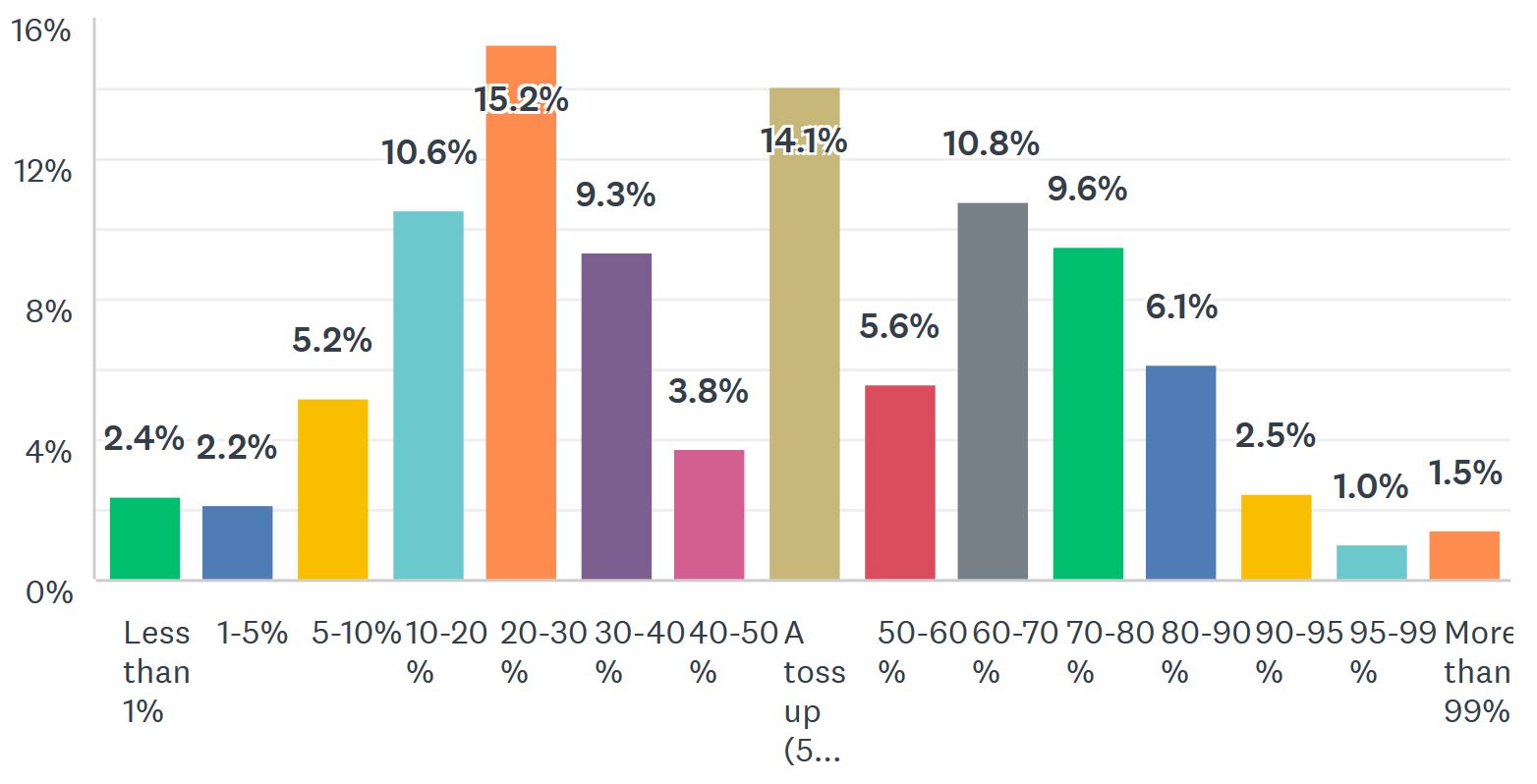
Here's the full report from the survey, including 164 comments.
4) If you're one of the many folks having difficulty buying things like masks, toilet paper, gloves, cleaning wipes, and paper towels, I have some great news!
My best friend, Fred Singer, owns a third-generation family business called Singer Equipment Company. It's one of the largest food-service equipment and supplies distributors in the country, and the largest in New York City.
He has a huge warehouse full of supplies he normally sells only to business customers, but since they're not buying very much these days, he'd like to sell them directly to you (he ships anywhere in the country).
He's put together several packages, which you can review here. Here's a screenshot of them:
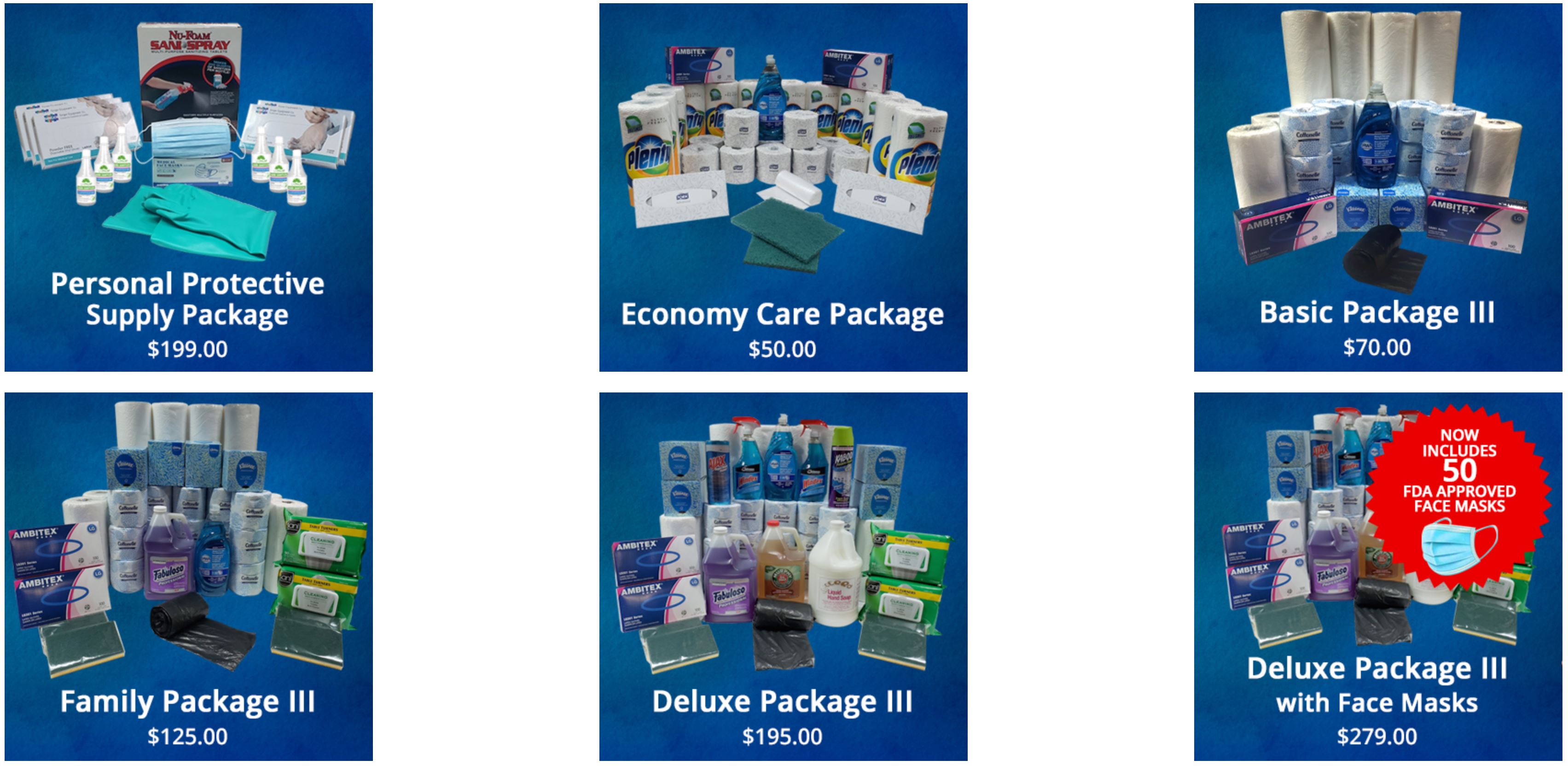
(Note that because Fred is short on masks right now, they're only part of the Deluxe Package III With Face Masks. Fred is working to get more and, if/when he does, he'll make them available in other packages.)
Best of all, if you use the customized link above and enter the code WHITNEY when you check out, 10% of your purchase will go to Robin Hood to help New Yorkers suffering from the coronavirus.
It's a win-win-win: help yourself by getting products you might not be able to find elsewhere (and save yourself a trip to the store), help Fred move his inventory, and help New Yorkers in need!
I hope this e-mail and my Facebook post about this offer go viral (please share it widely!), so order now before Fred runs out (many folks are also buying them for their parents or others as gifts). Again, here's the link, and don't forget to use the code WHITNEY.
Fred and I were officemates at the Boston Consulting Group from 1990 to 1992, and he's been my best friend ever since. He was the best man in my wedding in 1993:
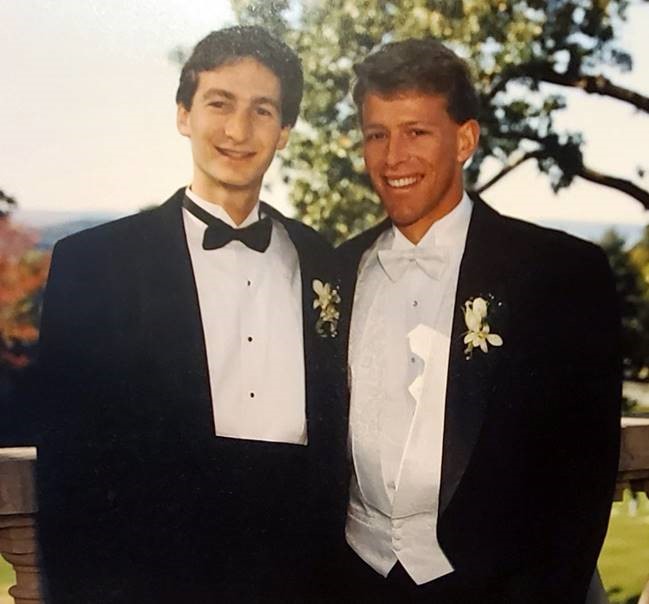
And here's a picture from 2011 of us with our families...

Warren Buffett once told me how important it was to pick your friends wisely... and I sure did with Fred. I know of no one who is more kind, decent, honest, fun-loving, and big-hearted.
Best regards,
Whitney
P.S. A couple of friends thought Fred's pricing seemed high, so I asked him about this and he shared some incredibly interesting comments, especially about the insane market for masks (with similar dynamics at work among other scarce products like hand sanitizer and toilet paper). He wrote:
Dear Whitney,
I am so appreciative that you told your friends and readers about our program.
In particular, thanks for sharing the feedback that you heard from a few folks that they thought our care packages were expensive.
The first thing I'd say is that to make them for households, I have to have my warehouse workers (union guys earning $23/hour plus good benefits) manually break down boxes of 96 rolls of toilet paper, 50 rolls of paper towels, 40 bottles of dish detergent, etc. – and then repack them. Thanks to the success of this program, I've been able to hire back quite a few guys I'd laid off, but the cost is substantial...
Turning to the cost of the products, let's first talk about masks. They are indeed expensive. Prior to the pandemic, you could buy them in Asia for just a few cents per mask (at wholesale) and then efficiently transport containers of them to the U.S. in trans-Pacific shipping containers. Then there was a wholesale mark-up for distribution/sales/inventory/marketing, but the total cost for hospitals and medical offices was very affordable – only a few dollars for a box of 50.
Then came the coronavirus. In a few weeks, the demand for masks went up exponentially. First, medical professionals needed more masks as they started screening activities that required a new mask for every patient they saw. Then, people in related activities needed them – those working in nursing homes, foodservice, funeral homes, etc. Soon thereafter, governments around the globe recommended that everyone wear masks whenever they leave their home. These needs are expected to continue for quite a while.
All of this was happening as Chinese manufacturing was running at reduced capacity from their government's shutdown of industry to contain the virus.
The massive surge in demand paired with a supply squeeze caused prices to spike like crazy.
First, the cost of the material that is used to make the masks jumped. (As a side note, the same material used for three-ply masks is also used for hospital gowns – and now you can't find gowns because all of the material is sucked up into mask manufacturing– the gross margin per square inch of fabric is higher in masks than in gowns.)
So the price of the primary raw material used to make masks went up, plus the mask makers had more demand than supply, so they raised prices even more.
Then add in freight. Because the demand is so urgent, nothing is being sent on container ships – it's now air freight. Even during normal times, the cost of air freight is massively higher than sea freight. And now, as the demand for air freight has taken off, its already-high cost went up by 5x or more. (There's a glimmer of good news here, however, as some carriers are now converting passenger jets to carry freight, which is starting to bring down the cost.)
Add it all up, and prices are not only high, but also extremely volatile. Every day, the price for masks changes like a spot market, and every transaction is only finalized when it is 100% fully paid in advance by wiring cash to the Asian manufacturer as well as the air freight company.
But wait, it gets even crazier! Because there is more demand than supply in the U.S., the brokers get more mark-up than normal, so by the time the product arrives at distributors like me, it's at prices that three months ago would have seemed insane – up to 30 times the price I used to pay.
Then, I have to allocate the limited product I am able to source to my best, long-time customers – but I can't do so at a market-clearing price because that would be immoral (and likely illegal) price gouging. If I let the price of the masks float to an actual efficient market price through some type of bid or auction system, I can't even begin to tell you what the real market price for the masks would be.
So, one could argue that the prices I am charging for masks is crazy high – but you could also just as easily argue that the price I am charging is crazy low.
I could tell you story after story like this. Don't even get me started on hand sanitizer and toilet paper! In each case, the market is responding to massive changes in demand and/or distribution for different products. On the one hand, prices go up quickly for products in great demand, creating strains on consumers and businesses. On the other hand, the high prices stimulate manufacturers and distributors to innovate, increase production, and meet the needs of the market.
I hope this is helpful in understanding why pricing on items can move quickly during times like this. We want our packages to be seen by our customers as a good value for them given our current challenges in sourcing products like this and having them reliably delivered to their homes.
I can tell you that I am charging a price for masks (and every other item in my care packages) that hundreds of businesses and consumers gladly pay in an open market and overwhelmingly thank me for finding the product for them.
For those customers who don't see the value, or have other ways to secure these products, I am happy that they have found solutions that work for them.
We will all get through this together!
Best regards,
Fred
P.P.S. One of my buddies, David Berman, sent me a funny reply to an earlier version of the e-mail above, in which I said Fred was my best friend. He wrote: "Who's Fred? I thought I was your best friend?!"
So I called Fred and we patched in David so they could fight it out real-time, but we got David's voicemail, so Fred left this hilarious message:
Hey David, I hear you think you're Whitney's best friend. Well, let me tell you, that spot is already taken – and there's only room for one at the top! Heck, I'll bet you're not even in the top 10! So, if you want to challenge me, you'd better bring your "A" game!