

Should I have tried to save Tarik?; Thinking correctly about tail risk; My first day in Tashkent; An introduction to Uzbekistan
1) I got a lot of nice feedback from readers regarding my story in yesterday's e-mail about my crazy, scary experience in Istanbul on Saturday – in which my guide was beaten – and the lessons I took from it.
One of my readers e-mailed me the following:
I bet if you had gone over to them and said sorry they would have backed down and not beat him up. If a foreigner gets in the middle of local disputes I've found that the locals tend to avoid each other because they fear the retribution of hurting a foreigner more than they do beating up one of their own. You could have been the great peacemaker!!!!
Here was my reply:
I've been asking myself the same question. Was I foolish and/or cowardly not to have tried to intervene?
I think not, even with the benefit of hindsight. Here's why...
As the incident was unfolding over approximately five minutes, I had plenty of time to think about what to do. I was standing a few feet away and everyone was ignoring me, so I didn't feel threatened.
I chose not to do anything for a number of reasons. First, I had no idea what was going on. Tarik and the five men were clearly angry with each other and the men were behaving in a threatening way, but I didn't know why they were arguing. Did they have a prior grievance with Tarik? Were we using the Segways in an area we weren't supposed be? Were they a local gang defending their turf?
I could also tell that Tarik had, to some extent, created this problem for himself. It wasn't like muggers had jumped an old lady. Though I couldn't understand what was being said, Tarik was yelling just as loudly at the men as they were at him. Rather than trying to deescalate the confrontation, he was pouring fuel on the fire. To use one of my favorite sayings, he was violating the first rule of holes: "When you're in one, stop digging!" In light of this, I wasn't as inclined to risk my neck to bail him out of a situation I could sense he was partly responsible for creating.
I also didn't expect them to actually assault him. We were in a heavily trafficked tourist area, just outside one of the largest mosques in the city – and I'd never seen anyone attacked like this in my entire life (and I've lived and traveled in a lot of hairy places!).
But even if I thought an assault was likely (or once it began), I still think I made the right decision not to intervene.
You are no doubt correct that there's a good chance I might have saved Tarik from being assaulted (or shortened it) had I gotten in between them, especially if I'd been clever enough to wave the $20 bill I had in my pocket and given it to them. I'd estimate the odds of this best-case scenario at 60%.
But I also think there's a 30% chance that it wouldn't have made any difference... A 9% chance that I would have been beaten as well... and a 1% chance that one of the guys pulled a knife or a gun – and I'd be dead right now.
As I discuss extensively in my recent book, The Art of Playing Defense: How to Get Ahead by Not Falling Behind, avoiding the calamities that can derail (or end) your life isn't about your decisions 90% or even 99% of the time – it's successfully managing the tail risks: not making the one trade in a career that might be based on inside information; turning around rather than pushing for the summit as nightfall or bad weather approaches (in climber's lingo, resisting the "summit fever" that kills so many), etc.
So that's why, as badly as I feel about what happened to Tarik, I have zero regrets about not getting involved.
I often tell investors that "you don't have to be a hero." For example, the Reddit crowd praising each other for "diamond hands" (i.e., not selling when a stock is collapsing) is one of the dumbest things I've ever seen.
Well, this advice is equally true in life...
2) I flew into Tashkent, the capital of Uzbekistan, on a redeye flight from Istanbul on Sunday morning. I met up with my dad, who's here for a consulting project – funded by the U.S. Agency for International Development – doing curriculum development with the Ministry of Education.
After a quick nap and breakfast, we took a tour of the city with a local guide (for photos and details, see my Facebook post). Here are a few of my favorite pictures:
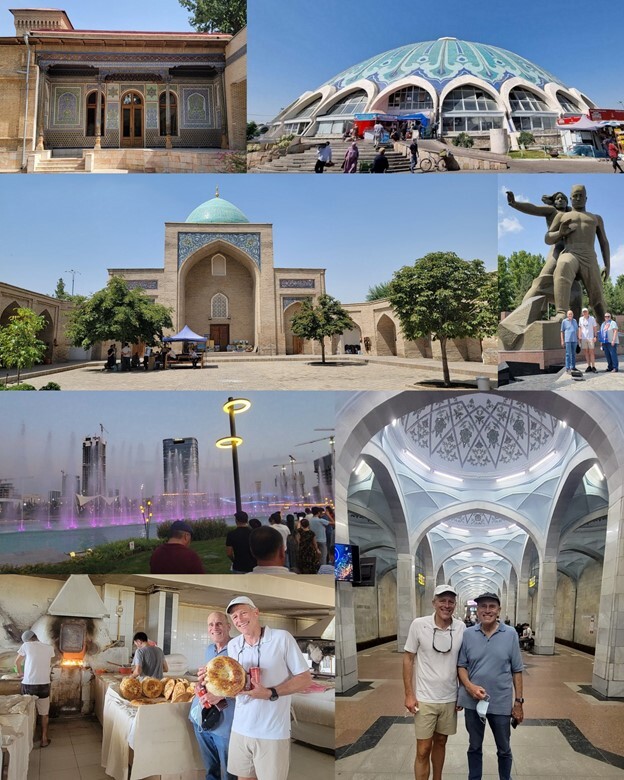
Overall, I enjoyed Tashkent... But when it comes to magnificent monuments, mosques, and museums, it doesn't hold a candle to, say, Istanbul. Tourists will want to spend no more than a day here and then go to the three ancient, legendary UNESCO World Heritage cities on the Silk Road: Samarkand, Bukhara, and Khiva (I took a high-speed train to Samarkand today and continue on to Bukhara tomorrow... Unfortunately I don't have time to visit Khiva, which is much further away). I have yet to see a single foreign tourist, and my guide thinks I may be the only American tourist in the country right now, due to the pandemic!
3) If you're not familiar with Uzbekistan (I sure wasn't!), here's some background...
The country is in the middle of Central Asia, as you can see in this map (I've circled Uzbekistan and the three cities I'm visiting):
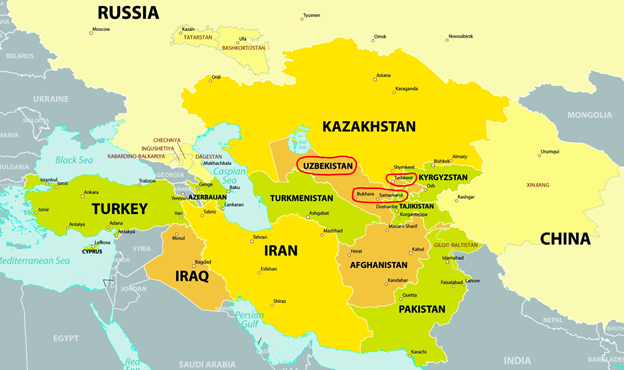
If you look closely at the map, you'll see a major reason why Americans should care – especially now – about Uzbekistan: it shares a southern border with Afghanistan.
In light of our military forces' recent withdrawal there, we now have an even greater need for assistance from nearby countries so that we can conduct military operations against the Taliban and make sure Afghanistan is never again used as a base for terrorist attacks against the U.S. (For more on the challenges we face, see these New York Times and Voice of America articles: How the U.S. Plans to Fight From Afar After Troops Exit Afghanistan and U.S. Seeking New Security Arrangements in Central Asia.) With three global superpowers – Russia, China, and the U.S. – all competing for influence, Uzbekistan is in a good situation.
A bit of history... The country is on the famed Silk Road, an ancient 4,000-mile network of routes used by traders carrying goods and ideas between China and the West for more than 1,500 years. China's silk, porcelain, tea, paper, and bronze products... India's fabrics, spices, semi-precious stones, dyes, and ivory... Central Asia's cotton, woolen goods, and rice... and Europe's furs, cattle, and honey were all traded for centuries.
As such, Uzbekistan has a fascinating history, dating back thousands of years. (I'll write more about this in future e-mails after I visit Samarkand and Bukhara.)
The territory of the present-day country was conquered by the Russians in the 19th century and became part of the Soviet Union in 1924 until its breakup in 1991. Uzbekistan was then ruled by an authoritarian dictator, Islam Karimov, until his death in 2016.
As my colleague Kim Iskyan wrote in last September's issue of American Consequences:
For about a quarter of a century after the end of the Soviet Union, Uzbekistan was a global pariah of near North Korea-caliber, under the repressive dictatorship of Islam Karimov.
Uzbekistan rivaled Somalia as one of the worst human rights abusers in the world, and had a lower score than Saudi Arabia in Reporters Without Borders' Press Freedom Index. The economy was crippled by a dual foreign exchange system and a tightly controlled currency. Investment in Uzbekistan was almost nonexistent.
(I first visited Uzbekistan in 1996. It was grey and felt like a big Intourist hotel – Soviet-style non-service and inhospitable manner that was designed to make you feel unwelcome.)
After Karimov finally died in September 2016 (to the great relief of nearly all of his countrymen), his prime minister took over. Everyone figured that Shavkat Mirziyoyev, who'd also come of age in the Soviet era and had spent his career advancing Karimov's agenda, would serve up more of the same... aggressive xenophobia, brainless brutality, and retrograde policies focused on keeping Uzbekistan as isolated as possible.
But that's not what happened. Against all expectations, Mirziyoyev took a U-turn that makes Bruce Jenner's life trajectory seem obvious and predictable by comparison. He pushed through an Uzbek "glasnost" – the openness policy favored by the Soviets' final leader, Mikhail Gorbachev – of economic liberalization and political transparency. He kneecapped the monster-under-the-bed security services. He started talking to the neighbors rather than only threatening them. Uzbekistan joined the club of the rest of the world.
In one sign of just how much things had changed since Karimov's death, the country last year raised $1 billion in an oversubscribed sovereign bond issuance. (Now you can even invest in a hedge fund that buys the shares of Uzbek companies listed on the local stock exchange.) Another clue was the Financial Times running a long "visit Uzbekistan before it's spoiled" piece... (I had gone back the year before... and when the FT is telling its readers to go, you know it's almost too late.)
An American friend who's been living in Tashkent for the past few decades told me recently, "It's been as complete a turnaround as you can imagine since Karimov died." His business went from a few hundred thousand dollars a year, to 10 times that. Multinationals that two years ago couldn't pronounce the name of the country are falling over themselves to get a foothold... That's what death can do.
The country has been liberalizing fairly rapidly, though it remains one of the least free countries in the world. Reporters Without Borders ranks it 157 out of 180 countries in press freedom... Freedom House ranks it 188 out of 210 countries and territories in "people's access to political rights and civil liberties"... Transparency International ranks it 146 in its "corruption perceptions index"... and the Heritage Foundation ranks it 108, just behind China, in economic freedom.
When I e-mailed these rankings to Kim, he replied:
I think the indicators you mention are likely lagging substantially. I've found the turnaround following the death of Karimov (a seriously not-nice guy) pretty extraordinary. The impact of the death of a single person can be incredible...
Uzbekistan is slightly larger than California, with a slightly smaller population of 35 million, about 10% of whom live in Tashkent. Seventy-nine percent of the population is Muslim, who tend to be secular – the Soviets didn't permit religion of any sort and the government closely monitors imams... there are only 10 madrasas (Islamic schools) in the country. There is near-universal literacy and women have it better here than almost anywhere else in the Muslim world.
Uzbekistan is a lower middle-income country, with GDP per capita of $1,725, though adjusted for "purchasing power parity," it's $7,400 (the difference is mainly the low prices here: the monthly minimum wage is $71, a 25-minute taxi ride is $3, the subway is $0.14, a big piece of bread is $0.25, and a bottle of Coke is $0.50).
The standard of living is rising rapidly, as GDP per capita doubled from 2000 to 2009 and has doubled again since then, thanks to the country's ongoing transition from a Soviet-style command economy to a market economy. It was one of only three economies in Europe and Central Asia that experienced growth in 2020, despite the pandemic.
The agricultural sector accounts for a quarter of GDP. Uzbekistan is the world's sixth-largest producer of cotton and second-largest producer of carrots and apricots – who knew? Natural resources and energy are also huge. Uzbekistan mined 101 tons of gold last year, ranking it eighth worldwide and accounting for 40% of exports. It has an abundance of natural gas, used both for domestic consumption and export... oil used for domestic consumption... and significant reserves of copper, lead, zinc, tungsten, uranium, rhenium, molybdenum, phosphate, and graphite.
Overall, I'm quite impressed with Uzbekistan and think it has a bright future. Later this week, I'll share more thoughts on my outlook for the country... Stay tuned!
Best regards,
Whitney