

Special event tonight; Today is the last day to buy my new book for $0.99; How Making a Lot of Money Increases the Odds of Divorce; Lordstown Motors crashing; Elon Musk's Bitcoin Fun Continues; Bill and Melinda Gates Divorce Highlights Rise of Older-Age Splits
1) Tonight, my friend Marc Chaikin is hosting a special event called "Prediction 2021," where he'll reveal his favorite small-cap stock, a popular stock to avoid, and discuss how his system can help everyday investors succeed in the markets.
I'd urge you to tune in... Marc's resume is outstanding. His data is used by Wall Street's top investors, and his clients included hedge fund legends George Soros, Paul Tudor Jones, and Steve Cohen.
I'm looking forward to the event myself. You can save your seat by clicking here.
2) Today is the last day to buy the Kindle version of my new book, The Art of Playing Defense: How to Get Ahead by Not Falling Behind, for only $0.99, so please order it before the price goes up! Further below is another excerpt from it on "How Making a Lot of Money Increases the Odds of Divorce."
3) In Thursday's e-mail, I told my readers to "avoid over-hyped, revenue-less dogs like Nikola (NKLA), Workhorse (WKHS), and Lordstown Motors (RIDE)..."
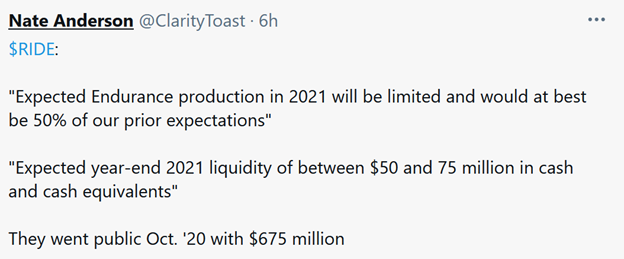
Sure enough, after the close yesterday, Lordstown reported disappointing first-quarter earnings, and the stock is down big today.
Activist short seller Nate Anderson of Hindenburg Research – who published a bearish report on the company (The Lordstown Motors Mirage: Fake Orders, Undisclosed Production Hurdles, And A Prototype Inferno) on March 12, when the stock was double today's levels – tweeted his take on the earnings report:
4) Longtime readers know what a fan I am of Bloomberg columnist Matt Levine, so when I say that this essay he penned last week is his best ever, that's saying something! Elon Musk's Bitcoin Fun Continues. Excerpt:
Oh Elon
I am sorry to keep talking about it because it is so stupid, but there really is something unprecedented and amazing and almost magical about Elon Musk's continuing ability and inclination to move the prices of Bitcoin and Dogecoin with his slightest whim. Imagine if you had gone to Warren Buffett 30 years ago – or J.P. Morgan 120 years ago – and told him: Here is a lamp. In the lamp is a genie. When you rub the lamp, the genie will come out and invent two assets. They will trade like stocks in many ways, but unlike stocks they (1) will not be subject to U.S. securities laws, (2) will trade 24 hours a day, seven days a week, and (3) will not represent claims on any businesses or cash flows. One will have a market cap – a total circulating supply – of about a trillion dollars; the other will be smaller but still like $65 billion. They will be liquid enough, with lots of people trading many billions of dollars' worth per day; you can buy or sell lots of them without too much price impact. And: Any time you want the price of either one to go up or down by 10% or more, you can just whisper "price go up" or "price go down" into the lamp, and it will happen instantly. You are the only person who can do this, and you can do it as often as you want.
How much would Warren Buffett pay for that lamp? I suppose its value is not literally infinite: Once you have all the money you could ever spend, you might get bored of whispering to the lamp all the time and go do something else. But it is as close to infinite as you're likely to get, as close to a free-money perpetual motion machine as you'll ever see in finance. You can quickly, easily, silently buy billions of dollars' worth of a liquid unregulated financial asset and then tell it to go up, and it will go up. Then you can sell it, tell it to go down, and repeat.
I will say again that I have no particular reason to think that Elon Musk is monetizing this magical ability that he has, and in fact I assume he's not, but:
- He definitely has the power to move Bitcoin and Dogecoin prices whenever he feels like it.
- He definitely exercises that power with some frequency and with no apparent pattern.
- He definitely has the money to buy lots of Bitcoin and Dogecoin before making them go up.
- If he did do that, he probably would not have much in the way of disclosure obligations, at least not real-time disclosure obligations.
- Similarly he could easily sell them before making them go down, without much in the way of disclosure obligations.
- The regulation and policing of Bitcoin and Dogecoin trading are rather less comprehensive and aggressive than the regulation and policing of stock trading.
So if he was doing the magic-lamp trading strategy – which, again, I don't think he is – it would look, to an outside observer, more or less exactly like what he's currently doing.
I just think that if you presented this possibility to any famous investor throughout history they would absolutely faint with excitement. And here Musk is, the second-richest person in the world, either doing it – in which case it's one of the greatest trades, and also one of the greatest trolls, in history – or not doing it, rubbing the lamp and making Bitcoin and Dogecoin go up and down and up and down and up and down with his whims, just for fun, leaving billions of dollars of profit on the table because he doesn't need the money and has the purest imaginable commitment to internet trolling.
5) Here's an angle on the Gates' divorce I wasn't aware of: Bill and Melinda Gates Divorce Highlights Rise of Older-Age Splits. Excerpt:
Bill and Melinda Gates aren't like most couples. But their split highlights a broader phenomenon in American relationships.
Divorce after the age of 50, often called "gray divorce," has risen in recent decades, bucking an overall decline in divorce among younger couples. The reasons for older-age divorces are often different than for younger ones: It's not necessarily acute conflict, but rather starting a new chapter – the children leave home, or retirement feels closer – that prompts reassessment in a marriage, counselors say. And people living healthier lives at older ages means they have more time to start over in a second act.
During the past year, many couples stuck it out as they hunkered down in crisis, but lawyers say they expect more split-ups among all age groups as the pandemic recedes. For couples over 50 in particular, counselors say, the pandemic has amplified the soul-searching that often hits people at this age.
6) The Gates' divorce reminds me of this excerpt from my new book, which you can order here:
How Making a Lot of Money Increases the Odds of Divorce
Most people think that making a lot of money strengthens a marriage. Up to a certain point, that's true, as financial pressures can strain a marriage.
But, counterintuitively, I've seen seven ways of how making a significant amount of money can actually increase the odds of divorce:
1) Divorce is crazy expensive, so having a lot of money removes this barrier.
There is both the short-term cost of lawyers and the long-term higher expenses due to two homes, less favorable tax treatment, etc. I know one guy whose wife suddenly inherited a huge amount of money – and told him that very night that she wanted a divorce. My wife and I joke (at least I hope she's joking!) that, even if we wanted to, we couldn't afford to get divorced. Even though it's not technically true, I'm glad she thinks it is!
2) Odds of infidelity go up.
Making a lot of money generally requires working long hours and, often, a lot of travel, which can put a huge strain on a marriage and increase opportunities for infidelity (both for the person traveling and for the one at home). Also, rich people are more likely to attract those interested in having an affair. Lastly, wealth equals power, which some people exploit for sexual advantage.
3) When a couple is scraping and hustling to make ends meet, it's a bonding experience.
When you're both young and working to support yourselves (and, eventually, a family), it can be stressful but also joyful and unifying. You're both in the same boat, leading similar, parallel lives.
4) It can change the power dynamic in the marriage.
When both of you are earning roughly the same amount, there's symmetry and equality. If that shifts, it can lead the high-earner – even if subconsciously – to feel a sense of superiority, lose respect for the spouse, and/or expect him or her to do more of the housework/childcare – in short, a recipe for marital strife.
5) If one person makes enough money that their spouse can stop working, it can eventually lead to deep unhappiness for the nonworking spouse.
I'll acknowledge up front that this is a high-class problem that pretty much only affects one-percenters – but that's my world. See my friends' comments on this below.
6) Deciding how to spend (or not spend) the newfound wealth can lead to conflict.
One friend told me that when he hit it big, he couldn't wait to spend his fortune and enjoy the luxuries of life. For example, he wanted to live in a big brownstone in New York City and have a mansion in the Hamptons.
But his wife was super frugal, uncomfortable with their new wealth, and even more uncomfortable displaying it. He ignored her wishes and went ahead with his purchases, which he believes was a major contributor to their divorce a few years later.
7) Becoming very rich can change people for the worse: they can become arrogant and self-absorbed and look down on others.
Just open the newspaper to see examples of rich, narcissistic jerks everywhere, like Tesla (TSLA) CEO Elon Musk or Uber (UBER) co-founder Travis Kalanick. But were they always this way, or did making a ton of money cause them to become so? My observation of dozens of extremely wealthy people is that it's 25% causation and 75% inflammation.
Regarding the former, if you make a lot of money, people start to suck up to you... And it's easy to come to believe that you're smarter, taller, funnier, better-looking, and more charming than you really are, which can lead to all sorts of bad behavior.
Regarding the latter, making a lot of money doesn't so much change people as inflame their preexisting tendencies. If they were a jerk when they had no money, they're likely to be an even bigger jerk after they make a lot of money.
But, conversely, some people improve. Becoming financially secure reduces their stress level, and they have the ability to help others, which can bring them joy.
I'm quite certain that I'm a much better human being now than I was 30 years ago in my twenties when I had almost no savings and plenty of student loans. I'm biased, of course, but I think I'm wiser, more self-aware, kinder, more philanthropic, a better listener, and more humble (though there's still a lot of room for improvement in every one of these areas!).
How much of this is due to becoming financially secure? Maybe a little, though I think most of it is having a learning curve that slopes upward (however slightly), the positive effect Susan has had on me, and the knowledge I've absorbed from Buffett and Munger.
Best regards,
Whitney