

Stock Shorts Collapse; Excerpt from my book: 'Getting Hooked on Short Selling'; Why Do We Let Corporations Profit From Rape Videos?
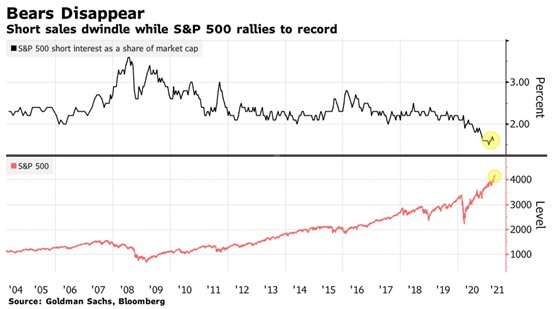
1) Following up on what I wrote in Friday's e-mail about the carnage among short sellers, this Bloomberg article documents the unsurprising result: Stock Shorts Collapse as No Hedge Fund Wants 'Head Ripped Off'. Excerpt:
Wall Street bears battered by the Reddit crowd earlier this year have yet to regain their gumption, even with stocks at records and valuations near two-decade highs.
The median short interest in members of the S&P 500 sits at just 1.6% of market value, near a 17-year low, according to Goldman Sachs (GS). In Europe, a short-covering frenzy has sent bearish bets collapsing like never before in Morgan Stanley (MS) data.
At the same time, hedge-fund longs are around the highest relative levels in years at JPMorgan Chase's (JPM) prime brokerage.
They're all signs of the bullish mania propelling global equities to fresh records this month, thanks to the economic re-opening and big policy stimulus. The smart money has little appetite to wager against either expensive or deadbeat companies – especially after being lashed by the day-trader army earlier this year.
"There's just mass euphoria," said Benn Dunn, president of Alpha Theory Advisors. "No one wants to get their head ripped off by a short anymore."
2) Here's an excerpt on short selling from a draft of a book I've been working on for a while, The Rise and Fall of Kase Capital, which I plan to publish next year...
Getting Hooked on Short Selling
Over the course of 15 years – before, during, and after my partnership with Glenn Tongue – I shorted hundreds of stocks.
It was intellectually stimulating and led to some of the biggest wins of my career – most notably in flooring firm Lumber Liquidators (LL). But overall, it was very costly.
Over my entire shorting career, I lost money – though not a ton, especially in light of the bull market. The real cost was the huge amount of time it consumed. Worse yet, it was the primary reason for my funds' terrible underperformance in 2016 and 2017 – so much so that I finally threw in the towel and closed them.
So why didn't I recognize this sooner and stop shorting entirely? Well, like most self-destructive things, it initially started off so well, which sucked me in, and I got hooked...
I shorted my first stock in April 2002, a little more than three years after launching my business. It was Farmer Mac, at $46 a share. Six months later, I covered at $27. In June, I shorted Orthodontic Centers of America at $24. Four months later, I covered at $11. In July, I shorted GameStop (GME) at $18. Six months later, I covered below $10. With three quick wins under my belt, I was off to the races...
I was having so much fun and success, in fact, that I wouldn't even listen to Charlie Munger.
Here's the story...
In 2002, Bill Ackman researched financial-services giant MBIA (MBI) and concluded that it was a house of cards. He shorted the stock and published an in-depth report titled "Is MBIA Triple-A?" I thought Bill's analysis was correct, so I also shorted the stock and was publicly critical of the company.
In response, the company planted a negative story in the Wall Street Journal about Bill and me, claiming that we were part of a nefarious group of market-manipulating short-sellers.
As if that wasn't bad enough, only four days later, I received subpoenas from both the U.S. Securities and Exchange Commission ("SEC") and the office of New York Attorney General Eliot Spitzer. Both regulators had obviously read the WSJ story and were following up, demanding all of my e-mails, trading records, research, etc.
I knew I hadn't done anything wrong. Nevertheless, I feared that the bad publicity and these two investigations might put me out of business.
Panicked, I called Warren Buffett for advice. He basically told me, "This too shall pass," and suggested that I speak to his long-time partner, Charlie Munger.
I had never spoken with him, so I asked, "Does he even know who I am?"
Buffett chuckled and said, "Oh, yes, he knows who you are. Give him a call."
So I did – and, to my surprise, his secretary put me right through to him. I still remember his exact words. He started by saying, "You and Bill are absolutely right on MBIA. The idea that anyone would ever think that MBIA is triple-A is so ludicrous!"
He spat out the last two words and continued:
"From a societal perspective, what you and Bill are doing is great."
At this point, I was feeling pretty good. My hero was complimenting me!
But then, he cautioned: "But if you go through life stepping on people's air hoses, they're going to hate you and attack you. So my advice to Whitney Tilson is, don't do it."
Then, he reflected on his own experiences short-selling decades earlier. "I shorted three stocks in my life and they eventually worked out," he said, "but not before running against me and causing me total misery. So I stopped."
He concluded with a phrase I'll never forget: "But every young guy seems to have to learn this for himself..."
He was saying this to himself as much as to me, because he knew I was so full of myself that I wasn't going to listen to him. That's how wise he is... and how dumb I was. My failure to listen to Munger eventually brought me to ruin...
3) Cheers to New York Times columnist Nicholas Kristof for exposing this horrific exploitation, and jeers to the many companies engaging in/enabling it: Why Do We Let Corporations Profit From Rape Videos? (For more on this, see Kristof's December 4 article, The Children of Pornhub.) Boy, talk about the dark side of capitalism... Excerpt:
That happens all over the world: Women and girls, and men and boys, are sexually assaulted or secretly filmed, and the video is posted on a major website like XVideos that draws traffic through search engines. While the initial video assault may be brief, the attack on dignity becomes interminable.
"The shame I felt was overwhelming," the Canadian student says.
I wrote in December about Pornhub, a Montreal-based website that pioneered access to free porn uploaded by anyone – so-called tube sites that are like YouTube for nudity and sex. Since that article, credit card companies have stopped working with Pornhub, the site has removed more than nine million videos, and the Canadian and United States governments have been cracking down on the company's practices.
But as I noted at the time, the exploitation is rooted not in a single company but in an industry that operates with impunity, and punishing one corporation may simply benefit its rivals. That's happening here. When Pornhub deleted videos, millions of outraged customers fled to its nemesis, XVideos, which has even fewer scruples.
Pierre Woodman, a veteran European pornographer, told me that while I may have damaged Pornhub financially, for XVideos, "You are Santa Claus."
That's not a comfortable feeling, and it's why we need to work to rein in an entire rogue industry – and for now, the behemoth is XVideos, bolstered by Google and other search engines.
Here's more on Alphabet (GOOGL) subsidiary Google's disgraceful role:
Google is a pillar of this sleazy ecosystem, for roughly half the traffic reaching XVideos and XNXX appears to come from Google searches. "The porn tube sites are obsessed with their Google rankings because Google is their lifeline," said Laila Mickelwait, the president of the Justice Defense Fund, which fights sexual exploitation online. "Google is the primary means by which they drive traffic to their sites."
A recent search with the words rape unconscious girl using Google's video tab directed people to scores of videos celebrating just that, including one in which a woman first appears to be strangled to death (presumably she is acting) and then her "corpse" violated.
A Google search for schoolgirl sex turned up video results of teenagers having sex of all kinds (on a bus, with a "stepbrother," etc.) on XVideos and XNXX. Most of the people in the videos are probably 18 or over, but who knows?
I reached out to Google to understand its reasons for complicity with companies that monetize child sexual abuse, but I didn't receive satisfactory answers.
Google does have limits. I tried searching "How do I poison my husband," and the results were literary or humorous, not how-to instructions. The top responses to "How do I commit suicide" were for a suicide hotline. So, Google, why not demonstrate the same responsibility when it comes to searches for rape videos?
Lastly, here are Kristof's ideas for much-needed change:
While there are no simple solutions, here are three steps that would help:
First, credit card companies should stop working with companies that promote illegal videos. PayPal (PYPL) had propped up XVideos because it was being used to pay for ads, but after this article was published online the company announced that effective immediately it could no longer be used to purchase advertising on XVideos and related sites.
Mastercard (MA) took an important step a few days ago by announcing that it can be used by porn websites only if they verify age and consent of each person in sex videos; other card companies should do the same.
Second, search engines like Google, Yahoo and Bing should stop leading people to rape videos and stop directing people to websites with a long record of distributing them.
Third, we should create accountability in criminal and civil law, for that's the best way to incentivize companies to clean up their act. In March a girl who was trafficked at 14 and forced to appear in sexual videos filed a lawsuit against XVideos, but such suits face difficulties under Section 230 of the Communications Decency Act. Bipartisan legislation before the House and the Senate would make these suits easier to pursue, which could be a game changer by harnessing capitalism to induce better corporate behavior.
Best regards,
Whitney