

Super-Apps Are Inevitable; What Europe can teach us about jobs; CEOs from India; Reader feedback on COVID-19 vaccines, love and hate
1) NYU marketing professor Scott Galloway thinks PayPal (PYPL) or Square (SQ), an Empire Stock Investor recommendation (you can subscribe here – it's only $49 for the first year), could become super-apps. Super-Apps Are Inevitable. Excerpt:
The newest and maybe the most exciting entrants in this contest are coming from the payments business, including PayPal, which owns Venmo, and Square. They already have the transaction network and financial relationships in place with businesses and consumers alike. People trust them. As far as we know, no fintech company has helped organize an insurrection or speedballed teen depression. Such companies print money, not conspiracy theories. They're well-financed and could pursue a titanic set of acquisitions that would change the tech landscape – while reaping trillions of dollars via the ultimate exercise in scale.
The core economic principle of the Internet is the arbitrage of your attention. Some of the most valuable companies in the history of capitalism got that way by taking your online attention (the average American spends some 119 days a year consuming media from a screen, roughly the same amount of time spent sleeping) and monetizing it through subscriptions and advertising. Here is the really mind-bending potential of super-apps: Subscriptions and ads are only part of the full super-app monetization model and not even the most profitable. Taking a direct piece of transactions is staggeringly lucrative, and a company built around payments could make the Facebook (FB) and Google (GOOGL) of today look small.
Payment processing is the nonnegotiable super-app service. It's the glue that integrates core features with those provided by third parties on the platform, and it gives users the simple convenience of not having to enter credit-card information across dozens of apps and websites. A shift in the arbitrage of attention, from ads to the more potent payments business, promises to fuel a historic merger-and-acquisition binge that will reshape the array of industries that tech snobbishly calls "content." And the biggest buyers will be in finance – not just startups but Wall Street's Old Guard.
2) Here's an interesting op-ed by Nobel Prize-winning economist Paul Krugman on What Europe Can Teach Us About Jobs. I average two to three trips annually to Europe, totaling nearly a month visited each year, and his arguments ring true... Excerpt:
Which brings me to an under-discussed aspect of the current economic scene: Europe's comparative success in getting workers idled by the pandemic back into the labor force.
You're probably aware that the United States is experiencing what many call the Great Resignation – a significant fall in the number of people willing to accept jobs, at least at pre-Covid wages. Four million fewer Americans are employed than were on the eve of the pandemic, yet the rate at which workers are quitting their jobs – usually a good indicator of labor market tightness – has hit a record, and the scramble of employers to find workers has led to rapid wage increases.
Earlier this year many Republicans insisted that labor was scarce because generous unemployment benefits were discouraging workers from accepting jobs. However, those enhanced benefits went away with no visible effect on participation in the labor force. So what is going on?
Well, a comparison with Europe may shed some light on the subject. For the Great Resignation, it turns out, is largely an American phenomenon. European nations have been much more successful than we have at getting people back to work. In France, in particular, employment and labor force participation are now well above pre-pandemic levels. What explains this difference?
Part of the answer may involve older workers. In the United States, the decline in the labor force has been especially steep among adults over 55, many of whom haven't come back after pandemic layoffs. This may have been less of a factor in France, where workers tend to retire earlier than their U.S. counterparts. However, older adults in some European nations, like Denmark, are actually more likely to be employed than their U.S. counterparts; yet Denmark has also avoided a Great Resignation.
Another answer may lie in transatlantic differences in how we approached Covid relief. While the United States made some effort to help businesses stay afloat and retain their labor forces, mainly we helped displaced workers through enhanced unemployment benefits. Europe, on the other hand, mainly relied on job retention schemes – government aid intended to keep people on employer payrolls even if they weren't working at the moment.
The problems with the U.S. approach are now becoming apparent. As I said, there's no evidence that unemployment insurance has been significantly discouraging work. But where European labor support helped keep workers linked to their old jobs, facilitating a rapid return, U.S. policy allowed many of those links to be severed, making an employment recovery harder.
Finally, let me offer a speculative hypothesis: Perhaps one reason Europeans aren't engaging in an American-style Great Resignation is that they don't hate their jobs quite as much.
Anecdotally, one factor behind Americans' unwillingness to return to their old jobs is that enforced idleness during the pandemic gave many people a chance to reconsider their life choices – and a significant number may have realized that low-paying jobs with lousy working conditions weren't worth having.
(Anytime I link to an essay by Krugman, as I did in yesterday's e-mail, I get flak because he writes for the New York Times, and his views generally lean left, so I try my best to include plenty of articles from the Wall Street Journal, too.)
3) I'll echo this tweet (and Elon Musk's comment):
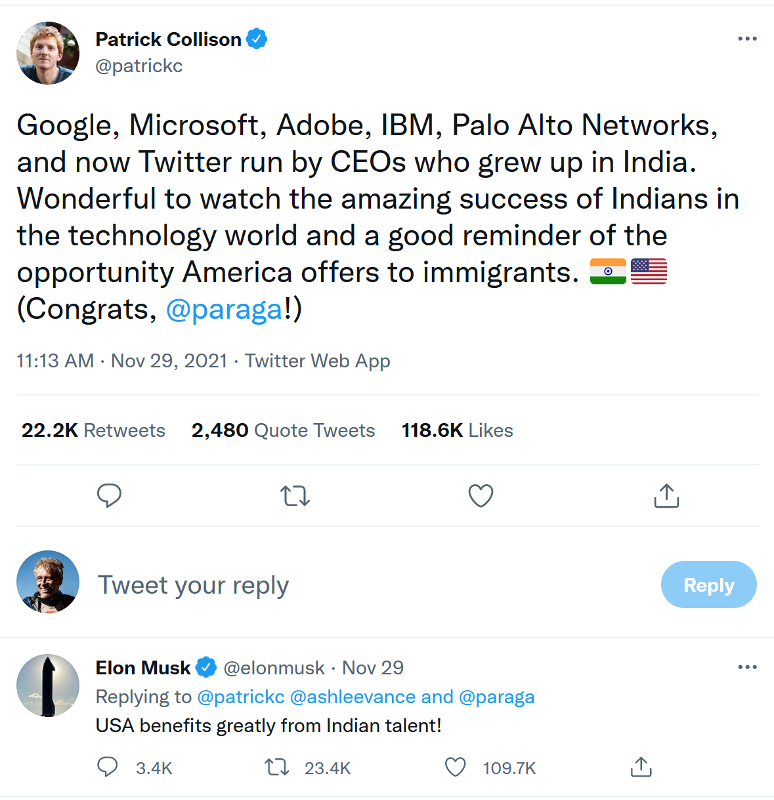
The number of Indians who have achieved huge success in this country is simply extraordinary. One of them even married my cousin – lucky guy! Here's a picture of us:

The best book I've read about the Indian diaspora is, ironically enough, about two of its most successful members who came to ruin: The Billionaire's Apprentice: The Rise of the Indian-American Elite and the Fall of the Galleon Hedge Fund.
The book focuses on Galleon's founder, Raj Rajaratnam (who's Sri Lankan), and Rajat Gupta, who was head of consulting giant McKinsey and on the boards of Goldman Sachs (GS), Procter & Gamble (PG), and American Airlines (AAL). They were co-conspirators in an insider trading scandal. Rajaratnam ended up serving eight years in prison while Gupta served two.
4) Every time I encourage my readers to get the COVID-19 vaccine or booster, I get a wide range of feedback. Roughly 75% of which falls into either the love or hate category. I included a number of each in the e-mail I sent to my coronavirus e-mail list yesterday (simply send a blank e-mail to:
cv-subscribe@mailer.kasecapital.com to join it). You can read my full e-mail here. Here are two examples of each type of response:
- "Tuesday will be a year since my husband of 39 years died from COVID-19. That was before the vaccines were available. Please continue to encourage everyone to get vaccinated. Thanks." – Vivian L.
- "Dear Whitney: Quick note that I got my Pfizer (PFE) booster on Tuesday – feeling great and no symptoms. I was motivated by your message. I also convinced another person reluctant about the booster to schedule their booster shot by using the info you shared about Israel's third wave getting stopped by its massive booster campaign.
I'm focused on Empire's investing content, but this was the icing on the cake. Thanks for keeping me updated on COVID-19-related developments!" – Vikram K.
And from the other side:
- "Whitney, this has become absurd with your constant pro-government/Big Pharma vaccine garbage. I will never recommend your service, your newsletter, or anything else you try to promote. It is obvious to me that you are oblivious to what is really going on in this world. Go back to your little naive and entitled hole you crawled out from under and give us readers a break with your partisan opinions. , the 'Horse Dewormer' you tried to belittle has saved my wife and many other friends that have had COVID-19. How do you explain away the fact that ivermectin is very effective for all three stages of the virus? Go ahead and make fun of it all you want because half of your readers are making fun of you, trust me. Never resubscribing." – Chad S.
- "How much do you get paid to propagandize the jab?? Your jab doesn't work; you can still get COVID-19, you can still spread COVID-19, and you can still die from COVID-19. Why didn't you mention the countries in Europe that have banned the Moderna (MRNA) jab because of the side effects?? You also never talk about cheap, effective treatments, such as ivermectin. Why don't you explain why you don't to your readers? Why don't you talk about the ineffectiveness of the jab in Israel?? You're one of the worst of the worst, someone who blatantly lies to his readers and prevents them from gaining knowledge on treatments that could actually save their life. Also, your stat about one American, every minute dies from COVID-19, is another lie. I would love to debate you about this, but you're the type that can't back up what you say, so you just censor the information. Please never move to Florida or Texas; we don't want people like you in our states after you have destroyed yours." – Don G.
Best regards,
Whitney
P.S. I welcome your feedback at WTDfeedback@empirefinancialresearch.com.