

Tesla's earnings; TikTok: Trojan Stallion; Lawmakers Near Deal on Tougher Rules for Stablecoins; I almost missed my flight this morning
1) Tesla (TSLA) reported second-quarter earnings yesterday after the close. Here's a summary from the company's slide deck:
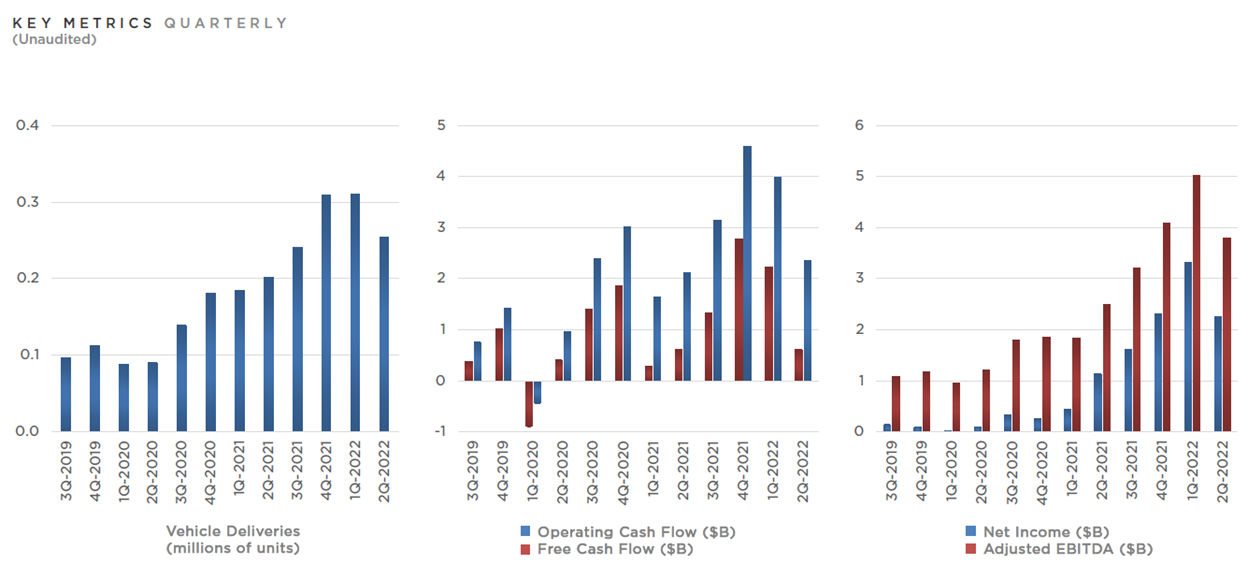
Due to COVID-19 shutdowns in China and supply chain issues that are plaguing the industry, revenues, deliveries, cash flow, and profits were all down from the very strong first quarter. However, the stock is up this morning on guidance for "a record-breaking second half of 2022."
Here's the Wall Street Journal's Heard on the Street commentary: Tesla's Tough Second Quarter Shows What Might Happen in a Recession. Excerpt:
The risk of recession could give some investors pause, though.
At the moment waiting lists suggest there is more demand for electric vehicles, of which Tesla remains the leading supplier globally excluding hybrids, than can be met by supply. But the technology is expensive and may prove to be the kind of luxury consumers cool on if their economic circumstances deteriorate.
If a two-month supply shock slashed Tesla's quarterly cash flows, a more prolonged demand shock just as it is ramping up capacity in Germany and Texas would look much worse.
Whatever happens to consumer appetite for EVs, it is hard to see Tesla as anything other than a car manufacturer that faces car-manufacturing risks. At about 52 times earnings forecasts, down from 120 times at the start of the year, Tesla stock is less outrageously priced than it was, but it remains a heroic bet on little going wrong in a hugely ambitious growth plan.
There is a reason most of its industry peers trade on single-digit multiples: When selling big-ticket consumer products that are reliant on global supply chains, things often go wrong – with outsized financial consequences.
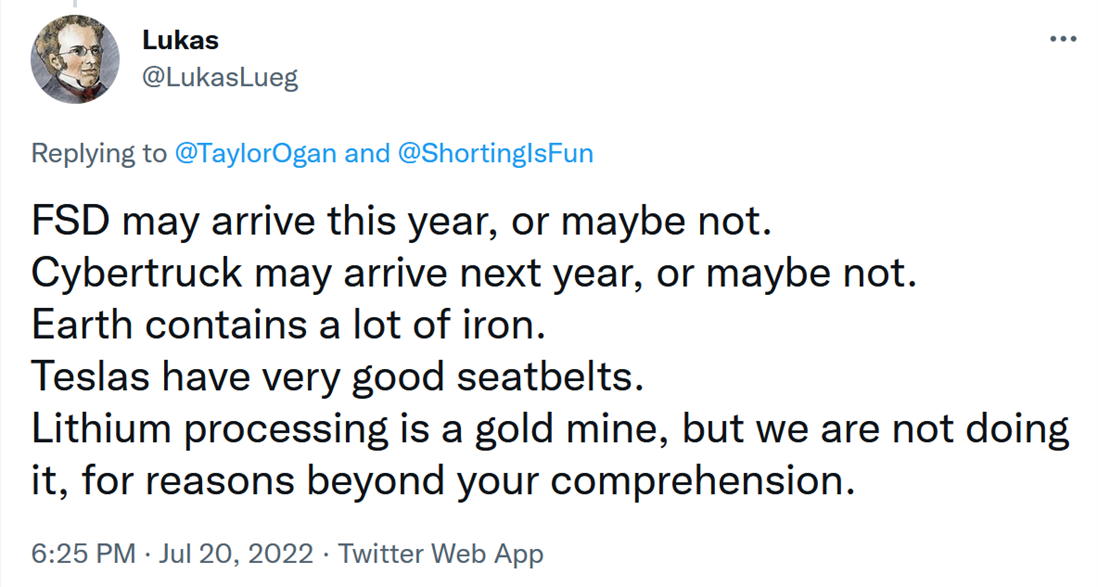
One skeptic tweeted:
My take: I have been very critical of Elon Musk's behavior when warranted – most recently as it relates to his attempt to buy Twitter (TWTR) – but I am by no means one of his many haters.
As I have written many times before, I think Musk is one of the greatest entrepreneurs of all time, and what he's pulled off in building Tesla and SpaceX boggles my mind. Humanity owes him a debt of gratitude.
As for Tesla's stock, I wouldn't touch it with a 10-foot pole right now.
This is mainly because I think Chancellor Kathaleen McCormick of the Delaware Court of Chancery is going to compel Musk to adhere to the contract he signed and buy Twitter, which would mean he would likely be forced to sell large amounts of Tesla's stock later this year.
There could also be selling pressure on the stock from Oracle (ORCL) CEO Larry Ellison, who leaves Tesla's board on August 4. He might want to sell some or all of the 15.3 million shares he owns, equal to 1.5% of the shares outstanding, worth more than $11 billion.
This said, I also wouldn't short Tesla's stock here – production is ramping up rapidly and there appears to be no shortage of demand.
2) I've long been skeptical of Tesla from an investment standpoint, but it's hard to deny that the company has scaled tremendously over the past several years.
Betting against these types of businesses can be extremely costly. On the other hand, spotting them early can create a windfall of wealth.
That's why I recently sat down with my friend Louis Navellier, a billion-dollar money manager, to discuss this powerful investment idea. We even shared the name and ticker symbol of one of our favorite ideas today – completely free, no e-mail address or credit card required. For the next few days, you can access this presentation (or a transcript) by clicking here.
3) I sent this to my China e-mail list on Monday (if you wish to subscribe to it, simply send a blank e-mail to: china-subscribe@mailer.kasecapital.com):
If you need any more persuading that the government should shut down TikTok immediately until it's fully controlled by a U.S. company, which I called for in my June 29 e-mail, read this essay by NYU marketing professor Scott Galloway (or listen to his podcast here): TikTok: Trojan Stallion. Excerpt:
China is not America's friend. There is a dangerous sentiment emerging in the U.S. that members of the "other" political party are the enemy. No, Americans are still the best allies for other Americans. If you blanched at the previous sentence, in my view, you have been targeted by propaganda from bad actors and/or manipulated by algorithms or cable news editors whose profit incentive pits us against one another.
The Chinese government aims to weaken the U.S. Its investment in kinetic power is massive (a third aircraft carrier took to sea last month), but it probably won't match raw American might for decades. So the Chinese press on our soft tissue strategically and play the long game with tactics that offer a greater ROI: IP theft and propaganda. America is most like itself when we perceive an external threat as the real threat, and when we're optimistic about the return we'll realize from long-term investments at home: education, infrastructure, research, and development. Pessimism is our kryptonite.
Tip of the Spear
The tip of China's propaganda spear is TikTok, which has a direct connection to the midbrain of a billion people, including nearly every U.S. teenager and half their parents. Facebook is the most powerful espionage vehicle ever created, and now China commands the most powerful propaganda tool. Putin and the GRU can manipulate an amoral Facebook from the outside, it just takes money. It has been easy, to date, to exploit management that's indifferent to teen depression, much less national security. But it will likely get increasingly difficult. Xi Jinping can simply pick up the phone. When he does (if he hasn't already) the shift in TikTok's messaging will be subtle, invisible in the details, hiding in plain sight.
4) This is good to see: Lawmakers Near Deal on Tougher Rules for Stablecoins. I can't wait to see the shady characters behind the largest stablecoin, Tether, try to comply with the forthcoming regulations. Excerpt:
U.S. lawmakers moved closer to a bipartisan agreement on new legislation that would regulate so-called stablecoins as part of efforts to impose basic safeguards on volatile cryptocurrency markets.
The potential deal would mark the first significant step to apply tougher rules on an industry that developed with virtually no regulation. Biden administration officials and a bipartisan group of lawmakers worry that current laws don't provide comprehensive standards for the new assets and have warned of potential risks to financial stability posed by stablecoins, a type of cryptocurrency intended to be pegged to the dollar or another national currency.
Those anxieties have grown in recent months after Tether, the largest stablecoin, briefly lost its peg during the collapse in May of TerraUSD, a so-called algorithmic stablecoin that was backed by another cryptocurrency rather than cash or safe assets.
More broadly, it's a disgraceful dereliction of duty that our lawmakers and regulators have allowed the cryptocurrency "asset class" (I use that term loosely) to emerge and grow to over $3 trillion at its peak (and still well over $1 trillion today) with virtually no oversight whatsoever.
Banks, especially after the global financial crisis, are rightly carefully monitored and regulated... And yet, there has been nothing to prevent financial "institutions" (again, a word I use loosely) in the crypto sector from taking crazy risks, blowing themselves up, and saddling average folks with billions of dollars in losses.
Exhibit A is Celsius, as these articles note:
- Behind the Celsius Sales Pitch Was a Crypto Firm Built on Risk (WSJ)
- Inside Celsius: how one of crypto's biggest lenders ground to a halt (FT)
- Crypto Crash Drags Lender Celsius Network Into Bankruptcy (WSJ)
5) In the "travel tips" section of my e-mail 10 days ago, I wrote in bold: leave lots of time.
Well, this morning I violated that rule because I wanted to get a little extra sleep (here's my April 1 e-mail on the importance of this) and, as a result, almost missed my 6:30 a.m. flight from Newark to San Francisco. Here's how my crazy morning went...
Normally I would have just taken an Uber (UBER) or Lyft (LYFT) to the airport, but they both wanted $120, which I thought was outrageous (being the cheapskate value guy that I am!), so I looked into public transportation.
I found a 5:07 a.m. train from Penn Station to the Newark Airport stop, from which it would be a short ride on the AirTrain to Terminal C, arriving at 5:45 – a little tight, but I wasn't checking a bag and figured there wouldn't be much of a security line that early (plus I need my sleep!).
But I live on the Upper East Side and the buses and subways don't run very often that early in the morning, so I hit upon a new idea to get to Penn Station: take a Citi Bike! (One of the many advantages of minimalist packing – which I discussed in Monday's e-mail – is that my bag converts to a backpack, so I can easily hop on a bike or scooter.)
Everything initially went smoothly as my alarm went off at 4:25 a.m. I was on the electric Citi Bike 10 minutes later, zipped along for 20 minutes from 97th and Madison to 31st and Eighth, and made my train with 15 minutes to spare...
But as the train pulled out of the station, it started making a loud hissing noise and never picked up speed. We limped into the first station well behind schedule, sat there for a while, and finally the conductor announced that the train was being taken out of service... so we had to get off and take the next train.
As I looked at the schedule and did the math in my head, I realized that I would probably miss my flight and cursed myself for not following my own advice. But, hey, I'm in good shape and am a fast runner, so you never know...
The AirTrain pulled into Terminal C at 6:05 and I took off like a rocket. As I sprinted up to security, I saw that there were two dozen people in the TSA PreCheck line. I was looking for a way to cut to the front when a guy from Clear saw the panicked look in my eyes and said he could get me through their dedicated lane in three minutes (if I reactivated my account for $189 this year).
With not a minute to waste, I said yes, he delivered, a kind gentlemen let me cut in front to put my bag through the security machine, and I sprinted to my gate – which was (of course!) at the furthest end of the terminal. I arrived, panting and drenched in sweat, at 6:23, and was the last person to board just before they closed the door.
It was a miracle!
The flight on United Airlines (UAL) – a new B777-300 widebody – was very nice. Economy class was full and I wanted to spread out to get some work done on my laptop, so I grabbed an open seat in Premium Plus, which had a very comfortable seat with a leg rest.
I was hoping to pull off the same trick as when I was coming home from Italy on July 10, but the flight attendant noticed that I wasn't in my assigned seat and said I would have to pay for an upgrade. When I checked in yesterday, it was $389, which I wasn't willing to pay, but I was pleasantly surprised when she said it was only $189, so I took the offer.
Lesson learned: It never hurts to ask about a paid upgrade at the boarding gate or even on the plane! The worst that can happen is that they say no or kick you back to your assigned seat...
As you read this, I'm catching a connecting flight to Eugene, Oregon (hopefully no sprinting involved, as I have 70 minutes to get from the International Terminal to Terminal 3), where I'll be going to the last three days of the World Track and Field Championships tomorrow, Saturday, and Sunday with my cousin and his family.
Best regards,
Whitney
P.S. I welcome your feedback at WTDfeedback@empirefinancialresearch.com.