

The Economic Rebound Is Skidding; Rise in Weekly Unemployment Claims; Small Businesses Brace for Prolonged Crisis; Retailers and airlines are suffering; Home sales jump; Why I'm cautiously bullish; Step 4 of cultivating mentors
1) It's clear that the resurgence of the coronavirus across much of the country has affected the economy, but it's hard to know exactly to what degree. Below are some of the most informative articles I've read on this subject recently...
For starters, I found yesterday's summary by the Washington Post's "Finance 202" daily newsletter an excellent resource: New signs show the economic rebound is skidding as coronavirus cases surge. Excerpt:
The economy is sending up alarms across the map, showing how the pandemic's resurgence is dragging a fledgling rebound back into a skid.
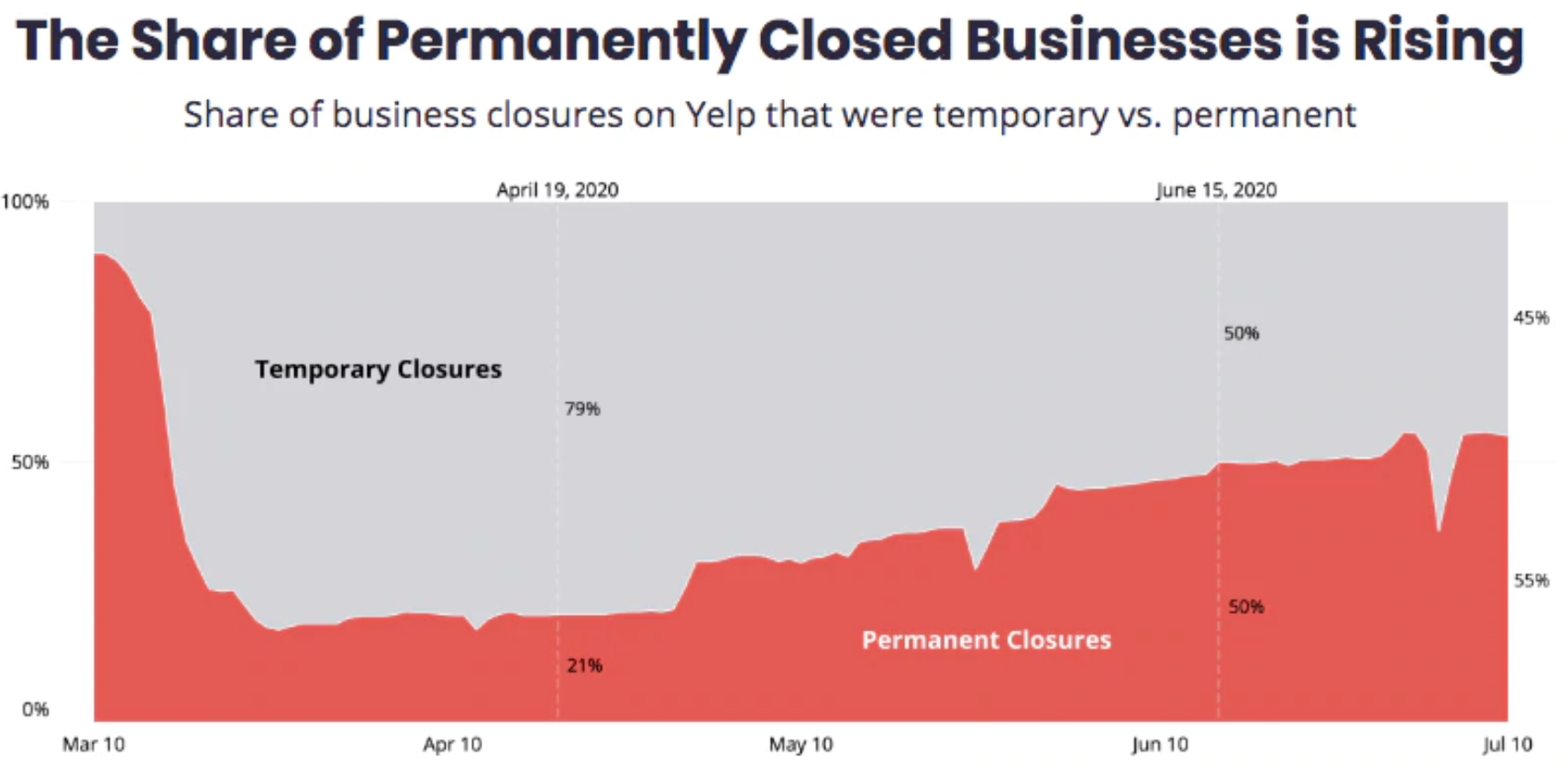
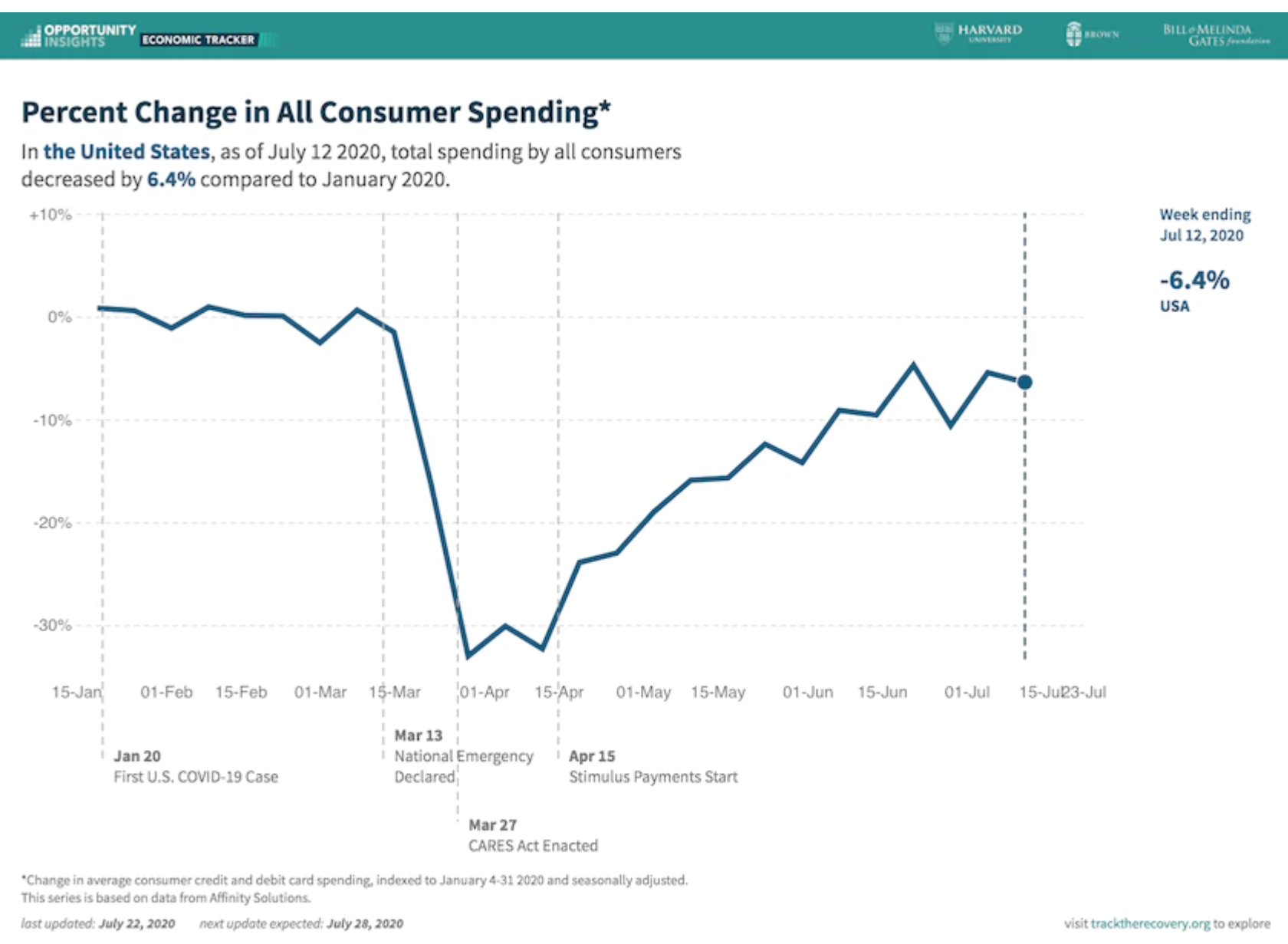
Economists are watching a raft of real-time data measuring everything from credit card spending to the extent to which people are venturing from home as the crisis remains too fluid to judge solely by traditional indicators of stress. Their analysis depicts a recovery that peaked a month ago. The weeks since have seen an uptick in businesses closing permanently, a drop-off in consumer spending; and layoffs reaching into white-collar sectors that have typically proven more recession-proof.
The upshot, economists warn, is likely a longer slog out of a deeper hole — and more permanent scarring. "It's not just the regulations forcing a rollback, not just increased fear among consumers, and not just the deteriorating public health situation," Oxford Economics chief U.S. economist Gregory Daco tells me. "It's a combination of all these factors, and we've seen them all taking hold over the last four weeks."
Here are two of the most interesting charts in the newsletter:
2) From the front page of today's Wall Street Journal: Rise in Weekly Unemployment Claims Points to Faltering Jobs Recovery. Excerpt:
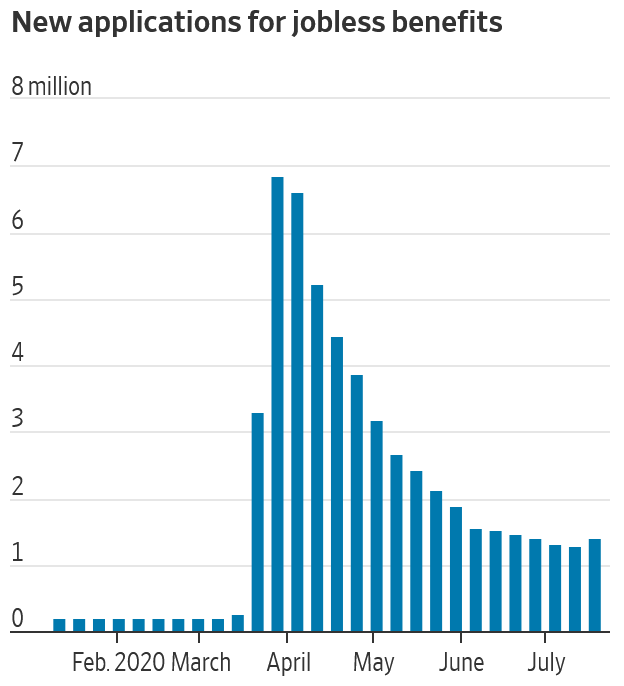
Filings for weekly unemployment benefits rose for the first time in nearly four months as some states rolled back reopenings because of the coronavirus pandemic, a sign the jobs recovery could be faltering.
Initial unemployment claims rose by a seasonally adjusted 109,000 to 1.4 million for the week ended July 18, the Labor Department said Thursday, halting what had been a steady descent from a peak of 6.9 million in late March, when the pandemic and business closures shut down parts of the U.S. economy.
3) Here's a related "Heard on the Street" column in today's WSJ: Jobs Warning Light Starts Flashing. Excerpt:
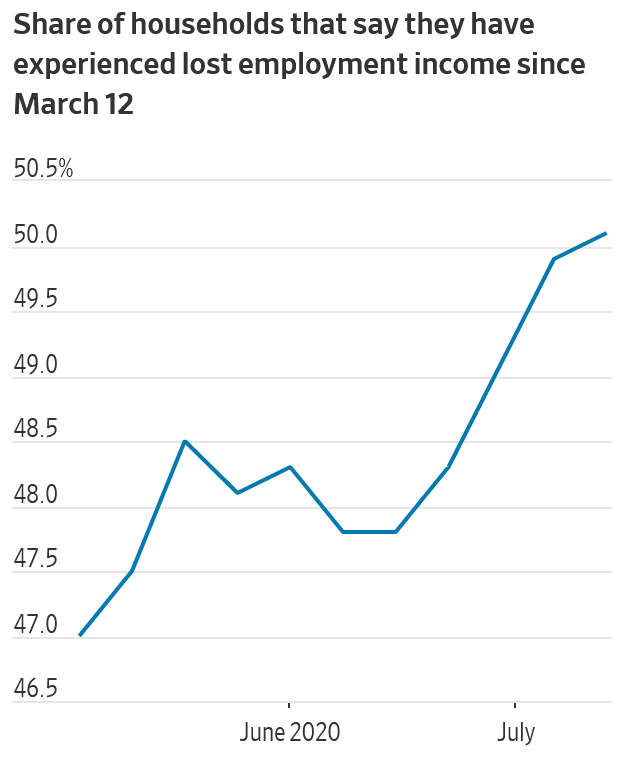
The evidence suggests that any job gains in July will be much more muted than in June, with the potential for the economy to have actually shed jobs. With the unemployment rate at 11.1% – higher than it ever got in the wake of the financial crisis – this spring's stimulus payments largely spent, and the additional $600 a week unemployed workers have been receiving from the Federal government set to expire at the end of this month, many Americans could soon be cast into dire straits.
4) Here's the WSJ again: Small Businesses Brace for Prolonged Crisis, Short on Cash and Customers. Excerpt:
Small businesses such as restaurants, dog-care centers and manufacturers brought back staff beginning in mid-April, believing they could get back to business. Now, many are shutting down or slashing jobs again as local officials and consumers pull back and the pandemic shows no signs of abating.
Beyond merely depressing sales, the crisis has uprooted the ways people work, learn, relax and consume. More than 142,000 people in the U.S. have died, and the continued spread of the virus means people's habits have mostly not reverted – and questions remain over whether or when they ever will.
More government support may help in the short run, but many business owners are facing make-or-break challenges. Many may not last.
Businesses are entering this phase just as many are exhausting their rescue funds from the federal Paycheck Protection Program, a $670 billion coronavirus stimulus measure launched in April to offer loans to small firms.
5) Two sectors are doing especially poorly – retailers and airlines – as these two WSJ articles highlight: Retail Carnage Deepens as Pandemic's Impact Exceeds Forecasts. Excerpt:
The financial pain for U.S. retailers is worsening beyond what retail executives and analysts anticipated when the coronavirus began to spread, foreshadowing an unrelenting pace of store closures and bankruptcies.
With a resurgence of coronavirus cases across much of the country, some companies that were relatively healthy before the pandemic are showing signs of buckling. Bankruptcies in the sector are piling up, with more retailers seeking chapter 11 protection so far in 2020 than in all of last year.
And: Southwest and American Trim More Flying. Excerpt:
American Airlines (AAL) and Southwest Airlines (LUV) said they were tempering expectations for an air-travel recovery, as mounting coronavirus cases have driven down bookings by as much as 80% in some parts of the U.S.
American, which has been flying twice as much as some of its rivals as part of a plan to capture summer demand, said Thursday that it will pare some flying. Southwest, which also maintained more flying this summer than United Airlines (UAL) and Delta Air Lines (DAL) said cancellations are picking up and demand looks weaker heading into fall.
Executives at American said bookings have started to slide and business travel, which usually picks up after Labor Day, shows no signs of resuming. "In short, the crisis continues," Chief Executive Doug Parker said on a call to discuss results for the latest quarter.
The coronavirus pandemic has plunged airlines into their worst crisis in memory after a decade of steady profits. Ebbing demand this summer is the latest sign that the recovery is unlikely to be quick or straightforward. Airline executives have said that travel may not return to last year's levels until a vaccine or an effective treatment is widely available. Tens of thousands of job cuts could happen once federal aid aimed at paying workers runs out at the end of September.
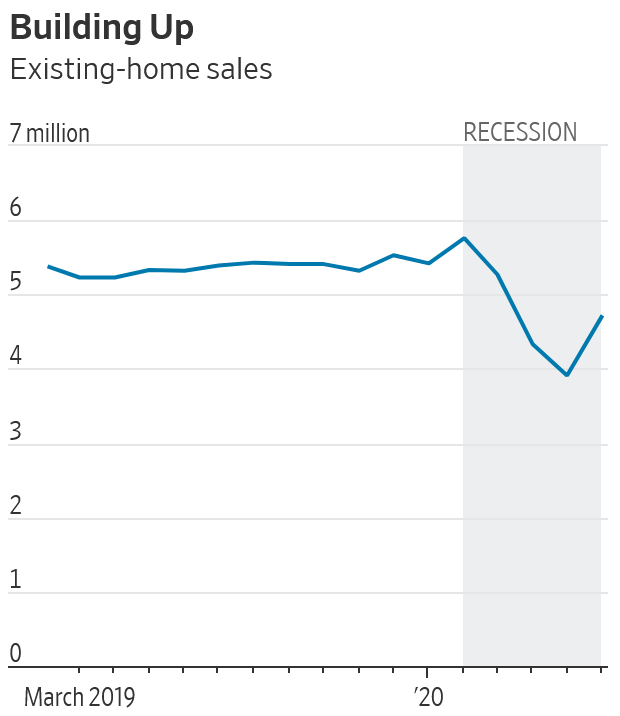
6) There was a glimmer of good news from the housing sector, however: U.S. Existing-Home Sales Rose 20.7% in June. Excerpt:
A sluggish U.S. housing market is staging a recovery amid the pandemic, shaking off high unemployment and a rising number of infections as buyers with pent-up demand seize on record-low mortgage rates.
Sales of previously owned homes rose 20.7% in June over the prior month to a seasonally adjusted annual rate of 4.72 million, according to data from the National Association of Realtors released Wednesday, the biggest monthly increase on record going back to 1968. The surge in existing-home sales follows other recent bullish indicators such as rising new-home sales, robust home-builder activity and a flood of mortgage applications.
Driving sales are apartment renters seeking more space, young families moving to the suburbs, and wealthy city dwellers looking for second homes, brokers and economists say.
7) Overall, it's a grim picture.
I remain cautiously bullish on stocks, however, for two reasons...
First, things are so bad that even this totally dysfunctional Congress is likely to pass another big relief bill, which will buy us time for the second reason to kick in: I think, for reasons I outlined in Tuesday's e-mail, that we may have passed the worst of the spread of the virus.
8) Continuing my series on the five steps to successfully cultivating mentors, here are my thoughts on Step 4: the follow-up.
When you follow up with a prospective mentor after the initial contact, refer to it – they might not remember you, so remind them who you are and thank them for having taken the time to meet/e-mail you earlier (for e-mail, reply to the previous one).
Keep it brief, and quickly make it clear why you're contacting them again. Most potential mentors are super busy, so don't waste their time by hiding the punch line three paragraphs into your e-mail.
Initially, don't ask for anything (other than perhaps a meeting, if you haven't already met) – it's too early for that. Instead, look for a way to add value. (If you can't find a way, then don't contact them at all – bide your time.)
For example, if the person is an investor, see if you can send them differentiated, insightful information about a stock they own (either your own analysis or an article/report they may not have seen). Or, in one page or less, outline a great new stock idea that's likely to be in their sweet spot. Or, it could be something as simple as an article or analyst report that they're likely to be interested in.
It is always better to give than receive – but of course, the whole point of a mentor is that they can help you! But be very careful in asking for anything – even asking a question that they feel obligated to reply to.
Nearly all of the e-mails I've sent to Berkshire Hathaway (BRK-B) CEO Warren Buffett over two decades (roughly one per month) have been articles for which I don't ask for or expect a reply – rather, I'm just a clipping service, trying to be his eyes and ears... and only e-mailing him when I'm confident that I've found something that: a) is interesting and/or valuable; and b) he likely hasn't already seen.
If you ask for something, make sure you think they're very likely to say yes. People love to say yes to small asks, and hate to say no.
Finally, you must always project the confidence that, years from now, they are going to be delighted that they met you.
Here's a great example of a great follow-up e-mail a young guy sent me years ago:
Whitney,
Congratulations on the Value Investing Congress! It was a great learning experience and I enjoyed it all around.
All the invited speakers gave great presentations and the opportunity to meet colleagues and make new friends with whom I share common interests is priceless.
I just wanted to send you a quick thank you note since I can only imagine the time and effort that you must have placed in organizing the event.
I look forward to seeing you at the next VIC in New York!
Best,
Francisco
PS – My investment focus is mainly Mexico and Brazil; I will email you whenever I find interesting investment opportunities in these countries.
Francisco is now a close friend, and I'm going to his upcoming wedding in Mexico...
Best regards,
Whitney