

The Southeast Asia Opportunity; The rise and fall of fund manager Neil Woodford; OxyContin Made the Sacklers Rich. Now It's Tearing Them Apart; How information is like snacks, money, and drugs – to your brain
1) At the 16th Annual Value Investing Seminar in Italy last week, Florian Weidinger of Hansabay, an investment fund based in Singapore, gave a presentation on The Southeast Asia Opportunity, which you can read here.
By southeast Asia, he means the countries highlighted here:
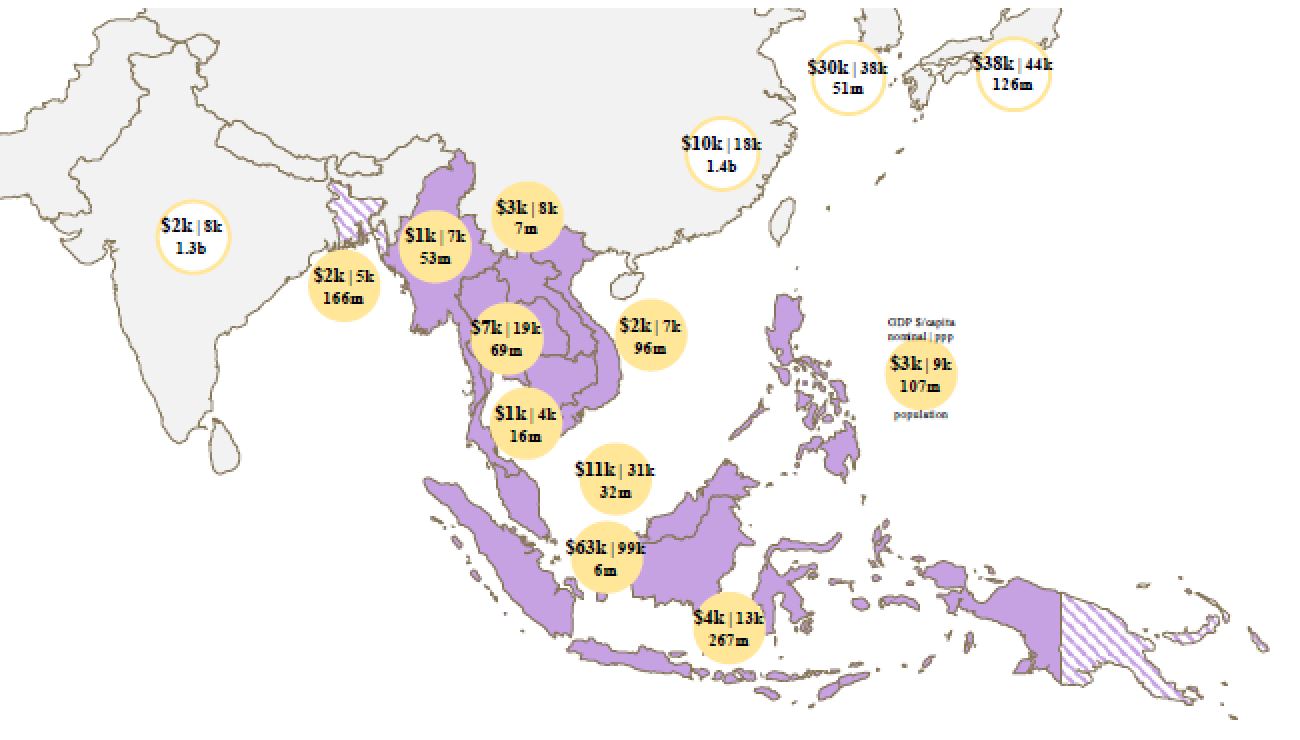
These countries have a total population of 641 million and collectively their economies would rank as the fifth-largest in the world. It's a region experiencing rapid growth and is especially appealing now, Florian argues, because the trade war between the U.S. and China is driving a surge in foreign direct investment.
This is certainly what I'm seeing in my research on Lumber Liquidators (LL). The Chinese flooring manufacturers were already shifting production to southeast Asia due to rapidly rising labor costs in China, but the trade war has massively accelerated this trend...
2) There are a lot of lessons in the rise and fall of British superstar fund manager Neil Woodford, who was once called "the Oracle of Oxford": Bright star to black hole: the rise and fall of fund manager Neil Woodford. Excerpt:
He was, the BBC declared in 2015, "the man who can't stop making money". He was the rock star of pensions and fund management, awarded a CBE for his services to the economy. But now, since Neil Woodford stopped investors from withdrawing their own money from his flagship fund, he is in the spotlight for all the wrong reasons.
His Woodford Equity Income Fund holds the pension savings and investments of tens of thousands of people. But it has been performing so badly that investors were withdrawing money at the rate of £10m a day.
Last week, after 23 consecutive months in which withdrawals from the fund had been greater than the new money coming in, Woodford found he couldn't realise cash quickly enough to meet the withdrawal requests – at least at a decent price. He closed the fund to withdrawals, leaving legions of investors angry and in limbo for 28 days.
In a YouTube video he posted on Wednesday to finally apologise to investors, he looked anything but the archetypal City fund manager, with his close-cropped hair and trademark casual jumper rather than suit and tie. In the video, filmed at his fund's headquarters on an industrial estate near Oxford, Woodford said: "I'm extremely sorry that we've had to take this decision. We understand our investors' frustration. All I can say in response to that is that this decision was motivated by your interests."
Woodford said he had been forced to "gate" the fund because so many big investors were trying to pull money out that he wasn't able to meet the demand. His funds hold unusually big stakes in smaller and early stage unlisted companies, which are hard to sell quickly.
3) I knew Jon Sackler years ago and he was an incredibly nice, philanthropic guy. But I now believe that his and his family's money is blood money. I hope they lose every penny of it: OxyContin Made the Sacklers Rich. Now It's Tearing Them Apart. Excerpt:
The Sackler family, with its competing branches, has long been fractious. The arrival of nearly 2,000 lawsuits accusing its company of helping to spark a public-health crisis in America has forced the family to a crossroads as it weighs the future of a company that helped make its members wealthy.
For years the Sacklers avoided being publicly linked to the opioid crisis and OxyContin, a prescription painkiller containing a morphine derivative called oxycodone. They cultivated an image as global philanthropists, donating millions to New York's Metropolitan Museum of Art, Columbia University and scores of other institutions both in the U.S. and abroad.
The host of lawsuits, some of which name as defendants many individual Sacklers who served on Purdue's board, has unraveled the family's standing in philanthropic, academic and financial circles. Family members have been leaving the boards of nonprofits. Prestigious museums and universities are rejecting their donations. Some investment funds are returning their money.
The backlash has intensified infighting among family members, whose disagreements have threatened efforts to resolve the litigation...
4) This certainly describes me – I am such an information junkie! How information is like snacks, money, and drugs – to your brain. Excerpt:
Can't stop checking your phone, even when you're not expecting any important messages? Blame your brain.
A new study by researchers at UC Berkeley's Haas School of Business has found that information acts on the brain's dopamine-producing reward system in the same way as money or food.
"To the brain, information is its own reward, above and beyond whether it's useful," says Assoc. Prof. Ming Hsu, a neuroeconomist whose research employs functional magnetic imaging (fMRI), psychological theory, economic modeling, and machine learning. "And just as our brains like empty calories from junk food, they can overvalue information that makes us feel good but may not be useful—what some may call idle curiosity."...
People tended to over-value information in general, and particularly in higher-valued lotteries. It appeared that the higher stakes increased people's curiosity in the information, even when the information had no effect on their decisions whether to play.
The researchers determined that this behavior could only be explained by a model that captured both economic and psychological motives for seeking information. People acquired information based not only on its actual benefit, but also on the anticipation of its benefit, whether or not it had use.
Hsu says that's akin to wanting to know whether we received a great job offer, even if we have no intention of taking it.
Best regards,
Whitney