

The Ugliest Part of the Buyback Bonanza; Chewy Finally Looks Appetizing; Enrique Abeyta on Chewy; Summary of the seven reasons why getting rich can increase the odds that your marriage goes bad
1) For more on the critically important and controversial topic of share repurchases (which I discussed in yesterday's e-mail), I highly recommend this essay that my colleague Dan Ferris of Stansberry Research published in the November 25 Stansberry Digest: The Ugliest Part of the Buyback Bonanza. Excerpt:
Some financial topics confound investors no matter how much they're discussed...
Take "stock buybacks," for example.
Also known as share repurchases, it's when a company buys back its own stock in the open market. A buyback reduces the number of outstanding shares available to investors.
Regular Digest readers know buybacks can be great for investors when used appropriately – when a company's shares are trading for cheap and it has enough extra cash to buy them.
Under the right conditions, Berkshire Hathaway CEO Warren Buffett believes they're the best thing a company can do with its cash.
But not everyone feels the same way...
Democratic presidential candidate and Vermont Sen. Bernie Sanders unveiled a plan last week to ban share buybacks altogether. He argued that they constitute stock-price manipulation and "provide absolutely no benefit to the job-creating productive economy."
Recently, I (Dan Ferris) have received several questions and comments about buybacks from Stansberry Investor Hour podcast listeners. (I addressed the topic last week.) And the questions have all generally revolved around a simple one... Are they good or bad?
But the thing is, the answer isn't as simple... Share buybacks can be good, as Buffett believes. But as you'll see in today's Digest, most companies don't use them properly...
Most companies tend to buy back tons of their own stocks near market tops. And they don't do it at market bottoms, when they probably should be buying shares at a discount.
It's a great time to talk about buybacks. We're in never-before-seen territory...
For the first time ever, U.S. share-buyback announcements topped $1 trillion last year...
And we're currently on track for more than $1 trillion in buybacks again this year.
2) I've been very skeptical of the entire unicorn sector, but have been impressed with Chewy (CHWY), so I read this "Heard on the Street" column in today's Wall Street Journal with interest: Chewy Finally Looks Appetizing. Excerpt:
That walk around the block reflects general investor disillusionment with this year's crop of IPOs, as well as nervousness over the share lockup for insiders, which ends Wednesday. But Chewy's growth story remains intact, and a path to profitability is becoming clearer.
Chewy raised guidance slightly for its full fiscal year, which ends on Feb. 1. It now expects sales growth of around 40%, adjusted for the fact that there is one fewer week this fiscal year. That compares with earlier guidance of 38% to 39%. Perhaps most encouraging is the company's margin expansion, which suggests it can scale into profitability as sales keep growing. Gross margins in the third quarter were 23.7%, up from 19.6% a year earlier. The company also raised its full-year guidance for adjusted earnings before interest, taxes, depreciation, and amortization.
3) For more on Chewy, here is what I wrote about it in my November 21 e-mail:
Speaking of great calls, in my e-mail on September 5, I quoted my colleague Enrique Abeyta calling pet food e-commerce company Chewy (CHWY) "the new Pets.com."
In the 11 weeks since then, the stock has crashed more than 30% while the S&P 500 has risen about 5%, as you can see in this chart...
I asked Enrique for his latest thoughts, and he replied...
I've done some more work on Chewy and have to say that it's an impressive story. It makes a lot more sense than some of the other new age Internet companies that have gotten a lot of press like Uber or WeWork.
That said, I'm still not constructive on the stock, which hit a new 52-week low earlier this week and broke its $22 IPO price for the first time.
Chewy seems like an excellent company from a customer service perspective and product proposition... but given that it's still trading north of 2 times revenue, remains unprofitable, and faces ongoing negative market sentiment, I think the stock continues to drift lower.
When the company reports earnings on December 9, it will need to show a better handle on its business after the disappointment of last quarter's report. If not, look out below...
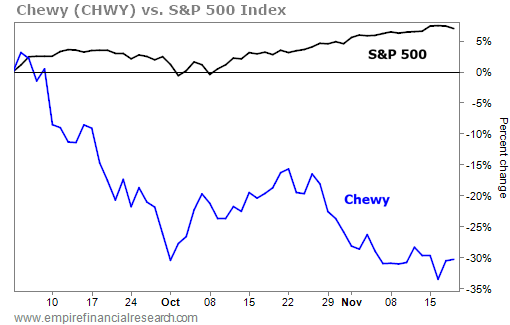
I asked Enrique this morning for his post-earnings thoughts, and here's what he shared:
In my last update, I mentioned that the company would need a strong earnings report to support its valuation. The results earlier this week were indeed solid, with a slight upgrade to very high expectations.
It will be interesting to gauge the current sentiment on the high-valued "unicorns" by looking at how Chewy's stock trades over the next few days. As a reminder, the lockup expires today, with 83% of outstanding shares now free to trade.
As I wrote before, I think this is actually an interesting company – it's more than just an interesting stock, given the valuation and the overall set up.
4) In the past week and a half, I've discussed the seven reasons why getting rich can increase the odds that your marriage goes bad. Here's a summary of all seven (you can read the discussion of each by accessing the e-mail archive):
- Divorce is crazy expensive, so having a lot of money reduces this barrier.
- Making a lot of money generally requires working long hours and, often, a lot of travel.
- Rich people tend to attract those interested in having an affair.
- If one person makes enough money that their spouse can stop working, it can eventually lead to deep unhappiness for the non-working spouse.
- When a couple is hustling to make ends meet, it's a bonding experience.
- Deciding how to spend (or not spend) the newfound wealth can lead to conflict.
- Becoming rich can change people for the worse – they can become arrogant, self-absorbed, and look down on others.
To be clear, lots of people go from having net debt to achieving financial security without having their marriages fall apart. (I'm delighted to say that I'm one of them: my wife and I recently celebrated our 26th anniversary, and our marriage is the best it has ever been!)
So in sharing these warnings, I'm not trying to be a Debbie Downer. Rather, I'm trying to highlight "tail risks" that could wreck your life – and having your marriage go bad is pretty close to the top of the list of things that can do this...
This topic has been in the forefront of my mind recently, as I just finished the first draft of my new book, entitled: All I Want to Know Is Where I'm Going to Die: The Five Calamities That Can Destroy Your Life and How to Avoid Them, which I hope to publish by early next year. "Being in a bad marriage, which typically ends in divorce" is calamity No. 2, trailing only "the death or serious injury of yourself or a loved one."
Best regards,
Whitney