

Two friends hate their new Teslas; Digging Into a $344 Billion Investing Mystery; Last day of skiing at Jackson Hole
1) Because I've been critical of some of Tesla (TSLA) CEO Elon Musk's antics, some of his fanboys (they're all men) have accused me of hating him or being short the stock.
Neither is the case.
In my February 9 e-mail, I replied to a reader who accused me of "Musk bashing," writing:
Have you simply forgotten all the praise I've heaped on him when deserved (e.g., "humanity owes him a debt of gratitude")? That used to be quite often... But then some combination of factors – likely including becoming the richest man in the world and making the disastrous decision to buy Twitter – caused him to totally run amok, so I have been (correctly) calling out his bad behavior.
Rest assured I will continue to do so if he continues to behave like a wicked and spoiled child.
As for the stock, I haven't had any position in it since 2015, when I covered the (ill-advised) short position I had established in the hedge funds I managed and (wisely) warned all my short-seller friends that Tesla was a bad short.
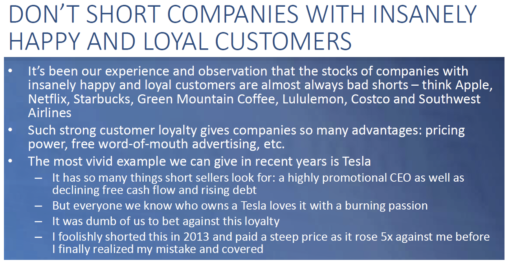
A major reason for this viewpoint is that every person I knew who owned a Tesla loved it. The stocks of companies with such passionate customers are generally bad shorts, as I explained in this slide from my presentation on Lessons from 15 Years of Short Selling:
For nearly a decade, I heard nothing but good things from Tesla owners about their cars until this weekend, when two of my buddies started talking about their terrible experiences with the new Teslas they'd just bought.
One is an auto enthusiast whose Model S was the first electric car he's ever owned.
The other owns a Model X and hated the Model S so much that he sold it, even though he had to take a $40,000 loss.
Both represent Tesla's core demographic: wealthy, environmentally conscious, coastal elites.
I was so shocked by what I heard that I whipped out my phone and quickly jotted down what they were saying:
- They hate the yoke (instead of a steering wheel)
- There are buttons for the horn and wipers – it's all just stupid. And it's dangerous – they need to be able to quickly press the center of the steering wheel to toot the horn in an emergency situation (for more on this, see: Tesla Model S and Model X steering yoke to receive push center for horn update)
- Elon tried to go too far
- The font on the touch screen is so small they can barely read it, and there's no way to make it larger
- The stereo is horrible – poor audio quality and it doesn't get loud enough
- If they fiddle with the stereo when they're backing up, the rear camera disappears from the screen, which is dangerous
- They don't have full self-driving, but the autopilot sucks; it puts them in the middle of the lane and doesn't adjust when truck encroaches on their lane; the autopilot in their Toyota RAV4 is much better
- One's son, a college student, is an avid car lover and hates his Tesla, saying, "The software sucks"
- Service has been a total nightmare; they're not responsive on e-mail, phone, or text; it was so bad that one time they drove out to its service center in Brooklyn
- A friend needed his bumper replaced recently and it took four months to get one
- After they got rid of their Tesla, they replaced it with the BMW i7, which they love
I don't want to read too much into two data points – but I wouldn't ignore them, either. From 2013 to 2015, when I was short the stock, I ignored data points that were contrary to my investment thesis (about how much Tesla owners loved their cars) and paid a steep price as the stock ripped upward 6x.
So if I owned TSLA stock, which is up 50% this year, I'd be looking closely at the latest customer satisfaction levels...
2) Kudos to Jason Zweig of the Wall Street Journal for exposing yet another investing scam. I'd never even heard of "Reg D" securities! Digging Into a $344 Billion Investing Mystery. Excerpt:
For the cost of notarizing a single document – probably $10 or less – you can declare yourself one of the biggest financiers in history.
That's about all it takes to file private investment offerings at the Securities and Exchange Commission under what's called Regulation D. Judging by Form D filings purportedly made by a man named Stephon Patton, the SEC won't stop you.
Alternative investments – assets such as stocks and funds that don't regularly trade in public markets – are one of the biggest fads on Wall Street. Investors being pitched on them should take note: The market for Reg D investments isn't the Wild West, where some rules don't apply. It's closer to anarchy, where rules barely exist and disclosures can be utterly untrustworthy, as I pointed out in a column earlier this year.
It's illegal to make false statements on an SEC filing. Unlike disclosures for public companies, Reg D disclosures, known as Form D's, contain only the most basic information, such as the company's address, the size of the deal, the number of investors and a few other items. The SEC doesn't regularly review Form Ds, as it does prospectuses for public companies. So it's buyer beware.
"As investors, we need to understand that when someone files a Form D, the government isn't endorsing it," says Christine Chung, a securities-law professor at Albany Law School.
Nor does the government check if the disclosures are absurd, as appears to be the case with Mr. Patton's filings.
Since February 2020, according to these disclosures, four companies ostensibly controlled by him have raised at least $344 billion combined. That is preposterous: It would make him one of the greatest financial titans in American history.
3) I'm flying home today from Jackson Hole, Wyoming, where I skied the past five days with seven buddies.
The mountain had nearly 50 feet of snowfall this year, making it one of the best years on record, and the conditions are still excellent, but the resort nevertheless had to close because it's in a national forest.
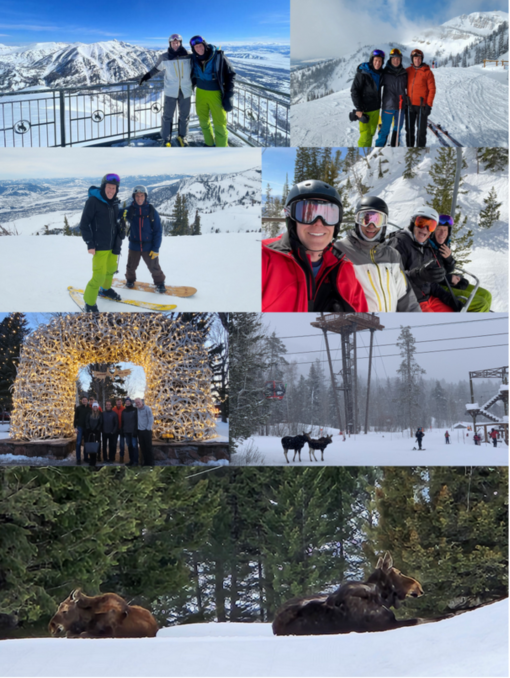
Below are some pictures and I've posted two videos of me tree skiing and seeing two moose on the trail here and here:
Best regards,
Whitney
P.S. I welcome your feedback at WTDfeedback@empirefinancialresearch.com.