

Virgin Galactic to launch Richard Branson into space; Record Stock Sales From Money-Losing Firms Ring the Alarm Bells; More evidence for the mother of all economic booms; Meet the First Woman Officially Drafted by the NBA
1) My colleague Enrique Abeyta and I nailed it when we recommended shares of space-tourism company Virgin Galactic (SPCE) to Empire Investment Report subscribers in December 2019 at $10.20 per share.
Our sell recommendations were spot on as well, as we told our subscribers to sell their last shares at $50 on the day the "meme stock" bubble peaked on January 27.
The stock has traded below that level ever since, falling to $15 in mid-May before turning around and closing at $43.19 yesterday... But it's ripping higher today thanks to this news: Virgin Galactic to launch Richard Branson on July 11, aiming to beat Jeff Bezos to space. Excerpt:
- Virgin Galactic announced on Thursday that the space tourism company will attempt to launch its next test spaceflight on July 11, carrying founder Sir Richard Branson.
- Branson is aiming to beat fellow billionaire Jeff Bezos to space, as the latter plans to launch with his own company Blue Origin on July 20.
- This will be Virgin Galactic's fourth test spaceflight to date and its first mission with a crew of four on board, as the company launched its most recent spaceflight, on May 22, with just two pilots.
This is good news – but is it really worth $2 billion to $3 billion in additional market cap this morning? I think not...
If you're going to invest in highly volatile, speculative stocks like Virgin Galactic, you need to be smart, patient, and disciplined enough to buy them either: a) before they've been discovered and become a darling of the Reddit crowd... or b) after they've soared and crashed, such that you can get in before a possible second bounce.
But don't chase them on days like today...
P.S. The average return of all of our Empire Investment Report stock picks since inception in April 2019 is 51%, more than double the 25% return for the S&P 500 Index.
To learn more about Empire Investment Report – including how to get 40% off the regular price for the first year – click here.
2) More signs of foolishness in the markets: Record Stock Sales From Money-Losing Firms Ring the Alarm Bells. Excerpt:
If you think a rush by companies to sell their shares is a bad omen for the market, imagine a scenario where most of the sales come from firms that don't make money.
It's happening now. Since the end of March, almost 100 unprofitable U.S. companies, including GameStop (GME) and AMC Entertainment (AMC), have raised money through secondary offerings, twice as many as coming from profitable firms, according to data compiled by Bloomberg.
Granted, troubled companies are tapping into buoyant demand during a 16-month rally to beef up their balance sheets. And it's further evidence that the capital market functions as smoothly as it's supposed to. Yet some warn that the flood of shares coming from money losers is becoming extreme.
During the past 12 months, almost 750 money-losing firms have sold shares in the secondary market, exceeding those that make profits by the biggest margin since at least 1982, data compiled by Sundial Capital Research show.
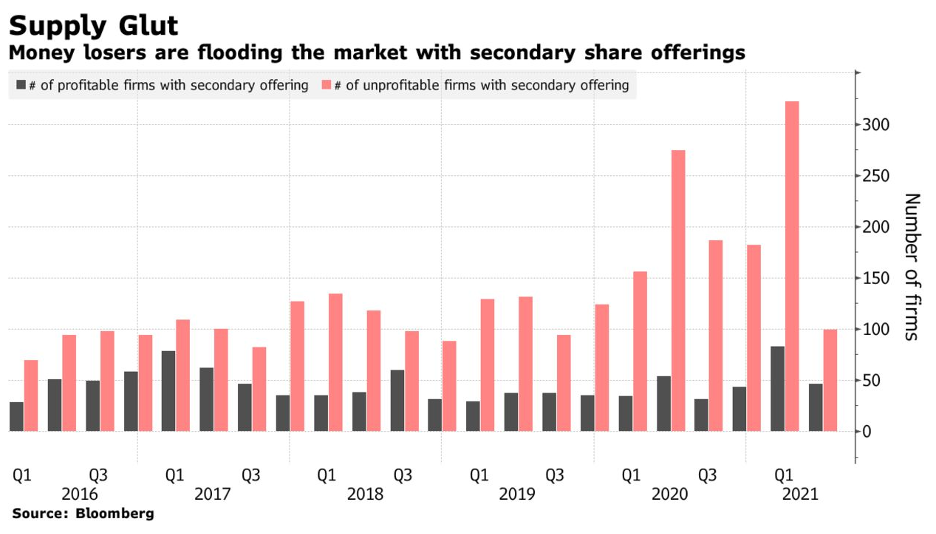
To be clear, these money-losing companies are very smart to issue a lot of stock at high prices – it's the investors who are going to get burned...
3) Despite the overall high (though not extreme) valuations in the markets and pockets of rampant speculation, I don't think we're at a top yet... because the massive fiscal and monetary stimulus is leading to the mother of all economic booms. This morning's better-than-expected jobs report is the latest evidence for it: June jobs report shows a gain of 850,000, better than expected. Excerpt:
Hiring leapt back up in June as employers added 850,000 workers, the government reported Friday, a fresh sign that the labor market's recovery is gaining momentum.
The unemployment rate rose slightly, to 5.9%, the Labor Department said.
The report follows several promising economic developments this week. Consumer confidence, which surged in June, is at its highest point since the pandemic's onset last year. Stocks closed out the first half of the year at record highs, and businesses' plans for capital investments are rising. The Congressional Budget Office said Thursday that the economy was on track to recover all the jobs lost in the pandemic by the middle of next year.
Here's an article about the report the Congressional Budget Office ("CBO") released yesterday: Budget Deficit Projected to Hit $3 Trillion as Pandemic Spending Buoys Economy. Excerpt:
The U.S. economy is rebounding from the pandemic downturn faster than expected and is on track to regain all the jobs lost during the coronavirus by the middle of next year, partly as a result of enormous amounts of federal spending that will push the budget deficit to $3 trillion for the 2021 fiscal year, the Congressional Budget Office said on Thursday.
New forecasts that incorporate the $1.9 trillion stimulus package that President Biden signed into law in March give little credence to warnings by Republican lawmakers and some economists that runaway inflation from all that spending could cripple the economy. Instead, the budget office predicted that a recent spike in prices for cars, airline tickets and other products would be temporary and begin to recede this year.
Administration officials downplayed the deficit projections and focused instead on the predictions for economic growth, saying the strong numbers validate Mr. Biden's push to douse the economy in stimulus and reinforce their view that inflation poses little threat to the recovery.
The budget office, which is nonpartisan, predicted the economy would grow 6.7% for the year, after adjusting for inflation. That would be the fastest annual growth in the United States since 1984. It is significantly faster than the budget office and the Biden administration had each projected this year.
The unemployment rate is also estimated to fall below 4% next year and remain historically low for years to come, signaling a significant acceleration in job gains from what the office predicted in February. The CBO said then that unemployment would not fall below 4% until 2026.
4) I've never been great at basketball – I like to say, "I'm 6 feet, but I play like I'm 5' 6" – but I've been an avid player most of my life, playing two to three times a week (pre-pandemic anyway) at the oldest pickup game in New York City at the 92nd Street Y.
I've also been a big NBA fan ever since I moved to Massachusetts in 1979, right when Larry Bird joined the Boston Celtics and turned around the franchise, leading the team to three championships. When my parents made me go to bed before a game was over, I'd curl up under the covers and listen on my little transistor radio to legendary announcer Johnny Most calling the game (listen to him here, blasting the Detroit Pistons – what a hoot!).
If you're a fan as well and have 22 minutes to spare, watch this video of the greatest basketball player you've never heard of... What a delightful person and story! Meet the First Woman Officially Drafted by the NBA. Excerpt:
Lusia Harris led her team to three national championships, scored the first basket in women's Olympic history and was an official draft pick in 1977.
As a child growing up in rural Mississippi, Lusia "Lucy" Harris often stayed up past her bedtime watching her favorite NBA players, dreaming of one day playing on the same courts. Reaching 6 feet 3 inches by the time she was in high school, Harris was often called "long and tall and that's all" by her classmates – but she knew her height would be an asset on the court. And she wasn't just tall enough to play the game. She was a rare talent who would go on to be a three-time national college champion and an Olympic silver medalist, making her a national sensation by the time she finished her college career.
For an electrifying young basketball player on the national stage, success often comes with a lucrative professional contract and brand deals – but Harris's moment came in the 1970s, decades before the WNBA was founded, when few opportunities were available to female athletes interested in pursuing a professional career. In the short documentary above, Harris tells the story of what happens when an unstoppable talent runs out of games to win.
Best regards,
Whitney
P.S. The Empire Financial Research offices are closed on Monday in observance of Independence Day, so look for the next edition of my daily e-mail on Tuesday, July 6.