

We're No. 1 in COVID Resilience Ranking; Chinese Regulators Suggested Didi Delay Its U.S. IPO; Robinhood and iAddiction; Robinhood's Investors Have Fun; Dancing robots
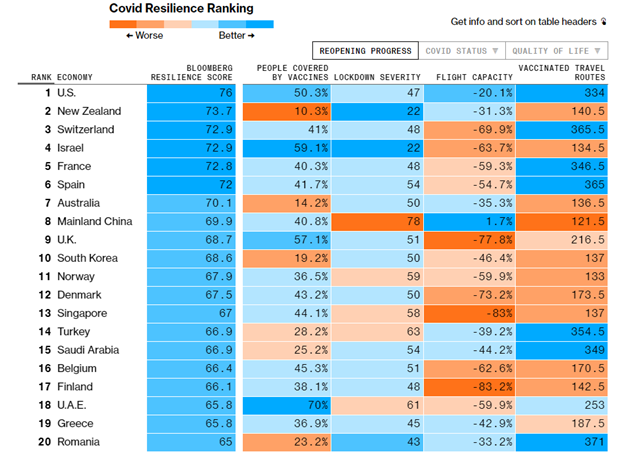
1) Given where we were during the first year of the pandemic, our turnaround is nothing short of astonishing! According to Bloomberg's "COVID Resilience Ranking," the U.S. is now ranked first in the world. Excerpt:
Almost a year and a half into the pandemic, the best and worst places to be in the COVID-19 era are increasingly defined by one thing: normalization.
The biggest vaccination drive in history is enabling parts of the globe to abolish mask mandates, relax restrictions and dismantle border curbs, making the magnitude of reopening key to quality of life. Taming cases and deaths was once paramount, along with ensuring a robust health-care system. Now, the ability to essentially turn back the clock and return to pre-pandemic times is taking on an even greater significance.
Central to that is an economy's openness to the world, and that's why we've introduced a new element – Reopening Progress – to Bloomberg's COVID Resilience Ranking. Two new metrics capture the ease of moving in and out of a place and how much air travel has recovered, alongside our 10 other measures tracking mortality rates to infection counts, freedom of movement to economic growth.
This pivot has ushered in dramatic changes to the ranks. The U.S. is now No. 1, with its fast and expansive vaccine rollout, dominated by the highly effective Messenger RNA shots, stemming what was once the world's worst outbreak.
2) In Thursday's e-mail, I linked to a recent interview CNBC did with Berkshire Hathaway's (BRK-B) Warren Buffett and Charlie Munger, and highlighted that Munger:
... expressed admiration for how China's regulators cracked down on billionaire Jack Ma and fintech giant Ant Group, and said he wished U.S. regulators would "step in preemptively to stop speculation... I don't want all of the Chinese system, but I certainly would like to have the financial part of it in my own country."
Munger would no doubt approve of this latest development: Chinese Regulators Suggested Didi Delay Its U.S. IPO. Excerpt:
Weeks before Didi Global (DIDI) went public in the U.S., China's cybersecurity watchdog suggested the Chinese ride-hailing giant delay its initial public offering and urged it to conduct a thorough self-examination of its network security, according to people with knowledge of the matter...
On Friday, it started its own cybersecurity review into Didi and blocked the company's app from accepting new users; and on Sunday, it ordered mobile app stores to pull Didi from circulation.
The sudden regulatory actions, which surprised investors in coming just days after the company's IPO, suggested that protecting national security trumps Beijing's ambitions for China Inc. to go global. One upshot: Beijing is unlikely to hold fire even if its regulatory moves risk the ability of Chinese firms to court international investors.
I agree with Munger: U.S. politicians and regulators need to take a page out of China's book and crack down on the seemingly endless abuses of power by tech giants.
That said, China has done nothing to rein in the countless frauds and promotions its foisted on U.S. investors. Didi doesn't appear to be one of them, but the collapse of its shares today highlights how reckless and irresponsible it was to proceed with its IPO last week despite knowing about Chinese regulators' concerns. This further underscores why I've long maintained that Chinese firms should be banned from U.S. exchanges until they behave more responsibly toward investors and are subject to the same regulations and auditing requirements as U.S. firms.
3) I also agree with Munger's slam of trading app Robinhood – he said it was "beneath contempt" – a view that NYU marketing professor Scott Galloway also shared in his latest blog post: Robinhood and iAddiction. What a truly brilliant sentence: "The company's mission to 'democratize finance for all,' is similar to Pablo Escobar saying his mission was to 'democratize cocaine.'" Excerpt:
There are a lot of great things about Robinhood and online trading, including onboarding an entire generation into equity investing. (Disclosure: I am an investor in rival investment firm Public, which does not sell order flow, but I was on record with my criticisms of Robinhood before I'd even heard of Public.) My concern with Robinhood – i.e., I believe these guys are mendacious f***s – is more fundamental. The company's mission to "democratize finance for all," is similar to Pablo Escobar saying his mission was to "democratize cocaine."
Providing people access to the tools of finance is a worthwhile mission. Just this week on the Prof G Pod, I interviewed Pierpaolo Barbieri, the CEO and founder of Ualá, an Argentine attempting to reach the 50%+ of Argentines who are unbanked.
Robinhood, on the other hand, is the Sith Lord of finance – monetizing the addictive nature of day trading. Day trading is gambling. And it doesn't pay off. I wrote about this a year ago, when a 20-year-old Robinhood customer killed himself after the app mistakenly suggested he was down $730,000. We're reprinting that post below because this leopard has not changed its spots, only becoming bigger, bolder, and more menacing.
In response to criticism, Robinhood removed the confetti animation "celebrating" each trade. And it claimed it was increasing educational support on the app and instituting more rigorous criteria for eligibility for options trading. The company now has 2,700 customer support staff, triple the number it had in March of 2020 ... underwhelming, as the company has roughly the same number of reps per account it did last March. The Wall Street Journal didn't mince words in a recent analysis: "Robinhood Has a Customer Service Problem."
Our analysis of the S-1 reveals that "addict" does not appear anywhere. The filing does mention the suicide, but only as a disclosure of litigation filed against the company. (Robinhood reached a settlement with the young man's family.) "Protect" is used 37 times, compared to 87 times for consumer lender Affirm (AFRM) and 65 times for crypto exchange Coinbase (COIN). The phrase "compound interest" appears exactly zero times, while "trade" shows up 191 times. And then there are all those fines and investigations. "Fine" appears 47 times in Robinhood's S-1, vs. 28 in Coinbase's and 30 in Affirm's.
Robinhood traders invest overwhelmingly in highly speculative assets: Dogecoin accounted for 34% of Robinhood's cryptocurrency transaction-based revenue in Q1 2021, and 6% of the trading firm's overall revenue in the same period. Dogecoin shed 30% of its value when "dogefather" Elon Musk took the SNL [Saturday Night Live] stage. Trades in the private market(s) reflect a valuation of $55 billion. That feels right. Pablo Escobar was believed to have amassed wealth of $64 billion.
4) Bloomberg's Matt Levine also had some interesting comments on what Robinhood revealed in its S-1 filing: Robinhood's Investors Have Fun. Excerpt:
It is tempting to joke that Robinhood is a dogecoin brokerage, but it isn't. Economically, Robinhood is an options brokerage. Robinhood's main business is convincing people to trade options, and then having options market makers pay to take the other side of those trades. In the first quarter, $197.9 million of Robinhood's revenue came from payment for options order flow, representing 38% of its total revenue; stocks and crypto were 26% and 17% respectively.
At the end of the quarter, Robinhood customers owned $65 billion of stocks, $11.6 billion of cryptocurrency, and $2 billion of options. You can divide. Robinhood extracted about 0.2% of the value of its customers' stock portfolios for itself, as trading revenues, in the first quarter of 2021. That is, you know, higher than Vanguard charges (remember, that 0.2% is for one quarter), but Robinhood's customers are having a lot more fun, fine. Again, Robinhood is a bet that people want to pay up (sort of) for fun investing. Robinhood extracted about 1.2% of the value of its customers' crypto portfolios for itself, from trading revenues, that quarter. That doesn't seem wildly out of line for crypto.
Robinhood extracted 9.5% of the value of its customers' options portfolio for itself in the first quarter, $197.9 million of revenue on $2 billion of assets. That's a lot! That's some combination of (1) people may not own a ton of options, but they trade them a lot; you get more volume from options traders than you do from boring stock investors, and (2) spreads are high and it is lucrative to trade against retail options traders, so market makers are delighted to pay Robinhood large amounts of money for the privilege. On average, if you have $1,000 worth of options in your Robinhood account, and you're an average Robinhood options trader, by the end of the year Robinhood will have made... $380?... on your options trades? Presumably that money comes from somewhere.
But presumably it also buys something. If your model is that Robinhood is the brokerage of fun investing, then options offer even more fun than stocks, so it makes sense that they're Robinhood's most lucrative business. (With dogecoin, also fun, coming up fast.) Incidentally that is not quite the model that Robinhood pitches. From the customer-and-shareholder letter at the front of the S-1:
We're proud to serve this next generation of investors, and it's painful to see them lambasted in the news reports. Anecdotes of people winning (and losing) large amounts of money garner more attention than the more pedestrian truths – the majority of our customers prefer to buy and hold.
Fine sure yes most customers buy and hold, but most of the money comes from customers YOLOing options.
5) Robotics company Boston Dynamics, whose three-minute video of its robots dancing to the classic song "Do You Love Me?" went viral at the end of last year, with more than 32 million views to date, is out with another fun one-minute video: Spot's On It. Trust me, it will put both a smile and a look of amazement on your face!
Best regards,
Whitney