

When do you average down?; China Plans New Spending Drive, Other Stimulus to Revive Flagging Economy; Ukraine counteroffensive; Howard Buffett is back in Ukraine; Ukrainian children's art exhibition next week
1) John Hempton of Bronte Capital posted an insightful article on his blog back in 2017 that I just discovered, asking – and answering – one of the trickiest questions in investing: When do you average down? Excerpt:
Warren Buffett is famously fond of "averaging down". If you liked it at $10 you should love it at $6. If it goes down "just buy more". And in the value investing canon you will not find that much objection to that view.
But averaging down has been the destroyer of many a value investor. Indeed averaging down is the iconic way in which value investors destroy themselves (and their clients).
After all if you loved something at $40 and you were wrong, you might love it more at $25 and you almost as likely to be wrong, and like it more still at $12 and could equally be wrong.
And before you know it you have doubled down three times, turning a 7% position into a 18% loss.
Do that on a few stocks and you can be down 50%. And in a bad market that 50% can be 80%.
After warning about the perils of averaging down, Hempton outlines some criteria for when investors should – and shouldn't – do it:
At a very big picture: averaging down when you are right is very sweet, averaging down when you are wrong is a disaster.
At the first pick the question then is "when are you wrong?", but this is a silly question. If you knew you were wrong you would never have bought the position in the first place.
So the question becomes is not "are you wrong". That is not going to add anything analytically.
Instead the question is "under what circumstances are you wrong" and "how would you tell"?
--
When you put it that way it becomes obvious that you must not average down (much) on highly levered business models. And looking at Buffett he is very good at that. He bought half a billion dollars worth of Irish Banks as they collapsed. They went approximately to zero. But he did not double down. He liked them down 90%, he did not like them more down 95%.
By contrast these are the stocks that Bill Miller blew up on: American International Group, Wachovia, Washington Mutual, Freddie Mac, Countrywide Financial and Citigroup. They were all levered business models.
By contrast you can probably safely average down on Coca Cola: indeed Buffett did...
There is another iconic way that value investors lose money - and that is technical obsolescence. Kodak was made obsolescent and was a value stock all the way down to bankruptcy. The circumstances on which you might be wrong (digital photography going to 95% of the market) could have been stated pretty clearly in 1999...
The iconic bad situation to average down is a levered business model involving fraud. It is surprisingly common because people who run highly levered business models have very strong incentives to lie or to cover it up when things turn to custard. I can think of two recent examples: Valeant and Sun Edison.
Much to my shame I added to my (small) position in Sun Edison as it fell. Ugh. But also this was a highly levered business model and thus by definition the sort of place where losers average losers. I should not have done it - and I won't in future.
2) I follow China closely because I think it's a fascinating country and because what happens in the world's most populous country and second-largest economy affects our economy and markets.
So it's big news that China's economy is slowing, as this article on the front page of today's Wall Street Journal notes: China Plans New Spending Drive, Other Stimulus to Revive Flagging Economy. Excerpt:
Beijing is planning major steps to revive the country's flagging economy, including the possibility of billions of dollars in new infrastructure spending, and looser rules to encourage property investors to buy more homes, people familiar with the discussions say.
The push follows a series of interest rate cuts by China's central bank this week, including one on Thursday that cut a key policy rate for the first time since August, as fresh data showed the country's economic recovery is flickering out.
The moves are a sign that Beijing officials are increasingly uneasy about the economy's prospects now that a wave of excitement following the country's abandonment of its draconian Covid-19 controls has receded.
Slowing growth adds to a list of challenges for Beijing that also includes icy relations with the U.S. and moves by Washington and its allies to throttle China's access to advanced computer chips on the grounds of national security. Multinational manufacturers are rethinking China's role in their supply chains in response to concerns over future trade disruptions from frictions with the West.
But many economists remain skeptical that the latest measures will be enough to reverse weakening confidence and prevent a further slowdown. The moves also signal that officials are still wedded to old ways of juicing growth by using borrowing to fire up investment, rather than taking more difficult steps to boost household incomes and consumption, some economists say.
After posting solid 4.5% growth in the first quarter, China is wrestling with numerous economic challenges, including cooling exports, a continuing property downturn and stubbornly high youth unemployment. More stimulus might not help, some economists warn, because businesses and consumers are unwilling to take on more debt.
"It's hard to be positive about China's economy at the moment," said Katrina Ell, senior China economist at Moody's Analytics.
Here are other related articles that I sent this morning to my China e-mail list (if you'd like to be added to it – roughly one e-mail per week – simply send a blank email to: china-subscribe@mailer.kasecapital.com):
- Heard on the Street in today's WSJ: Beijing Must Act to Avoid an 'L-Shaped' Future
- Front page of today's New York Times: As Ties to China Turn Toxic, Even Chinese Companies Are Breaking Them
- Another article in today's NYT: As Blinken Heads to China, a Wall of Suspicion Awaits Him
- Other recent articles in the WSJ:
- And two articles from earlier this month in the NYT:
3) Ukraine's counteroffensive began to ramp up earlier this month and is progressing exactly as I predicted in my April 18 e-mail:
I expect at least a month of brutal, bloody fighting, with only small territorial gains, which will reinforce the views of those who believe this will be a long, drawn-out conflict, possibly ending in a stalemate.
These articles in the WSJ ('Mines Everywhere': Ukraine's Offensive Is Proving a Hard Slog) and the NYT (Retaking Villages Leaves Ukrainian Troops Exposed and Diving for Cover) capture the pessimistic consensus view.
That said, my view hasn't changed. As I wrote:
But I believe that Ukrainian forces will not stop, no matter how high their losses, because the idea of having Russian forces on their soil another year is intolerable. As such, their continued attacks on depleted and demoralized Russian forces will result in a breakthrough and a chaotic Russian retreat to the border.
By mid-to-late summer, having expelled Russian forces from eastern Ukraine, Ukrainian forces will likely be on the border of Crimea.
At that point, I expect them to pause and there will be a peace deal that ends the war...
4) Speaking of Ukraine, in my January 18 e-mail, I wrote:
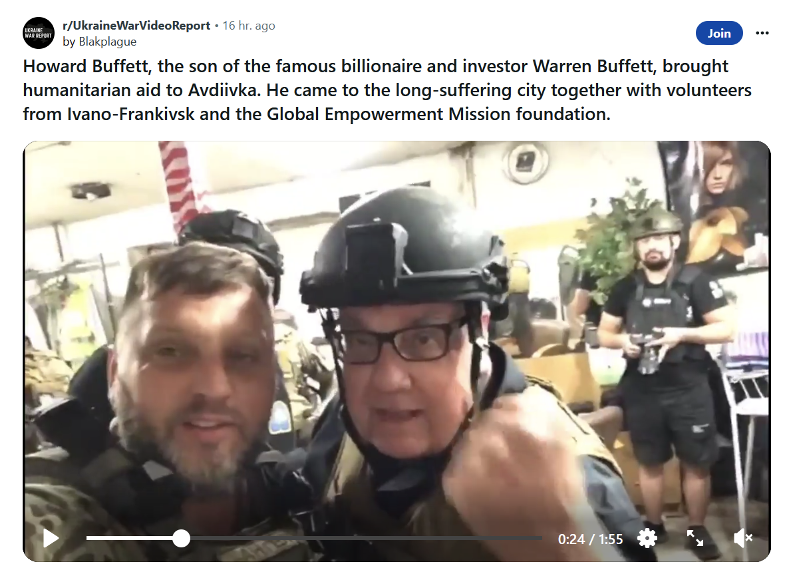
Three cheers for Howard Buffett, son of my hero, Warren Buffett, who's been to Ukraine four times since the war started and is supporting their fight in a big way with his $529 million foundation.
He met Zelensky in June (Ukraine's Zelenskiy meets philanthropist Howard Buffett, discusses rebuilding), bought $30 million of electric generators a month ago (Howard Buffett Foundation to supply Ukraine with heavy-duty generators), and wrote this beautiful opinion piece for CNN: From the U.S. to Ukraine, farmer solidarity is universal.
Buffett's commitment to Ukraine hasn't wavered and he's back there now, near the front lines (note his body armor and helmet), as you can see in this two-minute video:
5) My commitment to Ukraine hasn't wavered, either...
With the counteroffensive underway and retreating Russian forces engaging in scorched-Earth tactics like blowing dams, I've been hearing increasingly urgent appeals for help from my many Ukrainian friends, both soldiers on the front lines and those providing much-needed humanitarian aid: ambulances and medical care for the wounded, food and shelter for refugees, etc.
So I'm back with my beggar's cup in hand, asking my friends and readers to make a donation to help Ukraine – you can do so here.
My goal is to quickly raise another $250,000 (I'm already at $110,000) and send it to the following charities, which I visited during my six-day trip to Ukraine in March (see photos below):
- The refugee center in Kryvyi Rih, which provides food, shelter, clothing and medicine to families displaced by the war. (An apartment building in the city was struck by a Russian missile earlier this week, killing 12 and injuring 28 – see: Russia Targets Central Ukraine in Deadly Aerial Attack.)
- Small generators my friend Amed Khan is providing to villages liberated by Ukrainian forces and/or ravaged by the flood (see video here).
- Medical supplies for two hospitals in Kryvyi Rih and Dnipro.
- Operating funds for MOAS, which transports wounded soldiers using 33 ambulances, 12 of which my friends and I purchased earlier this year (with 15 more donated by Bill Ackman on the way). MOAS needs to pay the drivers, medics, and doctors who staff each ambulance.
- My U.S. 501(c)(3) charity partner, TAPS, which supports the families of fallen Ukrainian soldiers out of their office in Dnipro.

As part of my fundraising campaign, I've organized an exhibition and auction of 92 stunning pieces of art created by children at the Visual Art Center in Kryvyi Rih. Schools in Ukraine have been closed since Russia invaded more than 15 months ago, and the Visual Art Center has been a lifeline for children in the city.
I didn't have high expectations when I visited the Center in March, but I was blown away by the power and beauty of the art! Here's a picture of some of what I saw and here's a four-minute video about the Center:

On the spot I made a $10,000 cash donation to support and expand the Center and asked them to fill one of my large suitcases with all 92 pieces of art on the walls. I promised to bring them back to the United States and auction them off to raise additional money for the Center as well as other wonderful charities.
The artwork will be on display at Franklin Parrasch Gallery (19 East 66th Street) next Tuesday, Wednesday and Thursday, June 20-22, from 11 a.m. to 6 p.m. daily. Franklin is a close friend and is generously donating his space for this exhibition.
We will host a cocktail reception at the close of the exhibition on Thursday, June 22 from 6-8 p.m., which I hope you will be able to attend. I'd like to pack the gallery, so please feel free to share this invitation with anyone you think might be interested in attending. To RSVP, go to this page, and click the "Donate & Tickets" button (there is no charge, but we'd like to know how many people are coming).
If you can't make it to the gallery next week, you can see the 92 artworks and bid on them here. The minimum bid is only $100.
The auction will end at 8 p.m. on June 22. If you don't want to wait until then, or fall in love with a particular piece, or simply want to make a fixed donation, I've established "Buy It Now" prices of $500 for each of the 34 prints, $1,000 for the 50 drawings, and $2,500 for the eight largest ones.
I hope to see you next Thursday!
Best regards,
Whitney
P.S. I welcome your feedback at WTDfeedback@empirefinancialresearch.com.
P.P.S. Empire Financial Research and the market are closed on Monday for Juneteenth. Look for the next Whitney Tilson's Daily e-mail on Tuesday, June 20, after the Weekly Recap.