

Will China benefit from the Ukraine war?; Possible Outcomes of the Russo-Ukrainian War and China's Choice; Surge of Omicron Infections Prompts Lockdowns in China; China's COVID Lockdowns Set to Further Disrupt Global Supply Chains
Though I view investing in China as outside of my circle of competence, I follow the country closely, both because I find it fascinating and because what happens there is relevant to what's going on in the markets across the globe.
If you'd like to join my China-focused e-mail list, simply send a blank e-mail to china-subscribe@mailer.kasecapital.com.
Here is what I sent to that list recently...
1) China is delusional in thinking that it will benefit from Russia's invasion of Ukraine, per this New York Times article: China Sees at Least One Winner Emerging From Ukraine War: China. Excerpt:
The war in Ukraine is far from over, but a consensus is forming in Chinese policy circles that one country stands to emerge victorious from the turmoil: China.
After a confused initial response to Russia's invasion, China has laid the building blocks of a strategy to shield itself from the worst economic and diplomatic consequences it could face, and to benefit from geopolitical shifts once the smoke clears.
China's leader, Xi Jinping, has avoided criticizing President Vladimir V. Putin of Russia, but he has also tried to distance China from the carnage. His government has denounced the international sanctions imposed on Russia but, so far at least, has hinted that Chinese companies may comply with them, to protect China's economic interests in the West.
Mr. Xi reached out to European leaders last week with vague offers of assistance in negotiating a settlement, even as other Chinese officials amplified Russian disinformation campaigns meant to discredit the United States and NATO.
On Monday, President Biden's national security adviser, Jake Sullivan, met with a top Chinese official in Rome, and warned that the United States had "deep concerns" about Beijing's growing alignment with Russia.
In the end, China's leadership has calculated that it must try to rise above what it considers a struggle between two tired powers and be seen as a pillar of stability in an increasingly turbulent world.
"This means that as long as we don't commit terminal strategic blunders, China's modernization will not be cut short, and on the contrary, China will have even greater ability and will to play a more important role in building a new international order," Zheng Yongnian, a professor at the Chinese University of Hong Kong, Shenzhen, who has advised senior officials, wrote after the invasion in a widely circulated article.
At the heart of China's strategy lies a conviction that the United States is weakened from reckless foreign adventures, including, from Beijing's perspective, goading Mr. Putin into the Ukraine conflict.
In this view, which in recent days has been echoed in public statements and quasi-official analyses, Russia's invasion has dragged American power and attention toward Europe, making it likely that President Biden, like his recent predecessors, will try but fail to put more focus on China and the broader Asia-Pacific region.
My point of view is exactly the opposite: While China thinks it's cleverly playing both sides, in reality, everyone recognizes that the country has closely tied itself to the most toxic person on Earth right now.
Also, China in recent decades has been a huge beneficiary, both economically and militarily, of a weak, fractured West... which did nothing to stop China from stealing trade secrets, decimating their manufacturing bases, bullying Hong Kong and violating the agreement to allow the region to remain autonomous, refusing to cooperate in every way regarding the pandemic which has killed 1 million Americans and nearly 20 million people worldwide, building a military base in the Spratly Islands, being increasingly aggressive toward Taiwan, etc.
The days of a weak, fractured West have just come to a screeching halt.
Who in their right mind thinks that the world uniting to an extraordinary degree against an authoritarian bully in Europe is good news for an authoritarian bully in Asia?
Rather than being distracted in Europe, nearly every country now has the resolve and public support to work together to stand up not only to Putin but also to other dangerous strongmen... like Xi...
2) I think this analysis is more likely to be correct:

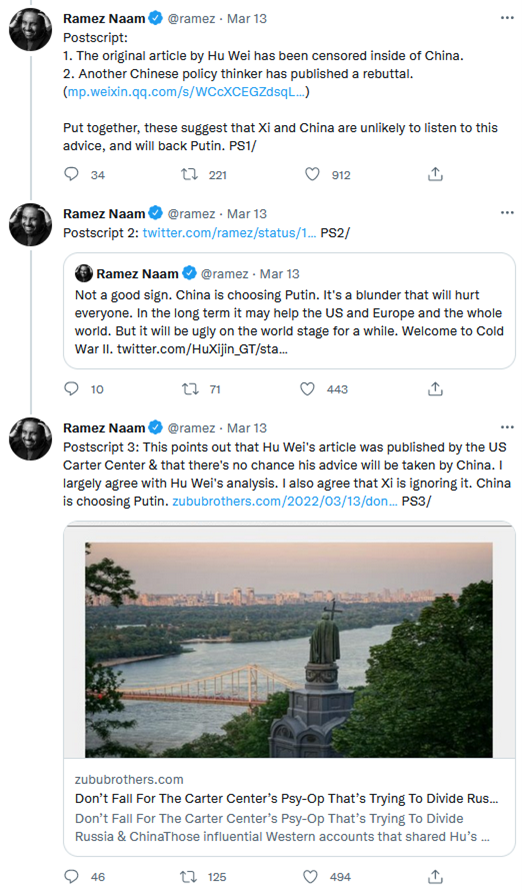
3) I've been warning for a while that China's highly successful zero-COVID policy is destined to fail due to omicron's high transmissibility, a prediction that is now coming true as cases, while still very low in a country of 1.4 billion people, are growing exponentially, as you can see in this chart:
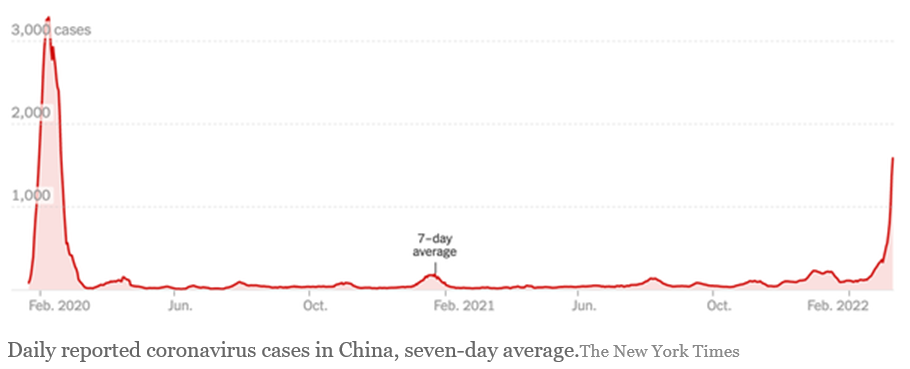
This is leading China to impose widespread lockdowns, as this New York Times article notes: Surge of Omicron Infections Prompts Lockdowns in China. Excerpt:
Several of China's largest factory cities have ordered a lockdown, halting production of Toyota (TM) cars and Apple (AAPL) iPhones. Theaters, cinemas, and many restaurants have closed in Shanghai. The northeastern province of Jilin on Monday banned its 24 million residents from leaving the province or traveling between cities.
China is grappling with its largest surge of COVID-19 infections since the coronavirus first emerged more than two years ago in central China. Sustained outbreaks in two-thirds of the country's provinces are proving the toughest test yet of China's zero-tolerance coronavirus policy.
Even as countries in the West are now loosening or abandoning mask mandates and other measures, Chinese officials are implementing some of their most stringent methods. That is in large part because China can't afford to lift restrictions.
The government has been concerned about comparatively lower rates of vaccination among China's older adults. The country also has far fewer intensive care hospital beds compared to its population than most industrialized countries. In China's vast rural areas, hospitals and medical facilities are often basic, and a major outbreak could quickly overwhelm hospitals.
In turn, this is leading to even greater supply chain disruptions, as this follow-up NYT article highlights: China's COVID Lockdowns Set to Further Disrupt Global Supply Chains. Excerpt:
Trucks are being delayed by the testing of drivers. Container rates are rising as ships wait for many hours at ports. Products are piling up in warehouses.
As Chinese officials scramble to contain the country's worst outbreak of COVID-19 since early 2020, they are imposing lockdowns and restrictions that are adding chaos to global supply chains. The measures in China, home to about one-third of global manufacturing, are disrupting the production of finished goods like Toyota and Volkswagen cars and Apple's iPhones, as well as components such as circuit boards and computer cables.
Cases rose on Tuesday to more than 5,000 new infections nationwide. That tally is small compared to many other large countries'. But China has taken a zero tolerance approach to outbreaks that calls for stringent lockdowns as well as mass testing and quarantine in government facilities. Because several of the country's largest industrial cities are now fighting outbreaks, such measures are taking a toll on the factory and transportation networks that are the backbone of China's manufacturing – and the global economy...
Airfreight is also facing fresh complications. The Civil Aviation Administration of China said Tuesday that many of the remaining international flights into Shanghai's vast Pudong airport would be rerouted to other Chinese cities from next Monday until May 1. The measure would free quarantine rooms in Shanghai for the city's residents and close contacts, but further delay exports.
At least five large factory cities have completely shut down because of the coronavirus: Dongguan and Shenzhen in southern China near Hong Kong, where Foxconn has huge factories to make iPhones and other Apple products; Changchun and Jilin City in northeastern China's Jilin Province; and Langfang, next to Beijing. Some smaller cities have also gone into lockdowns, like Suifenhe and Manzhouli on China's border with Russia.
In tomorrow's e-mail, I'll explain why what's happening with COVID in Hong Kong is rightly leading China to impose harsh lockdowns, even as the rest of the world is opening up...
Best regards,
Whitney
P.S. I welcome your feedback at WTDfeedback@empirefinancialresearch.com.