

Will the pandemic soon be over?
I continue to closely follow the pandemic and send updates to my coronavirus e-mail list roughly once a week (to join it, simply send a blank e-mail to: cv-subscribe@mailer.kasecapital.com).
I want to share the e-mail I sent last night in its entirety because I believe it's so important. If my theory proves to be correct – that the pandemic morphs into something akin to the seasonal flu in the next month or two – then the implications are massive.
I'm still trying to wrap my head around it...
Of course, the most important outcome would be a reduction in sickness, hospitalizations, and death. Again, not entirely, but similar to the flu.
It would likely result in a huge worldwide economic boost. But it's less clear what would happen to stocks...
It could result in the mother of all melt-ups. But maybe not, if the U.S. Federal Reserve tightens faster... And what might be the effect on inflation?
Which sectors and stocks would benefit most? Airlines and other travel-related companies perhaps? Which would be hurt? Zoom (ZM) and Moderna (MRNA)?
We could stop wearing masks (though I'm sure many folks will continue doing so) and fighting about mandates.
Could it reduce the political polarization that's crippling us? Who benefits politically?
I'll continue to follow the data, think about the implications, and update you regularly.
In the meantime, here's yesterday's e-mail...
In my e-mail last week, I wrote:
In a perfect world, the vaccines continue to work, and for the unvaxxed, COVID is nothing worse than the common flu. Fingers crossed!
I don't want to get too excited because of how many times this awful virus has been like Lucy pulling the football away from Charlie Brown (me), but every day that passes, evidence is building that the Omicron variant, rather than being a global nightmare, may actually soon lead to the end of the pandemic.
Note that I am choosing my words carefully here, as there is still high uncertainty. But I agree with Dr. Kevin Maki, who writes (see below for his full quote):
"I think we transition from the pandemic phase to the endemic phase of SARS-CoV-2 over the next 6-8 weeks, perhaps a bit faster if Omicron really takes hold more quickly and is truly less virulent."
I actually Googled "pandemic vs. endemic" to make sure I was clear on the difference and came up with this:
A PANDEMIC is an epidemic that's spread over multiple countries or continents... ENDEMICS, on the other hand, are a constant presence in a specific location. Malaria is endemic to parts of Africa. Ice is endemic to Antarctica.
To be clear, COVID isn't going away. But as this article notes:
But failure to eradicate the virus does not mean that death, illness or social isolation will continue on the scales seen so far. The future will depend heavily on the type of immunity people acquire through infection or vaccination and how the virus evolves. Influenza and the four human coronaviruses that cause common colds are also endemic: but a combination of annual vaccines and acquired immunity means that societies tolerate the seasonal deaths and illnesses they bring without requiring lockdowns, masks and social distancing.
In summary, the "best" combination for a COVID variant would be:
a) Highly transmissible (so that it displaces Delta and other variants);
b) Is blocked by vaccines or natural immunity; and
c) Has minor short- and long-term symptoms.
In other words, it just becomes something akin to the seasonal flu (but with better vaccine protection).
On all three variables, the latest data is excellent vis-à-vis Omicron.
Regarding transmissibility, here's a good summary by Dr. Katelyn Jetelina, a blogger and Assistant Professor at The University of Texas Health Science Center at Houston: Omicron Update: Dec 13. Excerpt:
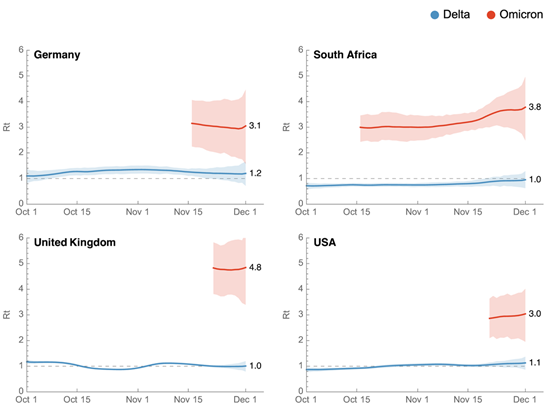
There's now enough data to estimate the reproductive number (i.e. contagiousness) in the United States. And it's not looking good: R(t)=3. With this high level of transmissibility, cases are doubling every ~3-4 days, so Omicron will easily be the dominant variant in coming weeks.
This R(t) is similar to other countries like Germany and South Africa. Nothing is stopping Omicron in its tracks. As time goes on, R(t) should differentiate itself across countries due to many factors: differing behaviors (public health mitigation measures), genetics, patchwork immunity, age distributions, etc.
You can certainly see evidence of this high transmissibility in the two countries getting hit hardest by Omicron, South Africa and the U.K. (source):
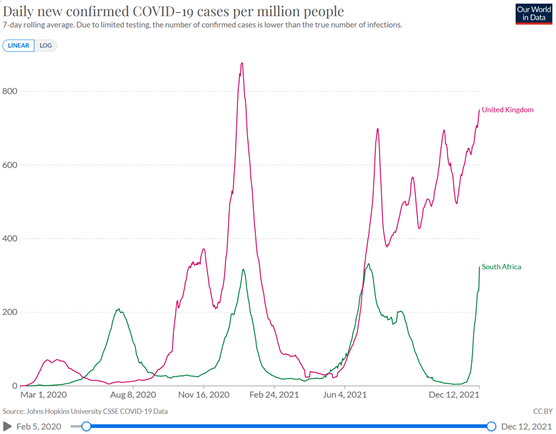
So, part a) certainly appears to be true.
Regarding b) ("Is blocked by vaccines or natural immunity"), the evidence is more mixed. To quote Dr. Jetelina again:
We now have 8 lab studies all largely saying the same thing: Omicron significantly reduces the number of neutralizing antibodies from a 2-dose mRNA series compared to previous variants.
Importantly, a "reduction in neutralizing antibodies" is not the same thing as "reduction in vaccine effectiveness". This is because immune systems are adaptive and diverse thanks to other types of antibodies, B-cells (antibody factories), and T-cells (secondary line of defense). So it's important to look at other data too.
In the U.K., we got our first glimpse of "real world" vaccine effectiveness against Omicron. On Friday, the U.K. Health Security Agency released a comprehensive report in which they compared 56,439 cases of Delta to 581 cases of Omicron from Nov 27 to Dec 6, 2021. Vaccine effectiveness against Omicron infection was 30-40% after two shots of Pfizer. After a booster, effectiveness increased to 70-80%. This is nothing short of phenomenal. This also probably means that boosters continue to reduce viral transmission.
In the past week we also had 3 T-cell studies come out. T-cells are critical to our immune system because they are our second line of defense. If neutralizing antibodies can't catch the virus before it infects our cells, then T-cells kick in. T-cell protection is harder for viruses to escape because their protection spans virtually the entire spike protein, whereas antibody responses tend to focus on relatively few regions. As hypothesized, the results from the studies look great – T-cells continue to work against Omicron. So even though the number of infections will substantially increase, we will largely stay out of the hospital.
With this data, the case for an Omicron-specific vaccine is becoming less and less apparent. This will be highly debated in the coming months, so it will be interesting to hear both sides of the argument.
Lastly, regarding c) ("Has minor short- and long-term symptoms"), the news is excellent.
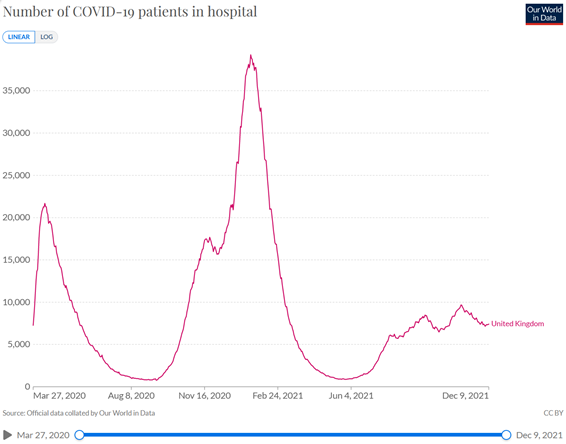
Despite a huge surge in cases, hospitalizations in the U.K. are actually falling (source):
In South Africa, hospitalizations are rising, but much more slowly than in past waves. This chart shows the data (including deaths) for South Africa's Gauteng province, where the Omicron variant is predominant (from the FT, posted in Dr. Jetelina's blog):
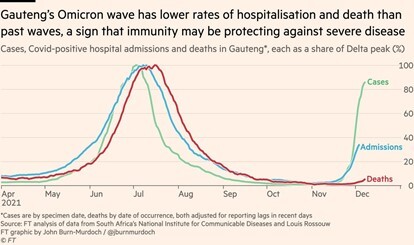
Yes, there is always a lag between cases, hospital admissions, and deaths, but the trends for the current Omicron wave are looking much better than the previous Delta wave.
For more on all this, watch this 23-minute video by a retired British nurse, Dr. John Campbell: Omicron, symptom changes.
I asked Dr. Maki for his thoughts on the video and the latest developments regarding how the pandemic is likely to play out, and he replied:
I have heard of John Campbell and have watched many of his videos. He is a PhD nurse and is definitely legit, although I don't always agree with his conclusions.
In this case, however, I think he is right.
Omicron does appear to be more transmissible than Delta, so will likely take over as the dominant form of the virus. Very early on, your good friend Bill Ackman said that Omicron may be a good thing for markets if it proves to be less virulent (produces less severe illness). Based on what is happening in South Africa, that looks likely.
Delta is still the dominant variant in the U.S. and will probably continue to be so for a few weeks. Hospitalizations and deaths are up from two weeks ago and it is hard to predict when the curve will bend in the right direction. There will probably be a transition period from Delta to Omicron that could take several weeks. If Omicron is less virulent, the faster that transition occurs the better.
Either way, I think we transition from the pandemic phase to the endemic phase of SARS-CoV-2 over the next 6-8 weeks, perhaps a bit faster if Omicron really takes hold more quickly and is truly less virulent.
Also, the availability of oral antivirals could be a major factor if coupled with ready availability of at-home testing, dramatically cutting down on risk of hospitalization.
I think there is light at the end of the Covid tunnel!
Thank you Dr. Maki – I couldn't have said it any better myself!
Best regards,
Whitney
P.S. I welcome your feedback at WTDfeedback@empirefinancialresearch.com.