

The $10 Billion Proposal Reshaping AI Infrastructure
Editor's note: Meta Platforms is spending up to $145 billion on AI this year. And according to Joel Litman, chief investment officer of our corporate affiliate Altimetry, it may have created a surprising new business model in the AI arms race that forces competitors to help foot the bill...
Big Tech companies, like Microsoft (MSFT) and Alphabet (GOOGL), invested billions of dollars in AI startups...
Those startups, in turn, spent money on Big Tech's cloud infrastructure and chips.
It was the first phase of AI's circular economy. Now, another loop is forming... AI competitors are starting to recycle one another's computing power.
AI research firm Anthropic recently approached social media giant Meta Platforms (META) to lease its AI data-center capacity. The potential agreement could be worth as much as $10 billion over two years.
At the same time, Meta is spending heavily to build AI models that can compete with Anthropic's Claude Code.
This is fueling concerns that Meta is falling behind in the AI race... and preparing to hand valuable resources over to a fierce rival.
But, as we'll explain, Meta's excess computing capacity could actually strengthen its AI strategy...
Scarcity Is Turning Competitors Into Customers
AI companies need tons of computing power to train large language models and run them for millions of users. The most popular models are consuming capacity faster than developers can secure it.
Anthropic's fastest-scaling enterprise product, Claude Code, has fueled a surge in demand. The company is now seeking infrastructure wherever it can find a reliable supplier.
The company reportedly signed a three-year, $45 billion agreement with SpaceX (the parent company of fellow competitor xAI). Under that agreement, Anthropic would pay $1.25 billion per month for computing power.
Now it's in talks with Meta.
Meta plans to spend as much as $145 billion this year, much of it on AI. That's more than double the roughly $72 billion it spent on the technology last year.
The company doesn't care if its servers belong to a rival. Meta just needs reliable computing power... and it's prepared to pay a lot for it.
Investors are worried that the aggressive build-out will eat into Meta's returns...
But along with developing models, Meta is expanding its computing capacity. Management acknowledged that the company may build more capacity than its own AI products need.
Leasing that spare capacity would turn a potential weakness into a revenue-producing asset. And because it's such a precious asset, Meta can charge top dollar.
That's an important point because investors expect Meta's returns to deteriorate. We can see this through our Embedded Expectations Analysis ("EEA") framework.
The EEA starts by looking at a company's current stock price. From there, we can calculate what the market expects from the company's future cash flows. We then compare that with our own cash-flow projections.
In short, it tells us how well a company has to perform in the future to be worth what the market is paying for it today.
Meta's Uniform return on assets ("ROA") has been at least 26% every year since 2021, more than twice the 12% corporate average. At Altimetry, we analyze earnings with Uniform Accounting to avoid the distortions of traditional accounting methods.
Even if the company sells some of its new computing power at top dollar, investors expect its Uniform ROA to fall to just 17% in the next few years. Take a look...
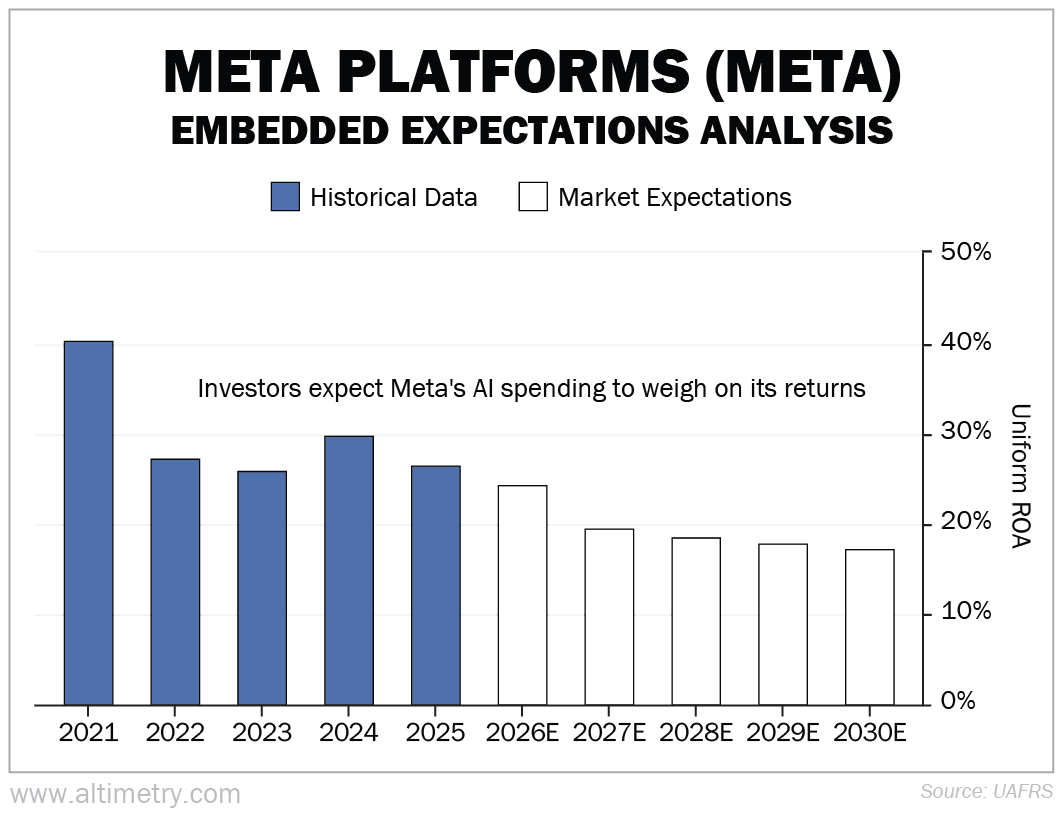
Their outlook assumes that Meta's infrastructure will become less productive as spending rises. But if Meta can lease its excess capacity at a premium, its returns may not fall as far as the market expects.
The AI Business Model Is Changing
Companies like Meta are selling computing capacity to competitors before their own AI products use up everything they've built.
Meta's infrastructure also supports internal products, advertising tools, and enterprise services.
That creates several paths to returns from the same asset base.
Right now, the market is concerned about Meta's infrastructure growth. And it's underestimating the company's AI business model.
But management has planned ahead... Meta can continue developing advanced AI models while collecting revenue from its competitors.
Regards,
Joel Litman
Editor's note: Some of the biggest winners in market history had something in common before they took off... and Joel has pinpointed it. The same signal that showed up before Tesla, Nvidia, and Apple took off is now flashing for a new group of stocks. And tonight at 8 p.m. Eastern time, Joel will reveal the latest names it has flagged.
Further Reading
Two powerful forces just placed major bets on the same struggling chipmaker. The U.S. government took a 10% stake... while Nvidia invested $5 billion. Those moves could give this former industry giant the firepower it needs to reclaim its place in the AI arms race.
For years, investors have focused on the chips that power AI. But for this revolution to continue, companies need to resolve the physical bottlenecks that limit computing capacity. And as Earth's finite resources are drained, the next generation of AI infrastructure could move to space.