

There's a Rally in This Falling Market
Editor's note: Anthropic is preparing for one of the largest stock market debuts in history. But with AI stocks under pressure, investors are divided over what its IPO could mean for the broader market. But according to Joel Litman, chief investment officer of our corporate affiliate Altimetry, there's a bigger story unfolding beneath the headlines. And it suggests the market may be healthier than the headlines suggest...
Anthropic could become one of the biggest stock debuts in history...
On Tuesday, the AI lab behind the Claude chatbot kicked off its IPO roadshow. That's the stretch when a company pitches big investors on its shares before they start trading publicly. Anthropic is asking for $70 to $78 per share.
At the top of that range, Anthropic would raise about $64.4 billion... trailing only Elon Musk's SpaceX (SPCX), which raised $86.2 billion during its record IPO in June.
And at that share price, Anthropic would be worth roughly $1.4 trillion. While that's a big number, some folks expected more. Just weeks ago, reports floated a $2 trillion valuation.
But since then, AI stocks have taken a beating. Democrats' gains in last week's midterm election sparked fears of tougher rules on the data centers powering AI.
Still, Anthropic is pushing ahead. Its shares are expected to start trading on November 19.
So investors are split... Some think this debut will mark the peak of the AI boom. Others think it will kick off the next leg higher.
But before you pick a side, you should see what the stock market's headline numbers are hiding right now...
The S&P 500 Doesn't Tell the Whole Story
Since mid-October, the S&P 500 is down nearly 4%. The tech-heavy Nasdaq 100 Index fared even worse... falling more than 9%.
Tech stocks took the worst of the damage. The State Street Technology Select Sector SPDR Fund (XLK), which tracks the S&P 500's tech sector, has dropped 14%.
If you only paid attention to those numbers, you'd think investors were running for the exits. But if you looked a bit closer, you'd see that most of the S&P 500's 11 major sectors are actually up. (You can see that through each sector's tracking fund.)
Healthcare stocks have climbed 11%. Consumer staples (companies that sell everyday goods like groceries and toothpaste) are up 8%. Financials, materials, real estate, and consumer discretionary (nonessentials like cars and vacations) have each gained between 6% and 8%.
In all, seven of the 11 sectors have risen despite the broad index's overall decline. Take a look...
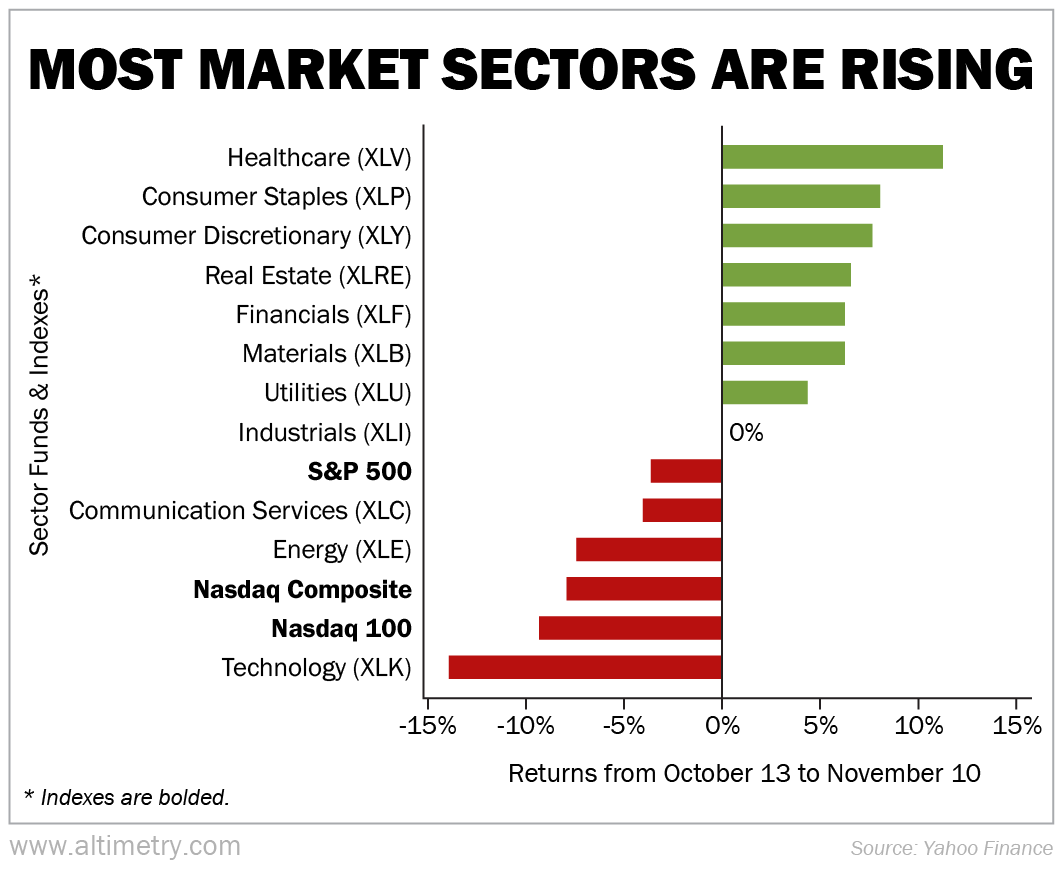
The index is flashing red. But most of the sectors inside it are green.
The reason comes down to how the index is built. The S&P 500 weights each company by its total market value. The bigger the company, the more it moves the index. And today, tech makes up nearly 40% of the S&P 500's value.
So when tech drops 14%, that alone drags the whole index down about 5 percentage points, even while most other stocks climb. If every company counted equally, the S&P 500 would be up about 4% since mid-October.
So don't let one number decide whether you're scared or confident...
The S&P 500 says the market is in trouble. But the selling is packed into one corner of it. Elsewhere, money is flowing in.
That's easy to miss in a choppy market like this one. And when the headline index is your only gauge, it's easy to make the wrong call.
Even when the headlines turn ugly, money is working somewhere. You just need a way to find it.
Regards,
Joel Litman
Editor's note: The recent post-midterm sell-off may signal a shift in market leadership. But that doesn't mean opportunity is disappearing. That's why Joel and Brett Eversole combined their research to identify a rare group of stocks called "Perfect Breakouts." And on November 19, they'll share the No. 1 move you must make to prepare.
Further Reading
"If everyone already owns a lot of stocks, you're probably late to a bull market," Brett Eversole writes. "But that doesn't mean the bull market is over." Mom-and-pop investors own more stocks than they have in nearly 10 years. But history shows that's a bullish sign for stock prices.
There's no shortage of reasons to be nervous about stocks. From rising energy costs to higher interest rates, the risks are real. But investors who react to every alarming headline could end up making a costly mistake.