
Editor's note: One of AI's biggest stories is being overlooked...
Amid the AI doom and gloom painting the headlines, one project seeks to completely change how we view our genetic code – and could aid in eliminating genetic mutations and illnesses.
In today's Masters Series, adapted from the September 14 issue of the free The Bleeding Edge e-letter, Jeff Brown – founder and CEO of our corporate affiliate Brownstone Research – shares why ignoring the news can reveal the breakthroughs that will change our lives...
An Atlas for a Future Free of Disease
Last month featured absolute chaos for more than a week...
We witnessed an unfurling of a massive, coordinated, well-planned, and well-funded AI doomer campaign pushing for regulatory capture...
Followed by the lightning-fast defense of AI – from rational minds that see the psyop for what it is.
And in the midst of it all, Google DeepMind made yet another extraordinary contribution to life sciences, but given the news cycle around that time, no one would have known about it.
On September 8, Alphabet (GOOGL) subsidiary Google announced AlphaGenome Atlas: a predictive map of every possible DNA letter change in the human genome.
AlphaGenome Atlas is what follows Google DeepMind's life-sciences breakthrough with AlphaFold, which accurately predicts the shapes of hundreds of millions of proteins.
However, instead of insights into proteins, AlphaGenome Atlas can predict the impact of all 9 billion single-letter DNA changes in our human genomes.
The implications are just incredible. In fact, Alphabet calls this "the most comprehensive catalogue of how genetic mutations affect molecular biology."
AlphaGenome Atlas effectively gives the human race a predictive map of the entire human genome.
And given the mass media incentives to push the AI doomer hysteria this last week and weekend, this has gone largely ignored.
We're not going to miss this one, though...
It's far too important for us to understand.
The issue Alphabet was trying to solve is the need to understand the functional impact of genetic variations on the human body.
In some cases, this is already well understood.
For example: Sickle cell anemia is caused by a single nucleotide mutation in the HBB gene on chromosome 11.
This single mutation alters a DNA sequence from GAG to GTG.
That simple "A" to "T" change is enough to cause a terrible disease that previously had no known cure – all because of a single mutation.
That knowledge – the awareness of the impact of the single mutation – was what enabled Crispr Therapeutics (CRSP) to develop a Crispr-based therapy using genetic editing to cure sickle cell anemia.
The company received approval from the U.S. Food and Drug Administration for its Casgevy therapy – which is manufactured by Vertex Pharmaceuticals (VRTX) – in December 2023.
It was a historic development, as it was the first Crispr-based genetic-editing therapy to be approved.
And it was symbolic, as it opened the door for many more to follow – to address the need to treat thousands of human diseases caused by genetic mutations.
There are four letters in DNA that represent nucleotides, which are nitrogen-based molecules:
- A – Adenine
- T – Thymine
- C – Cytosine
- G – Guanine
These letters are arranged in sequences to form genes, which are short segments of our DNA.
Genes provide the instructions for our bodies on how to build the proteins that they need.
Healthy DNA results in a body that functions properly.
DNA with unwanted mutations can result in diseases like sickle cell anemia – the example I provided earlier.
Have you ever paused to wonder about the "unforeseen" or "unintended" effects – either positive or negative – that could be caused by altering someone's genes?
This is why AlphaGenome Atlas is so valuable.
It predicts the functional consequence of every single possible letter change to the human genome.
Said another way, it has the ability to not only predict the impact of mutations, but also to help connect the dots and determine which mutations cause human diseases.
And in the same vein as AlphaFold and AlphaFold 2, Google has made the AlphaGenome Atlas AI model available to all for noncommercial use only.
AlphaGenome Atlas is a 1-petabyte dataset, which is 30 times larger than the AlphaFold dataset. It's absolutely massive.
And it goes one step further than AlphaFold, which accurately predicted protein structures...
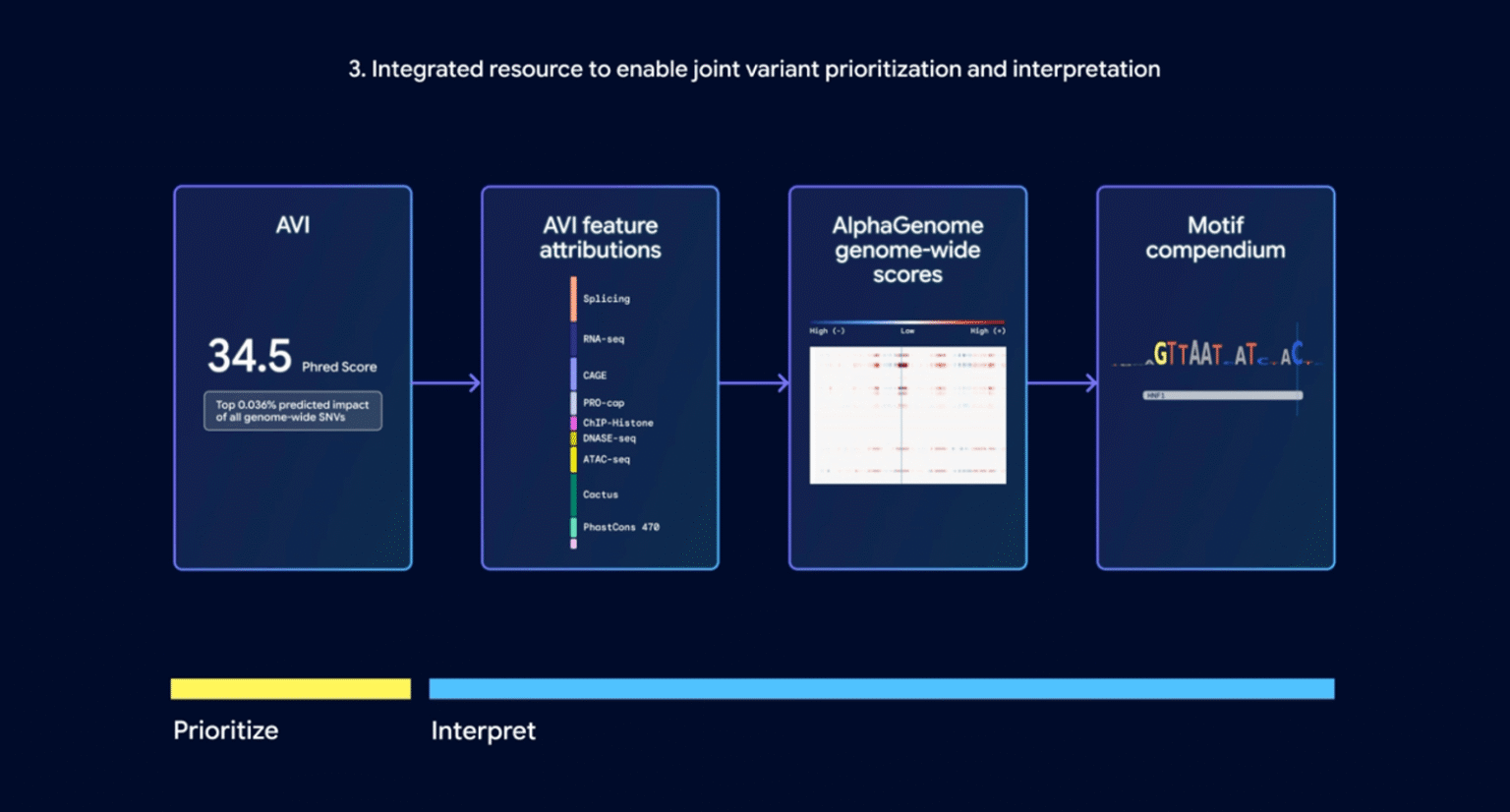
Source: Google DeepMind
It not only provides a prediction of the impact of genetic mutations, but it also provides what it calls the AlphaGenome Variant Impact ("AVI") score, which gives prioritization and genetic significance to each prediction.
The importance of this, by way of example, has already been demonstrated.
A team of researchers has already used AlphaGenome Atlas in search of the genetic cause of epileptic encephalopathy.
Not only did the AI model predict the specific mutation in the DNM1 gene responsible for the disease, but the AVI score showed how the genetic mutation functioned.
What this means is that every human disease and genetic mutation can be researched with this powerful new AI model from Google DeepMind.
This was previously inconceivable using human intelligence alone.
Understanding protein structures (AlphaFold) – combined with the understanding of the impact of genetic mutations (AlphaGenome Atlas) – empowers the entire life-sciences industry to develop therapies to potentially cure all human diseases.
Doesn't this development stand in stark contrast to all the politically motivated AI doomers and those that are pushing for regulatory capture and totalitarian control?
AlphaGenome Atlas is a perfect example of why this technological acceleration that we are experiencing is so important.
Google DeepMind's work has already transformed the life-sciences industry and will directly impact the world's population in a wonderful way.
Ironically, Alphabet has been conspicuously quiet during this AI doomer versus technological advancement for human good battle.
And there might be a good reason why.
The latest frontier AI models from OpenAI, Anthropic, and SpaceX (SPCX) have given the market the impression that Alphabet has fallen way behind in the race to develop artificial general intelligence.
However, Alphabet has a long history of working privately in its labs on artificial intelligence and quantum computing... and then suddenly dropping incredible news of technological breakthroughs.
The latest rumors circle around Alphabet having achieved recursive self-improvement ("RSI") with its frontier AI model.
The magnitude of RSI can't be understated.
It means that a frontier model can autonomously improve itself without the need for human developers.
And the only limitation of a frontier AI model capable of RSI is computational resources.
The more computational resources that are used to support RSI, the faster it can self-improve in generation after generation of "itself." What this means is model generation advancement in periods measured in months, not years.
To be very clear, nothing has slowed down. Alphabet is in the race. It wants to be the first to develop artificial superintelligence...
So does Anthropic. So does OpenAI. So does SpaceX. And so does the Chinese government.
Tens of trillions of dollars are at stake here.
And in the case of China, so is its desire to be the world's superpower.
Is it so difficult to believe that a handful of powerful, control-hungry billionaires in the U.S. – coupled with a bunch of power-hungry politicians that believe in pandemic-grade totalitarianism – want to control the most powerful (and most valuable) technology in the history of the world?
This is an existential battle that we the people must win.
Regards,
Jeff Brown
Founder and CEO, Brownstone Research
Editor's note: On October 28, a brand-new AI super chip will debut – one that's 50 times faster than Nvidia's. And it could change our daily lives as we know it, handling everyday tasks for millions of people.
But that's not all... The company behind this chip is going to send a ripple effect throughout the AI sector and could potentially cause five lesser-known stocks to soar. Jeff is warning folks to get in position now before they take off. Hear the full story of the stocks that could replace the Magnificent Seven here.