

It's Official: Foreign Investors Are Fleeing
It's official: Foreign investors are fleeing... Japanese gold sales are surging... 100 million investors could soon turn to gold... A short-term warning from gold and silver... Good news for U.S. banks... The perfect income investment for turbulent markets...
 Our suspicions were correct...
We thought foreign investors from Japan and Europe – fleeing from negative-yielding sovereign bonds in their countries – could be driving much of the recent rally in U.S. Treasurys. New data from Japan suggest this is the case...
This morning, Japan's Ministry of Finance released its latest weekly report on investment trends. The report shows Japanese bond investors bought a net 2.55 trillion yen ($31 billion) of medium- and long-term foreign debt last week.
This is the most in history... and most of it went into U.S Treasurys. As Yoshiyuki Suzuki, the head of fixed income at Japan's Fukoku Mutual Life Insurance, noted to the Australian Financial Review today...
Japanese bond investors are forced to purchase foreign-currency-denominated bonds... We cannot find any interest in domestic bonds. [Local yields are] not enough.
Of course, even the relatively large yields of longer-term U.S. Treasurys – just 2.2% for the longest-dated 30-year bond – offer a terrible risk-to-reward proposition today.
Perhaps that's why many Japanese investors are flocking to another asset, too...
Tanaka Holdings – the operator of Japan's largest bullion retailer – reports gold sales jumped another 60% last month from their already high levels.
As Tanaka general manager Eiichiro Kato told Bloomberg this week, gold's lack of yield isn't a big deal for investors when 90% of Japanese government bonds have negative yields.
By now, every Digest reader should understand the reasons gold could skyrocket over the next several years. Today, we'll share one more...
Back in March, our friend and former colleague Kim Iskyan explained why the upcoming presidential election could be a massive tailwind for precious metals. This week, he shared another event that could set off a huge new wave of gold buying... one that most Americans have never even considered.
In short, Kim notes that most of the world's 1.6 billion Muslims don't invest in gold. This is because under Sharia law – which governs the personal and financial lives of Muslims around the world – gold's status is "murky."
Physical gold can be owned as jewelry or as a currency or medium of exchange. But there is disagreement over whether it can be owned and traded as an investment... meaning most popular gold investments, from exchange-traded funds ("ETFs") to gold-mining stocks, have generally been off-limits.
But Kim says that's about to change. As he explained in his free Truewealth Asian Investment Daily e-letter earlier this week...
The Accounting and Auditing Organization for Islamic Financial Institutions (AAOIFI), which establishes Sharia standards for Islamic finance, and the World Gold Council (WGC), are currently drafting a "Shariah Standard on Gold." Natalie Dempster, a managing director at the WGC, told me that they plan to release it by the fourth quarter of this year.
This new standard could clear the way for Islamic investors to participate in gold's current rally.
Kim noted the world's 100 million Islamic savers and investors hold almost $2 trillion in assets today... and analysts estimate it could grow to $5 trillion or more by 2020. This represents a huge amount of new potential gold demand. More from Kim...
A recent report by Ernst and Young stated that 93 percent of Islamic financial assets are held in nine core markets – Bahrain, Qatar, Indonesia, Saudi Arabia, Malaysia, United Arab Emirates, Turkey, Kuwait, and Pakistan. Since there are virtually no Sharia-compliant gold products right now, money managers in these core markets are generally limited to investing in Sharia-compliant assets in equities, real estate, and Islamic bonds...
It makes sense that Islamic investors will embrace gold for the same reasons other investors do: the lack of low-risk alternatives in a zero interest rate world, stock market volatility, global economic concerns, diversification, and as a form of insurance. They may not all rush into buying it once the standards are accepted, but growing interest from Islamic investors should give gold prices long-term support.
(Kim's new venture – Truewealth Publishing – is dedicated to providing world-class, independent investment insight on Asia and world markets. You can learn more about his excellent free daily e-letter right here.)
Again, we believe we're in the early stages of a gold bull market unlike any before in history. Early investors in this trend will make a fortune... possibly the biggest profits in their investment careers.
But as we've discussed, no bull market goes straight up forever... Corrections are a normal (and necessary) part of every big rally.
Regular readers may recall we warned back in April that gold and silver were getting a little "frothy." Prices eventually fell more than 7% through May, before rallying 13% back to new highs in June.
Today, we're seeing warning signs again. Measures of investor sentiment are hitting even higher extremes, and history suggests gold and silver could be headed lower again in the near term. Our colleague Ben Morris recently shared some of these signs with his DailyWealth Trader subscribers...
The Commitment of Traders ("COT") is a government report that classifies different types of traders and tracks their positions. All you need to know about these reports is that there are two main groups of traders: industry professionals and speculators. The two groups usually bet in opposite directions. And when the speculators take extreme positions, they're often wrong.
COT reports led us to issue a warning about the extremely high price of oil near its peak in 2014... and to predict a big rally in oil near its low early this year. They have helped us time lots of profitable trades. And right now, the COT reports for gold and silver show that speculators are making record numbers of bullish bets. We'll start with gold...
The chart below shows the price of gold (the black line) and speculative positions in gold (the blue line) over the past 15 years. Speculators now have more bullish positions on gold than they've ever had before...
Here's the same chart for silver...


Ben also noted that gold mining stocks have become extremely "overbought" today. More from the issue...
The "Bullish Percent Index" (or "BPI") tracks the percentage of stocks in a sector that are trading in a bullish pattern. It ranges from zero to 100.
The BPI flashes a buy signal when it reaches 30 or lower (oversold territory) and then turns higher. And it flashes a sell signal when it reaches 80 or higher (overbought territory) and then turns lower.
In the chart below, you can see that 100% of gold mining stocks (tracked by the BPI) trade in a bullish pattern. In the eight-year history of the index, it has never reached 100 before. A sell signal doesn't come until the index turns lower. But it went from its lowest possible reading (of 0) to its highest possible reading (of 100) in less than a year. This is another big, sharp move...

As Ben explained, these indicators aren't perfect... sometimes these extremes can get much more extreme. Prices could continue to soar. It has happened before, and it is sure to happen again. But usually when we're at these extremes, short-term reversals soon follow.
What should you do? As always, the answer is, "It depends."
If you don't own any gold and silver, we still recommend establishing small positions today. Again, there is no guarantee gold and silver can't go much higher from here before a meaningful correction begins... And the risk of not owning any is greater than buying before a correction.
But if you followed our gold and silver recommendations – meaning you put a small portion of your portfolio in physical gold and silver and select precious metals stocks, and followed our advice on asset allocation, proper position sizing, and trailing stop losses – feel free to sit tight.
You are diversified... your trailing stop losses will protect your gains if necessary... and you'll likely get some great buying opportunities in coming days or weeks.
On the other hand, if you ignored our recommendations and put a huge portion of your portfolio in these investments, this is a good time to reduce your risk.
Most folks learn about diversification and proper position sizing the hard way: They lose a huge chunk of their portfolio virtually overnight. If you loaded up on gold and silver stocks this year, you beat the odds. You're sitting on huge gains.
Consider yourself lucky... book some profits or tighten your stops... and promise yourself you won't do that again.
Finally, JPMorgan (JPM) was the first major bank to report second-quarter earnings this morning. And it seems the surge in bond prices helped it earn better than expected profits...
Bloomberg reports that the company's fixed-income and bond-trading revenue was a big contributor to the earnings beat. The company earned nearly $4 billion, a 35% increase from the second quarter of 2015... and $400 million more than analysts were expecting. Revenue from stock trading was mostly flat.
JPM shares were up 2% today.
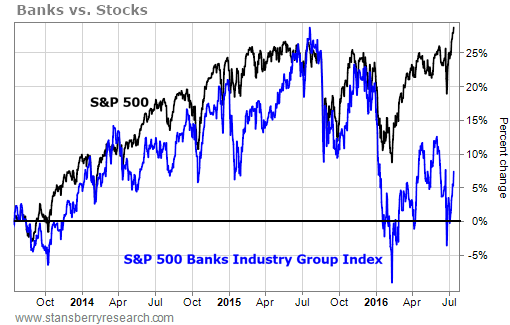
Strong results from bond trading may boost investor confidence in banks as they report earnings in the next week. Citigroup (C) and Wells Fargo (WFC) are scheduled to report results tomorrow, while Bank of America (BAC), Goldman Sachs (GS), and Morgan Stanley (MS) are due to report next week.
As you can see in the chart below, bank stocks have underperformed the market so far this year. Better-than-expected earnings could help close the gap...
This is great news for our colleague, Dr. David "Doc" Eifrig and his Income Intelligence subscribers.
Doc recently recommended what he calls "the perfect income investment for turbulent markets"...
Regular readers know yields of virtually every "typical" retirement investment are sitting at historic lows... Ten-year Treasury bonds yield 1.5%... savings accounts yield just 0.1% (if you're lucky)... and five-year certificates of deposit (CDs) pay only about 0.8%.
But if you're willing to try something a little different, Doc says there's an easy way to double or even triple the income you are getting from your "safe money" portfolio, without exposing yourself to risky strategies involving options, leverage, or anything like that. Here's how Doc puts it...
The turmoil in bank stocks has made right now the ideal time to buy a special kind of asset class... offering more safety than a stock and a higher yield than a bond.
If you're a serious income investor who wants to generate spendable income from a sturdy investment, these are the perfect investments for you.
However, it's likely that you don't currently hold a single one of these assets in your portfolio... even though you can easily buy and sell them just like stocks... and generate yields of around 4%-6% in a negative interest rate world, while taking on less risk than you would with stocks.
Doc notes that while banks have gotten much safer since the financial crisis, they aren't likely to return to the super-high growth of the "good ol' days."
With banks safer than ever – but growing more slowly – Doc recommends opening a position in preferred shares, an asset issued primarily by banks and other financial companies.
Preferred shares are often called a hybrid blend of stocks and bonds.
Like a common stockholder, you are a partial owner of the business. But preferred shares have a dividend rate that is often double or even triple what you might earn if you bought the stock.
Even better, you won't have to worry about that regular payment changing. And buying this investment gives your portfolio a margin of safety that stocks can never provide...
Doc says preferred shares tend to hold their value in all but the worst times.
During the financial crisis, a diversified portfolio of preferreds did drop... but as you can see in the chart below, it quickly regained its value. Thanks to the income, preferred shares rallied back while bank stocks lagged far behind.

If you're tired of the low yields in "regular" retirement investments, Doc says preferreds could be a great fit. Just don't expect to hear about them from your broker. More from Doc...
When I worked on Wall Street at Goldman Sachs and Chase Manhattan, I saw guys making a boatload of money off this asset, even though they rarely advised their clients to do the same.
Doc recently recommended several individual preferred shares in his excellent income-focused newsletter, Income Intelligence. He also recommends an investment that will give you exposure to a diversified portfolio of preferreds with one click... And it's currently yielding nearly 8%.
If you need to earn more safe income today, you owe it to yourself to learn more.
Doc has prepared a report with everything you need to know about these investments, including how they work and how they're able to safely pay out huge, reliable income streams. And if you agree to try Doc's Income Intelligence today, you can get immediate access to the same information others have paid thousands of dollars a year for... all for just $59. Click here for the details.
New 52-week highs (as of 7/13/16): Aflac (AFL), Bristol-Myers Squibb (BMY), Ciner Resources (CINR), Cisco (CSCO), Western Asset Emerging Markets Debt Fund (ESD), Fidelity Select Medical Equipment and Systems Fund (FSMEX), Cedar Fair (FUN), VanEck Vectors Junior Gold Miners Fund (GDXJ), Welltower (HCN), Johnson & Johnson (JNJ), 3M (MMM), Procter & Gamble (PG), PNC Financial Services – Series P (PNC-PP), Pretium Resources (PVG), Regions Financial – Series B (RF-PB), Gibraltar Industries (ROCK), Sysco (SYY), and Vanguard REIT Fund (VNQ).
In the mailbag, another reader praises P.J. O'Rourke's latest column... and another shares the benefits of using TradeStops. What's on your mind? Let us know at feedback@stansberryresearch.com.
"Absolutely loved his column from Tuesday. Nailed it 100%. The condescension from so many of our leaders is so prevalent. NIRP has stolen savings from the elderly and deflation is stealing jobs from the young. Enough is enough. Trump isn't great but he is really the only alternative." – Paid-up subscriber Dan Stringer
"Hi Porter, amazing what happens when one does a modicum of learning based on your newsletters. I have been using TradeStops (lifetime) and have added a portion of precious metal stocks/ETFs to my portfolio based on your recommendations. And I balanced the portfolio for risk per position; not perfectly, but good enough. AMAZED at the low volatility: When my non-metals stocks tank, the metals soar. Net: a small gain. When the metals drop, non-metals jump. Net: a small gain. Sleeping well. Just what the doctor ordered." – Paid-up subscriber Tim
Regards,
Justin Brill
Baltimore, Maryland
July 14, 2016
|