

The Bear Market Has Arrived
The bear market has arrived... A return to crisis levels... The 'generals' are retreating... 'Truly frightening' declines... What you need to know...
 The signs are showing up everywhere, if you just know where to look...
The Dow Jones Global Index – a broad measure that tracks the performance of 95% of the world's investable stock markets, including 25 developed markets and 23 emerging markets – is dangerously close to "official" bear market territory.
A bear market is officially defined by a decline of 20% or more from its peak. The Dow Jones Global has lost 19% from its 2015 highs as of today's trading.
More concerning, the index has already fallen below its 2007 high.
In fact, as you can see in the chart below, the index originally fell below this level last summer...
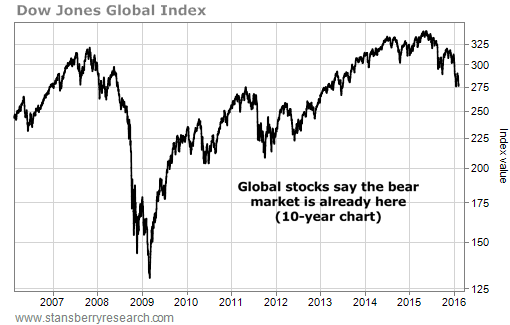
After hitting a new all-time high last spring, the index plunged below the 2007 high in September. The year-end rally pushed it back up to "test" this level. It then quickly reversed and headed lower again in January.
This is classic bear market behavior.
Unfortunately, things don't look much better here in the U.S...
Last week, the benchmark S&P 500 Index fell more than 3%, ending at its lowest weekly close since May 2014. But beneath the surface, the action was much worse.
The bull market "darlings" – the popular-story stocks that led the market higher over the past few years – took the brunt of the damage.
It's an old market adage that a bull market is like a military campaign... it's led by generals.
As long as the generals are moving forward, the troops are likely to follow. But without the generals, sooner or later, the troops are in trouble.
Last week, many of this bull market's "generals" were absolutely crushed. In fact, the declines were so bad, the numbers are hard to believe...
The so-called "FANG" stocks that the financial media love to tout – Facebook (FB), Amazon (AMZN), Netflix (NFLX), and Google – now known as Alphabet (GOOG) – fell 7%, 15%, 10%, and 8%, respectively.
But that's not all...
Camera maker GoPro (GPRO) fell 13%. Cloud-computing firm Salesforce (CRM) and online-reviews site Yelp (YELP) each fell 14%.
Billionaire Elon Musk's two "darlings" – electric-car maker Tesla (TSLA) and solar-energy company SolarCity (SCTY) – plunged 15% and 17%, respectively. (SolarCity plunged nearly 30% today after announcing "deeper than expected" first-quarter losses last night.)
And social-media website LinkedIn (LNKD) crashed an unbelievable 48%.
Again, these declines happened in just one week of trading.
Seeing former market leaders fall so quickly can be an early warning sign of an impending bear market. After all, when the "generals" are fleeing en masse, can the "troops" be far behind?
And the darlings aren't the only former leaders that are concerning...
Banks and financial stocks led the last bull market of the early 2000s. And as you likely remember, they were obliterated in the crisis that followed.
During the bear market of 2007-2009, a long list of these companies – including Lehman Brothers, Bear Sterns, Fannie Mae and Freddie Mac, General Motors, Countrywide Financial, and several others – were completely wiped out. And even those that survived saw their share prices decline by 50%, 75%, or more.
Despite the huge bull market of the past seven years, many of these stocks have continued to struggle.
Outside of a handful of "best-of-breed" exceptions like JPMorgan (JPM), Goldman Sachs (GS), and Wells Fargo (WFC), most financials are still trading well below their 2007 highs.
Following the latest selloff, many financial stocks in the U.S. and Europe are already officially in a bear market.
Worse – as DoubleLine Capital founder Jeffrey Gundlach noted in a talk last Friday – some major financial stocks have now fallen below their financial-crisis lows.
If you're not familiar with Gundlach, he's often referred to as the "Bond God" for his excellent track record in the credit markets. He's one of the most respected figures on Wall Street today, and isn't one to casually throw around hyperbole.
So when we heard him call the situation "truly frightening," it certainly got our attention. As he said...
We see the price of major financial stocks, particularly in Europe, which are truly frightening. Do you know that Credit Suisse, which is a powerhouse bank, their stock price is lower than it was in the depths of the financial crisis in 2009? Do you know that Deutsche Bank is at a lower price today than it was in 2009 when we were talking about the potential implosion of the entire global banking system?
We agree... While banks are no longer the market leaders they once were, they're still a critical part of our credit-based economy.
Seeing some of the world's biggest financial companies trading at crisis levels – while official government numbers tell us everything is fine – is unsettling. It suggests market stresses – like those Porter has been warning about – could be far worse than many believe.
Considered together, all these signs – and the many others we've been tracking – suggest a bear market in U.S. stocks is quickly approaching.
What does this mean for you?
First, as we've explained, it means you must take some simple precautions to protect your portfolio, like holding plenty of cash and gold, and selling risky assets.
Second, as Porter has explained, it means the investment strategies that worked so well in the bull market may not perform as well over the next year or two.
For example, if you read the Digest over the past two days (here and here), you know some of our publications earned high marks during the recent bull market but have underperformed since stocks peaked last summer. Others underperformed during the bear market but have done extremely well since the correction began.
Porter believes this trend is likely to continue – and even become more extreme – as the bear market develops.
In short, making money in a bear market is much different than profiting in a bull market... Many times, the analysts who do best in a bull market struggle in a bear market, and vice versa.
If you want to do well in a bear market, Porter says you had better be sure to read analysts with a proven track record of doing just that.
New 52-week highs (as of 2/9/16): Invesco Value Municipal Income Trust (IIM), Nuveen Municipal Value Fund (NUV), and short position in Viacom (VIAB).
What did you think of this year's Report Card? Let us know at feedback@stansberryresearch.com.
Regards,
Justin Brill
Baltimore, Maryland
February 10, 2016
|