

The latest from the Federal Reserve...
The latest from the Federal Reserve... A reminder about stocks and interest rates... 'The single greatest strategy on the planet'... Don't forget your trailing stop... You have until midnight...
 The market liked what it heard from the Federal Reserve yesterday...
U.S. stocks jumped higher following the Federal Open Market Committee's (FOMC) two-day June policy meeting. They're up another 1% today as of midday trading.
As expected, the Federal Reserve kept short-term interest rates unchanged. But Federal Reserve Chair Janet Yellen said there are signs the economy is strengthening again, after saying the economy had "moderated somewhat" at the Fed's last meeting in March.
The market expects the Fed to raise short-term interest rates later this year. And yesterday's announcement indicates that's still the plan. But the Fed also suggested interest rates are likely to be increased more slowly than previously expected.
Previous forecasts from the FOMC showed the first rate increase was likely to come in September, followed by a potential second increase in December. Yesterday's release suggests the Fed might increase rates only once this year, and possibly not until its December meeting. It also lowered its interest rate forecasts for 2016 and 2017.
As we've mentioned before, the Federal Reserve is orchestrating the biggest monetary experiment in history. And it's basically "making up the rules" as it goes.
These vague announcements are intentional. They're designed to give Fed officials as much flexibility as possible to "change course" if their plans go awry. Putting too much weight on their words is a waste of time.
Still, it's important to remember that even if the Fed does raise rates this year, it doesn't mean the bull market is over...
The conventional wisdom says rate hikes are bad for stocks. But as our colleague Steve Sjuggerud has told us many times, the conventional wisdom is wrong. Steve reminded DailyWealth readers about this in March...
Interest rates are expected to go up later this year – for the first time since 2006! This is striking fear into the hearts of investors. (Specifically, the Federal Reserve is widely expected to raise short-term interest rates – something it hasn't done since June of 2006.)
Most investors think that, when the Fed raises interest rates, asset prices (like stocks and real estate) have to fall. It is true that the Fed will raise short-term interest rates at some point – possibly later this year. However, this does not mean that stock prices have to fall...
If this idea is new to you, be sure to check out the March 10 DailyWealth.
Longtime Stansberry Research readers know "bad to less bad" trading is one of our favorite investment strategies. Editor in Chief Brian Hunt calls it "the single greatest strategy on the planet."
Brian explained the strategy in a classic interview on the subject in the Stansberry Research Education Center...
"Bad to less bad" is a term my colleague Steve Sjuggerud coined years ago to describe extreme contrarian trading.
It amounts to finding assets that have been hammered for some reason... be it a natural disaster, a broad market selloff, or a long industry downturn... buying them after the market has bottomed, and making tremendous returns when a bit of normalcy returns to the market – or when conditions get "less bad" for the industry.
Today, we'd like to walk you through a fantastic example of how a "bad to less bad" trade works in practice...
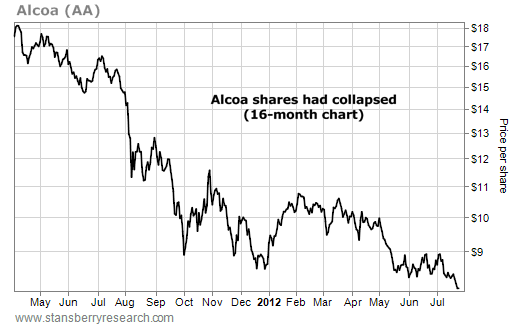
In October 2013, the DailyWealth Trader team recommended shares of aluminum producer Alcoa (AA) in an issue titled "Another 'Bad to Less Bad' Trade with 100% Potential."
From early 2011 through mid-2012, shares had gotten clobbered, falling more than 55% from $18 a share to around $8...
At the time, their reason for recommending buying shares was simple...
Most people are so pessimistic about the world that they can't believe things could actually be getting better. But things are getting a little better... And it's driving the price of economically sensitive stocks higher. It will do the same for Alcoa.
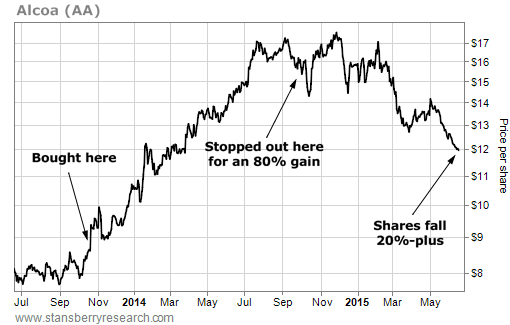
The DailyWealth Trader team thought shares could double. Alcoa wastrading for around $8.75. They recommended setting a "hard" stop – which is just like a trailing stop but based on a set price – around $7.75. This would give subscribers an upside of "at least $8 per share" and a downside risk of just $1 per share.
Two months later, in December 2013, shares were already up 12%... so they told subscribers to raise their hard stops to their entry price of around $8.60. This would guarantee that the "worst-case" scenario would be breaking even on the trade. They changed the "hard" stop loss to a 10% trailing stop later that month as shares continued higher.
By July 2014, the situation had played out just as they predicted. Conditions had gone from "bad" to "less bad"... and Alcoa shares had doubled. The DailyWealth Trader team told subscribers to stay the course, and mind their trailing stop.
Unfortunately, nothing goes straight up forever...
Aluminum prices pulled back again. And in October 2014, subscribers were stopped out of Alcoa at $15.36 a share. Folks who set (and followed) the recommended trailing stop locked in an 80% gain in one year.
But the decline in Alcoa wasn't over... Shares have continued lower this year, and are now down more than 20% since October. As you can see from the chart below, anyone who ignored their stops (or didn't use them) and held on coughed up more than half of their gains over the last eight months...
Speaking of trailing stops, we wanted to let you know the latest news from our friend Dr. Richard Smith. Longtime readers will remember Richard is a mathematics Ph.D. – and former Stansberry Research subscriber – who built the fantastic portfolio-management software TradeStops that we've mentioned many times (and personally use in our own portfolios). He's also helped us improve our recommendations, as Porter mentioned just last week.
One of the biggest complaints we hear when recommending trailing stops is that tracking them is a hassle. TradeStops began as a super-simple way to automate and track your trailing stops... and it does that incredibly well.
But over the last few years, Richard has been quietly working to make TradeStops even better... and when he recently showed us what the new TradeStops can do (and what's coming soon) we were blown away...
In addition to "smart" trailing stops that take the guesswork out of choosing a correctly sized stop for any stock, it now has tools to help you decide how much money to invest in any position, how to easily manage risk in your portfolio, and even tools that help you know when to buy.
There's too much for us to discuss here today, but you'll be hearing more about these features soon. In the meantime, if you'd like to learn more you can read about these features on Richard's TradeStops blog. And if you'd like to try TradeStops for yourself, you can do so here.
Finally, as we mentioned earlier this week, tonight is your last chance to take advantage of Extreme Value editor Dan Ferris' No. 1 recommendation.
If you've been thinking about trying Dan's research but still haven't taken us up on the offer, click here now. This opportunity ends at midnight tonight.
New 52-week highs (as of 6/17/15): American Financial Group (AFG) and Prestige Brands Holdings (PBH).
A subscriber asks about how to allocate his portfolio in today's mailbag. What's on your mind? Let us know at feedback@stansberryresearch.com.
"Hi guys... I've seen several of your writers make the statement that you shouldn't have more than 4-5% of your investment capital in any one stock/investment. That means your portfolio should have 20-25 different stocks/investments. While I can see that for the person with a million dollar portfolio that would make sense, but what about the person just getting started? If they even had as much as $10,000 to work with that would mean investing no more than $400-500 per stock/investment. And if you were a young person who had $500 to get started with, then what? How 'bout some insight on that subject? Thanks." – Paid-up subscriber Ken Brindle
Brill comment: That's a fair question – and one we get from time to time. To answer the first part, our analysts don't recommend putting more than 4% or 5% of your portfolio into any one investment. That's just basic position-sizing advice. But that doesn't mean you have to put 4% or 5% into every position. We also don't recommend putting 100% of your investment capital in stocks. In addition to diversifying into other assets outside of the stock market (see our asset allocation advice here), you'll usually want to keep some portion of your stock portfolio in cash to pick up bargains when they come along.
As for your second question, there's no "one size fits all" answer... but we generally recommend a minimum position size of about $500 for stocks. With smaller positions, brokerage fees will start to eat up a large percentage of your capital.
Regards,
Justin Brill
Baltimore, Maryland
June 18, 2015
|