

What History Says About Stocks This Year
Inflation continues to tick higher... More positive signs for the economy... 'Jobs are pouring in'... Volatility is sending a warning... What history says about stocks this year...
 This morning, the U.S. Department of Labor reported consumer-price inflation rose to a new five-year high last month...
The Consumer Price Index ("CPI") jumped 0.1% in February. While this was the smallest month-over-month increase since last summer, prices are now rising at a 2.7% annualized rate. This is up from 2.5% in January, and the highest rate of inflation since early 2012...

Yesterday, the Labor Department said wholesale price inflation continues to rise, too...
Its Producer Price Index ("PPI") rose 0.3% in February. It's now rising at a 2.2% annualized rate. This is up significantly from just 1.6% in January, and the highest since March 2012...

In other news this morning, the Federal Reserve Bank of New York reported the manufacturing sector continues to recover...
The New York Fed said its Empire State manufacturing index came in at 16.4 in March. This is down slightly from February's two-year high of 18.7, but it marks the fifth straight month of expansion.
As we mentioned last month, this report – along with a similar one from the Philadelphia Fed, due out tomorrow – tends to be correlated with the Institute for Supply Management's closely followed nationwide manufacturing index reported at the end of each month.
We're also beginning to hear some strong anecdotal evidence of economic growth...
Several friends who work in manufacturing and construction have mentioned business is booming in recent months. And our colleague Scott Garliss – editor of our brand-new Stansberry Newswire service – just shared two interesting conversations he has had recently. As he wrote in a private e-mail this morning...
My brother-in-law owns a company that does work for builders. He clears the land, moves dirt, puts in all of the drain pipes, roads, etc. so that the area is ready for the builders to start construction. He has 60 pieces of equipment and just bought a huge new earth mover at an industry convention in Las Vegas.
He told me his backlog is a year currently (above average) and he is seeing a bunch of new jobs to be bid. He saw demand pick up before the market really turned.
The other is from a parent at my son's school. He does industrial fittings for various plants. He said he is headed to West Virginia for the next five weeks to refit a cement plant. In our conversation the other day, he told me he has never been so busy. He said jobs are pouring in and he is having trouble keeping up. He also said the pickup in demand has definitely been correlated with the election.
These jobs trickle a lot of money back into the economy. The workers they employ tend to spend pretty liberally. When we've seen big economic pickups in the past, construction tends to do well. It certainly makes me feel better about the nation's growth potential.
Regular Digest readers know stock market volatility has plunged to historic lows...
As of yesterday's close, the benchmark S&P 500 index has gone 105 consecutive days without a decline of 1% or more. And the CBOE Volatility Index, or "VIX" – the market's so-called "fear gauge" – remains near 10-year lows.
This situation won't last forever. As we wrote in the February 1 Digest, just days after the VIX closed below 11 for the first time in years...
Investors haven't been this complacent in nearly 10 years, since early 2007...
As you can see in the chart above, if there's one certainty in the markets it's this: Periods of market calm and complacency (when the VIX falls into the teens or lower) are always followed by periods of volatility and fear (when it leaps past 20).

But we also warned that history suggested volatility could stay low awhile longer...
In short, our colleague Ben Morris had just looked at 20 years' worth of data and found that whenever the VIX closes below 11, stocks have tended to be less volatile than normal over the following month.
Ben was exactly right... The VIX is trading at just over 11 today, and has remained below 13 since he issued that warning. Meanwhile, the S&P 500 has risen more than 3% over that same time.
Now, Ben says the VIX is sending a much different message...
In this morning's edition of his excellent DailyWealth Trader service, Ben explained why he now expects stock to struggle – and volatility to rise – over the next few months. From the issue...
The most striking thing about the VIX today is that it has stayed at or below 13 – an extremely low level – for more than two months. Since the VIX was created in 1990, this has only happened seven other times.
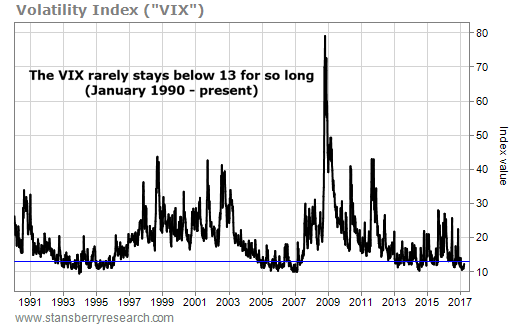
Ben noted each of these seven times occurred during bull markets...
That's not surprising. But what is surprising is what happened to stocks following these signals. More from Ben...
Except for one of the seven occurrences, the S&P 500's one-, two-, and three-month returns were not good. There's a clear negative bias...
(The "Start Date" column marks the end of the second month with a VIX at or below 13... and is the start of the following periods.)
|
Start Date
|
1-Month
|
2-Month
|
3-Month
|
6-Month
|
12-Month
|
|
9/7/1993
|
0.5%
|
-0.2%
|
1.7%
|
1.8%
|
2.9%
|
|
2/2/1994
|
-3.6%
|
-7.0%
|
-6.4%
|
-4.9%
|
-1.9%
|
|
7/29/2005
|
-1.8%
|
-1.4%
|
-4.5%
|
4.1%
|
3.4%
|
|
1/6/2006
|
-2.4%
|
-1.0%
|
0.8%
|
-1.4%
|
9.9%
|
|
4/13/2006
|
0.4%
|
-4.6%
|
-4.1%
|
5.7%
|
14.1%
|
|
11/10/2006
|
2.2%
|
3.7%
|
5.4%
|
9.6%
|
7.3%
|
|
7/15/2014
|
-1.3%
|
0.6%
|
-5.0%
|
2.5%
|
6.8%
|
|
3/2/2017
|
??
|
??
|
??
|
??
|
??
|
|
Average
|
-0.9%
|
-1.4%
|
-1.7%
|
2.5%
|
6.1%
|
|
Median
|
-1.3%
|
-1.0%
|
-4.1%
|
2.5%
|
6.8%
|
|
Up / Down
|
3 / 4
|
2 / 5
|
3 / 4
|
5 / 2
|
6 / 1
|
We can't draw any rock-solid conclusions based on seven occurrences... It's not enough. But the average and median returns going out to three months were all negative... And the S&P 500 generated more negative than positive returns over those periods.
As Ben explained, this doesn't mean you should sell all your stocks...
None of these signals have led to large declines in stocks. But it does mean volatility could rise... And the market could pull back over the next few months...
My advice is to be a little more careful with the timing of your purchases... And be ready for your bullish trades not to work out as well right out of the gate.
In the past, extended periods with an ultra-low VIX have led to sub-par returns. Trade with caution.
History also suggests the market could move higher following any pullback...
Remember that 105-day streak without a 1% or more decline in stocks? According to Ryan Detrick, senior market strategist for LPL Financial, we've seen 12 similar streaks since 1954. And stocks have tended to move much higher over the following year. As he explained in a note this morning...
History would say we can expect more volatility eventually, but this doesn't mean to be on the lookout for a major correction either. In fact, after a streak of 100 or more days without a 1% drop has ended, the S&P 500 has been up a very impressive median return of 14.4% a year later and higher 75% of the time. In other words, a lack of big down days or a lack of volatility by itself isn't a warning sign.
New 52-week highs (as of 3/14/17): American Financial (AFG), Ctrip.com International (CTRP), National Beverage (FIZZ), Alphabet (GOOGL), Goodyear Tire & Rubber (GT), and Johnson & Johnson (JNJ).
A quiet day in the mailbag. Are you seeing signs of economic growth in your area? Let us know at feedback@stansberryresearch.com.
Regards,
Justin Brill
Baltimore, Maryland
March 15, 2017