
Yesterday's 30% plunge... Why you should avoid 'market darlings'... Why we repeat ourselves... A strategy we wish every reader would try...
 Regular readers know we've been following the "business" of online-review website Yelp (YELP). The Stansberry's Investment Advisory team sold shares short in March, and we reviewed their bearish argument in the April 30 Digest...
The company's business model is questionable, many small-business owners (Yelp's primary revenue source) feel extorted, the company will likely have trouble growing in smaller markets and internationally, and it may face legal challenges...
People also claimed that paying Yelp monthly dues positively influenced their reviews. And business owners who didn't pay suffered the consequences – including "fake" reviews from competitors or people who actually write negative reviews for a fee (whom you can find on Craigslist).
In addition, while Yelp is currently operating within the law, one business owner in the Washington, D.C. area is asking the courts to force Yelp to turn over the information of its anonymous reviewers so he can essentially sue them for defamation. The lower courts ordered Yelp to turn over the information... which would be a disaster for the company. After all, how many negative reviews would users give if they knew they could be liable for defamation?
That day, shares fell nearly 25% on lackluster earnings. Yelp management cited slowing growth and reported earnings that fell short of analyst expectations.
But just days later, rumors surfaced that Yelp was working with investment bank Goldman Sachs to find a potential buyer... sending shares soaring higher and triggering the Investment Advisory team's stop loss. They closed the position for a small 1.4% loss.
The timing was unfortunate...
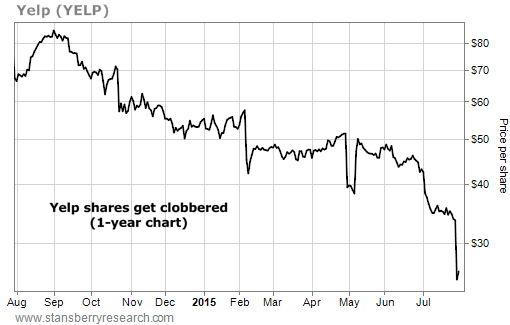
The downtrend in Yelp resumed shortly after the news, and accelerated earlier this month. As we reported in the July 6 Digest, shares plunged more than 13% in a single trading session after the company said the sale process had "stalled."
But the news isn't getting any better...
Yesterday, Yelp reported another round of dismal earnings and the stock crashed another 25%.
The company lost $1.3 million in the second quarter of 2015, down from a profit of $2.7 million in the same period a year ago. Revenue grew at its slowest pace in nearly five years.
Management noted it was having trouble hiring staff and said it would phase out its display advertising by the end of the year. It also cut its earnings forecast for the remainder of the year. Chairman Max Levchin announced his resignation to focus on a new startup company.
To make matters worse, Yelp officials say that recent changes to Google's algorithms have caused declining web traffic to Yelp, which gets a significant portion of its visits from Google searches.
As a result, analysts at investment bank Deutsche Bank downgraded Yelp from "buy" to "hold" and lowered their price target from $56 to $31, citing the company's "deteriorating fundamentals."
This short sale didn't work out as Porter's team had hoped. But as you can see from the chart below, it looks like their analysis was correct. Yelp shares are in a serious downtrend... and it's just the latest example of why we always recommend avoiding – or selling short – expensive "market darlings" with questionable business models...
If you haven't been with us for long, it might seem like we enjoy repeating ourselves...
But as longtime subscribers know, we have one goal at Stansberry Research: To provide you with our best investment ideas and strategies. Or as Porter says, we promise to tell you what we would want to know if our roles were reversed.
So if you find us "hammering" a particular idea in the Digest, please pay attention.
It's only because we think it's a fantastic opportunity... or incredibly important to your long-term investment success. And we've found we have to repeat ourselves over and over again before these ideas finally sink in...
It's why we practically begged readers for months on end to buy cheap blue-chip World Dominators, years before the idea went mainstream.
It's why we've highlighted the huge opportunity in municipal bonds again and again over the past few years.
And it's why we frequently remind folks to use proper position sizing and trailing stops... or to avoid expensive stocks like Yelp and to focus on quality instead.
These are the ideas and strategies we would want to know about if our roles were reversed. And we wouldn't be doing our job if we didn't do our best to make you aware of them.
And there's one idea in particular we think many of our readers could benefit from today. It's our colleague Dr. David "Doc" Eifrig's strategy for earning safe, consistent income streams in his Retirement Trader service.
We're thrilled that thousands of Stansberry Research subscribers have taken our advice and are benefiting from Doc's recommendations. (You'll find a small sample of testimonials in today's mailbag.)
But in today's 0%-interest world, we know many more of our readers could benefit from the safe 12%-20% income streams this strategy generates. Many of us here at Stansberry Research – including Doc himself – use this strategy in our own portfolios.
We've written thousands of words about this strategy, explaining exactly how it works. Yet many folks have still been hesitant to try it.
New 52-week highs (as of 7/29/15): American Financial Group (AFG), Becton Dickinson (BDX), Chubb (CB), CVS Health (CVS), iShares U.S. Insurance Fund (IAK), and SPDR S&P International Health Care Sector Fund (IRY).
In the mailbag, several subscribers share their results with Doc Eifrig's Retirement Trader, and three folks weigh in on Porter's apology. Send your e-mails to feedback@stansberryresearch.com.
"I can't wait to hear from Dr. E. each month. In July I made $5200, yes I am very happy and I have much more confidence to make a sensible, profitable put trade." – Paid-up subscriber Robert M.
"I have been 'trading for income' with Retirement Trader and DWT since January with a 100% success rate. Keep up the good work. I'm getting spoiled, and that's exactly the way I want it." – Paid-up subscriber Ken
"I have been using Doc's strategies in Retirement Trader for a few years now and could not be more pleased. Having been self employed I do not have any kind of work pension and have to rely on whatever government pensions were available plus whatever I could put aside in retirement savings accounts or unregistered accounts. I invest in mostly blue chip dividend payers and then use the margin made available by those to use Doc's trades in Retirement Trader. That provides an extra level of income on top of the dividend paying investments. This year I am on track for about $72,000 in additional income (which I split with my spouse) using Retirement Trader. This from the margin made available from my income investments. Keep up the good work Doc." – Paid-up subscriber George G.
"Hi, I would just like to let you know that under the old delivery system, I never received your newsletters by e-mail to my usual e-mail address (which is at work). I suspect our company firewall blocked them. So I had to set a reminder every month on the expected publication date to go into the website to get the newsletter anyway. Now, with your new method, I have started receiving all your e-mails to my work e-mail, which is much better and more convenient for me. I, for one, am pleased with the change. Thank you." – Paid-up subscriber Jerry
"Porter: I just rolled with it. you know, hey, something new! Not even a minor inconvenience. Just as long as I get the letter, I don't care if it comes by pony express." – Paid-up subscriber Gary A.
"Great explanation, Porter, of why there was a delivery modification of your publications. Bandwidth, expense, copyright, file size, etc. are probably not even considered by the average subscriber when he/she receives your publications. But I think you are being too hard on yourself, i.e., blaming yourself, for subscribers having to change their routine. Rapid change is the law of life, especially in this digital era. An efficient, creative change is always healthy and thought-provoking. Subscribers need to adapt and not cling to the old routine." – Paid-up subscriber M.K.
Regards,
Justin Brill
Baltimore, Maryland
July 30, 2015
|