

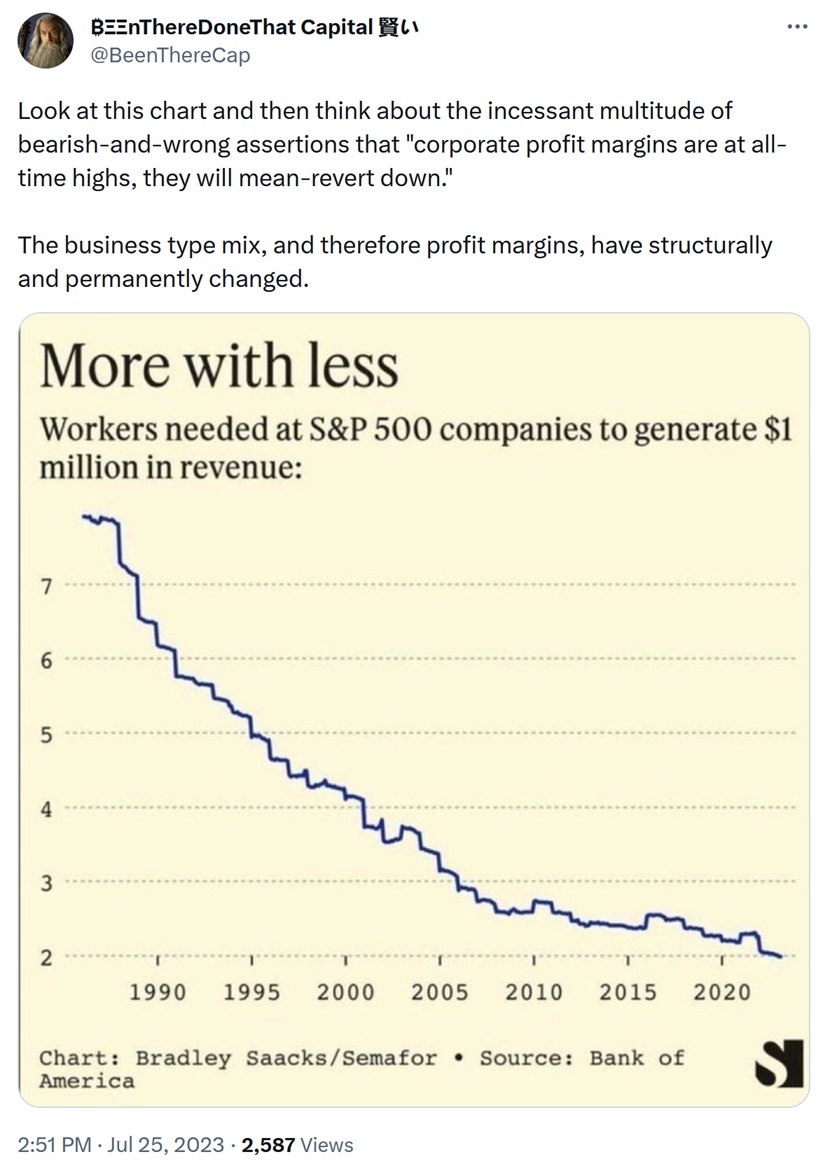
Alphabet's second-quarter earnings; Workers needed to generate $1 million in revenue; Paul Krugman: What Happened to Japan?; ATVs for Ukraine
1) Alphabet (GOOGL), the parent company of Google and YouTube, reported strong second-quarter earnings after the close yesterday and the stock popped as much as 6% this morning.
Revenue rose 7% (9% on a constant currency basis) to $74.6 billion, beating expectations for $72.85 billion, while earnings per share jumped 19% to $1.44, more than the $1.33 expected by analysts.
Alphabet continues to be a cash-generating machine, as operating cash flow was an astounding $28.7 billion in the second quarter – up 48% year over year. This easily funded another $15 billion in share repurchases – the share count is down 3.6% in the past year – and $6.9 billion of capital expenditures.
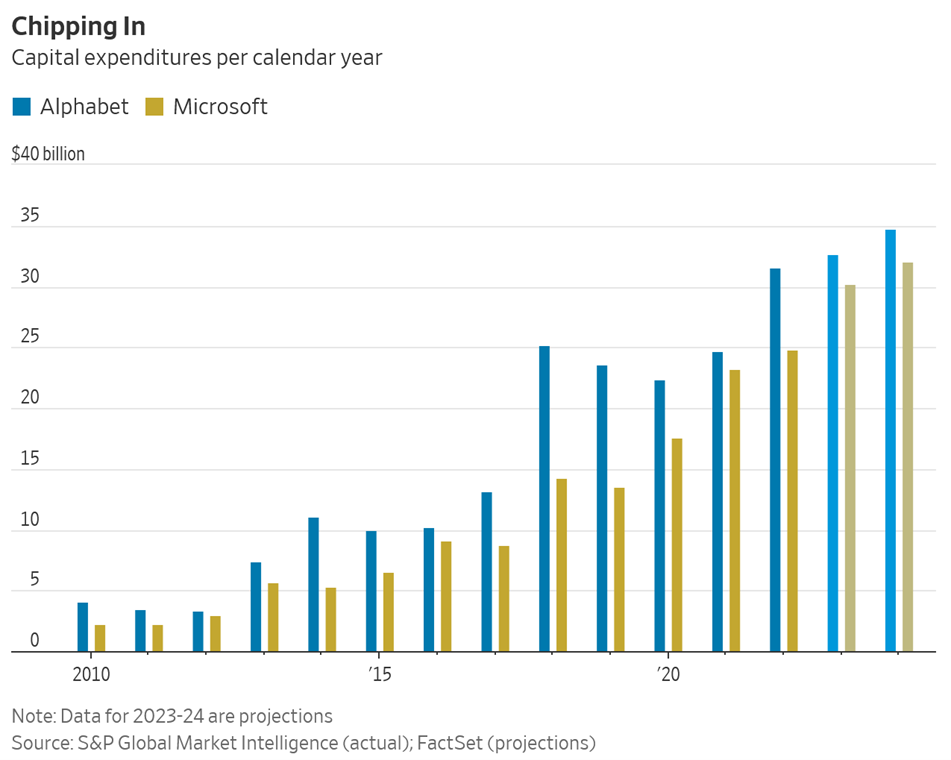
Speaking of which, both Alphabet and fellow tech giant Microsoft (MSFT), which also reported earnings yesterday, are investing heavily in artificial intelligence, which this Wall Street Journal article discusses: Google and Microsoft Paying Big to Play in AI. Excerpt:
Neither earnings release suggests any change in the two companies' pursuit of AI. In fact, both showed why the two are the best suited to build on a technology that requires massive computing resources – and equally massive pocketbooks. Microsoft now generates nearly $60 billion in annual free cash flow, while Alphabet produces $71 billion. Both have had a little over $28 billion in capital expenditures over the past four quarters – more than the annual revenue of three-quarters of the companies in the S&P 500.
And both sent clear signals Tuesday that they would take those numbers even higher. Alphabet's $6.9 billion in capex for the recent quarter came in well below the $8 billion Wall Street had anticipated, but Chief Financial Officer Ruth Porat told analysts on the company's earnings call that it will keep increasing for the rest of this year and into next "to support the opportunities we see in AI" across the company.
In summary, Alphabet's latest earnings report simply reinforces my long-held view that this is one of the greatest businesses of all time, which is why it was one of the four core stocks I recommended – along with Berkshire Hathaway (BRK-B), Amazon (AMZN), and Meta Platforms (META) – when we launched our flagship newsletters, Empire Investment Report and Empire Stock Investor in April and December 2019, respectively.
Since then, GOOGL has doubled, twice the return of the S&P 500 Index. I continue to believe the stock a solid foundation for any portfolio.
You can get lifetime access to Empire Stock Investor – and lifetime access to two more of our publications – and choose to have lifetime access to Empire Investment Report by joining our Empire Junior Partnership – just click here to learn more.
2) Alphabet certainly comes to mind when I look at this chart, which is powerful evidence that corporate profit margins are likely to remain elevated instead of returning to the long-term historical average – which would be great for stocks over time:
3) Love him or hate him (few people seem to be in the middle), Nobel Prize-winning economist and New York Times columnist Paul Krugman is a must-read for anyone interested in economic matters.
Here's his latest missive, What Happened to Japan?, with some very interesting data about Japan since 1990 and implications for China going forward. He concludes:
Which brings me to the question that I raised at the beginning of this newsletter: Will China be the next Japan?
There are some obvious similarities between China now and Japan in 1990. China has a wildly unbalanced economy, with too little consumer demand, kept afloat only by a hypertrophied real estate sector, and its working-age population is declining. Unlike Japan in 1990, most of the Chinese economy is still well behind the technological frontier, so it should have better prospects for rapid productivity growth, but there are growing concerns that China may have fallen into the "middle-income trap" that seems to afflict many emerging economies, which grow rapidly but only up to a point, then stall out.
Yet if China is headed for an economic slowdown, the interesting question is whether it can replicate Japan's social cohesion – its ability to manage slower growth without mass suffering or social instability. I am very definitely not a China expert, but is there any indication that China, especially under an erratic authoritarian regime, is capable of pulling this off? Note that China already has much higher youth unemployment than Japan ever did.
So, no, China isn't likely to be the next Japan, economically speaking. It's probably going to be worse.
4) I got a call a few months ago from someone who wanted to fund an ambulance for Ukraine, but I had already raised enough money for 27 of them... so I suggested (and he agreed) that we use his $120,000 donation to purchase nine ATVs, which are extremely useful for Ukrainian forces to transport supplies and soldiers (sadly, many of them wounded these days).
All but one of the ATVs were acquired and delivered by one of my Ukrainian contacts, Andriy Depko of the charity Stay Safe, who just sent me the pictures below (he's sitting on the ATV in the middle picture), plus this thank-you video.
Slava Ukraini!

If you'd like to help Ukraine, you can support my campaign here: www.taps.org/Tilson.
Best regards,
Whitney
P.S. I welcome your feedback at WTDfeedback@empirefinancialresearch.com.