

Apple's market cap vs. the top 50 Chinese companies; TikTok Ban Faces Obscure Legislative Hurdle; 'Buy Now, Pay Later' Is the Victim of its Own Success; 20 Days in Mariupol
1) This graphic caught my eye:

However...
a) The market caps of the top 10 Chinese companies shown in the orange bar are way off. For example, the market cap of China's largest company, Tencent Holdings, isn't $288 billion as shown above, but $465 billion, 61% higher. The numbers are similar for the other nine companies, so their market caps shown in this tweet must reflect their stock prices from a few months ago, before the huge rally in Chinese stocks.
b) I don't agree that this is "insanity." I'd rather own Apple (AAPL) than the top 50 Chinese companies because I believe Apple's numbers and I don't worry that the U.S. government is going to steal the company from me.
c) This chart is missing China's second-most valuable company, privately held Bytedance, the owner of TikTok, which is worth an estimated $250 billion.
2) Speaking of TikTok, I've long called for the U.S. to ban it entirely until it's 100% owned by a U.S. company (personally, I'd ban it no matter who owns it – what an enormous waste of time and cause of brain damage! – but I'm an old fuddy duddy).
So I was delighted to see this news: Biden signs TikTok ban for government devices, setting up a chaotic 2023 for the app. It's a good start...
But I was disappointed to read this story in yesterday's Wall Street Journal: TikTok Ban Faces Obscure Legislative Hurdle. Excerpt:
As lawmakers push to ban or restrict Chinese-owned TikTok, one of the many hurdles they face is a pair of measures passed by Congress decades ago to let films, books and music flow freely between the U.S. and hostile foreign countries.
The measures, known as the Berman amendments, date to the last years of the Cold War. They took away the president's authority to regulate or ban imports of "informational materials" from adversarial nations such as Cuba, and shielded those who produced such works – and their U.S. distributors – from penalties for violating economic sanctions.
TikTok and other social media platforms weren't around at the time, but the protections were later expanded to effectively extend First Amendment-type protections to foreign digital media and were invoked by TikTok attorneys in their successful 2020 lawsuit to block then-President Donald Trump's attempt to ban downloads of the video app.
The dilemma for lawmakers now: how to write legislation to prevent China's government from influencing content on TikTok or other Chinese social media apps, and gathering data on users, without shutting down global exchanges of content – or inviting retaliation against U.S. platforms and media.
The concern about retaliation is absurd. This ban is only aimed at a Chinese company – and China already blocks our leading tech companies, so that's another reason to ban TikTok: fairness!
3) I was glad to read this article in yesterday's New York Times that this scummy industry is on the rocks: 'Buy Now, Pay Later' Is the Victim of its Own Success. Excerpt:
The industry is now facing an existential crisis, as profits remain elusive, valuations plummet, competition increases and regulators ask tough questions about the lending practices behind B.N.P.L.
To understand why BNPL is so harmful, see this essay by NYU marketing professor Scott Galloway: Red Friday. Excerpt:
Buy Now Pay Later firms are quick to tell you that this is where they make most of their money – off merchants, not millennials. That's true.
But the business model only works by capitalizing on the instinct for immediate gratification. And younger neurons are more vulnerable to this marketing than older ones. The prefrontal cortex – the part of the brain linked to dopamine control and release – only finishes maturing at around 25 years old. As a result, younger people are far more likely to engage in risky behavior in search of instant gratification and quick dopa-hits.
This is what makes trades on Robinhood, likes on Instagram, and purchases on BNPL so much more rewarding to young adults: They're engineered to satisfy their neurocognitive architecture.
The problem is the companies are putting these people in debt. (Something I do every day: "NYU Professor of Marketing." But I digress.)
Australia's financial regulator found 15% of BNPL users had to take out another loan to make their payments, and 1 in 5 had to cut down spending on essentials to make them. In 2019, Australian BNPL providers raked in $43 million in revenue from late fees, up 38% from the previous year. At a major U.K. bank, 10% of customers making BNPL payments overdrew their checking accounts in the same month. The authors of one study dubbed BNPL users "Generation Debt Trap."
Some young people are beginning to catch on. TikTokers are dancing to the caption "crippling debt" after showing themselves purchasing new clothes with Klarna. Will a late BNPL payment hurt your credit score? Some of the companies say it won't, others say it might. But a recent study found that a third of U.S. BNPL users have fallen behind on one or more payments, and 72% of them said their credit score dropped.
4) Susan and I inadvertently booked our ski trip to Deer Valley last week right in the middle of the Sundance Film Festival in nearby Park City, Utah. Initially we thought we'd made a mistake because it significantly increased the price of our lodging and made it hard to get into restaurants, but it actually turned out to be a good thing because we ended up seeing five great movies.
By far the best and most powerful was 20 Days in Mariupol, which won the Audience Award for World Cinema Documentary and will be broadcast nationwide on PBS's Frontline later this year.
It was made by Mstyslav Chernov, a Ukrainian AP video journalist and the only reporter (along with colleagues Evgeniy Maloletka and Vasilisa Stepanenko) to remain in Mariupol once Russia's invasion began.
At enormous risk to their own lives, they stayed and filmed what the Russians did: indiscriminately bombing civilian areas and hospitals, etc. It was absolutely gut-wrenching... Here's a review by The Hollywood Reporter: '20 Days in Mariupol' Review: Harrowing Doc Chronicles Russian Siege of Ukrainian Port City. Excerpt:
The filmmakers capture the shock and agony of the residents as they suddenly find themselves under bombardment. In the immediate aftermath, not all of them were pleased to see the journalists, some reacting with hostility to their presence. "I understand their anger," Chernov comments in his narration. "Their country is being attacked. It's our country, too. And we have to tell its story."
And tell the story they did, at considerable personal risk. We see footage of a terrified little girl, whimpering "I don't want to die, I wish it would all end soon"; a father grieving over the body of his teenage son, who was killed while playing soccer; doctors, hampered by a lack of antibiotics and painkillers, desperately attempting to treat casualties; the dead body of a tiny baby being wrapped in a sheet; burials in mass graves; and people resorting to looting out of desperation and, in some cases, greed. As one doctor comments, war has a tendency to bring out both the best and the worst in people.
It's heartbreaking to see footage of four men carrying a bloodied pregnant woman on a stretcher out of a bombed maternity hospital (we later learn that both she and her unborn baby died). Infuriatingly, the Russian leader and media insist that this scene, and all the rest, is merely staged propaganda designed to rally the world to Ukraine's cause. As Chernov and others in the film point out, this makes their coverage all the more important to counteract Russian disinformation.
At one point, Chernov and his colleague are rescued by Ukrainian solders from a hospital where they had been trapped by snipers. The soldiers had been sent to retrieve the journalists to prevent them from being captured by Russian forces and tortured to make false confessions about their footage being faked. We see the soldiers and journalists running through the streets while under heavy gunfire, the harrowing footage playing out like a scene from a Michael Bay movie.
Chernov spoke afterward and I had the honor of briefly meeting him:
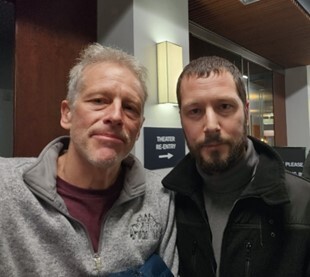
Here's a short interview with him, with clips from the film: Meet the Artist 2023: Mstyslav Chernov on "20 Days in Mariupol."
Russian atrocities continue every day – someone posted this image on Instagram yesterday (warning: it's graphic).
I'm deeply involved in helping Ukraine. If you want to help, I'll share some ideas in a future e-mail...
Best regards,
Whitney
P.S. I welcome your feedback at WTDfeedback@empirefinancialresearch.com.