

'I Call BS to Robinhood's Stock Price'; Buy quality stocks; Going for Broke in Cryptoland; IfYouBuyThisYouAreADumbass Coin; How I went down the COVID-19 rabbit hole
1) Following up on my skeptical comments in yesterday's e-mail about the stock of trading app Robinhood (HOOD), which crashed 28%... here's Doug Kass of Seabreeze Partners, who compares it with other absurd meme stocks, GameStop (GME), and AMC Entertainment (AMC).
I Call BS to Robinhood's Stock Price
- I call BS to those who are now endorsing HOOD's shares
- Many of the same pundits who supported the shares of other meme stocks – like GME and AMC (that have recently crashed and burned) – are now endorsing HOOD
- History will rhyme – and the shares of HOOD will likely fall, similar to the recent drop in the share prices of GME and AMC
- In the fullness of time, Robinhood's shares will likely end up back under its IPO price of $38/share
- In a bear market, HOOD could end up on the top of the ash heap with other speculative gewgaws from the past
- Robinhood is in the unenviable position of being a company that provides a platform for trading its own overpriced meme stock
"What we have learned from history is that we don't learn from history."
– George Hegel
One would have thought that the traders and commentators that backed the stocks of gewgaws (GME) and (AMC) have learned their lessons. After all, since the clamor of buying those meme stocks, the shares have plummeted and can't find a buyer.
In my view, they have apparently not learned their lessons.
But I don't want to bury the lede...
The Unfavorable Comparison of Robinhood's Metrics to That of Schwab and Goldman Sachs
With a market capitalization of about $67 billion, Robinhood's (HOOD) capitalization is more than one-half of each of Goldman Sachs (GS) and Schwab (SCHW) market caps (each possess market caps of $127 billion).
Robinhood's trailing-12-month revenues are only $1.3 billion and their income from continuing operations is a negative $1.3 billion. By contrast, Goldman Sachs' trailing sales are $57 billion, and they earn $20 billion net. Schwab's revenues stand at $15.9 billion, and they earn (net) $4.6 billion.
I would estimate the size of the average Robinhood account is only about $250 compared to over $5 million at Goldman Sachs and $225,000 for Schwab.
Robinhood has big plans to move from being a "one trick pony" and into multiple areas other than online trading of stocks, options, and cryptocurrencies.
Unfortunately, Robinhood is late to the party, and it cannot be questioned that Schwab and Goldman Sachs' client product offerings are expansive and provide a bona fide competitive threat to even the most innovative market entrants.
Will Robinhood Learn From AMC?
In the extreme, AMC's CEO, Adam Aaron, backed and kowtowed to the day traders when he said he was going to back their collective view that the company should not sell equity. I vigorously criticized this move. Since his statement and my criticism, AMC's shares have slipped from over $50/share to $29/share. By siding with day traders and not selling shares to the public, when there was demand, Aaron – who should have been fired – has permanently financially crippled the company he presides over.
As a company, Robinhood faces a similar challenge that AMC faced.
Will they take AMC's path of kowtowing to the perception of its (shaky) shareholder constituency's view and not sell stock or will they be smart and sell primary shares in order to bolster their financial resources?
Which road Robinhood will take – stay a meme or sell primary stock – will be crucial to the company's future success or failure in the deeply competitive and commoditized online trading business.
Robinhood Robs From the Poor and Gives to the Rich
As I was writing this column, Robinhood announced that selling shareholders are planning to sell up to 98 million shares.
None of the proceeds will go to the company.
At least the insiders are not making the same mistake that AMC's Aaron has made.
Enough said.
2) Rather than speculating in junk stocks, where the odds are stacked against you, you will lead a far less stressful, more profitable life if you stick to investing in high-quality businesses – like those Enrique, Berna, and I recommend across our many newsletters. That's how we consistently beat the market – something the vast majority of professional money managers fail to do.
Right now, we're offering a special deal for anyone who'd like to join or upgrade to become a Partner.
Beginning next year, it will cost as much as $15,000. But right now, you have the opportunity to register before the price goes up. Click here for the details.
3) To understand the absurdity of 99% of the crypto world (though not 100%, as I explained in my April 22 e-mail), look no further than this brilliant article by a New York Times reporter, who creates his own cryptocurrency, Idiot Coins: Going for Broke in Cryptoland. Excerpt:
It's hard to think of another financial craze in which so many people poured so much into entities with so little intrinsic value. Few hype coins have any utility as currency. Good luck buying lunch with one. Many are minted in numbers rarely seen outside astronomy books – trillions, quadrillions – which dooms them to vanishingly tiny prices.
From the outside, the hype coin party is a mystery. To understand it, you have to join it.
Which is surprisingly easy. You may have heard that Bitcoin, the granddaddy of crypto, is "mined" by power-gobbling supercomputers, a process that verges on the utterly incomprehensible. Making a hype coin, by contrast, is more like ordering a pizza online. The entire process is automated and speedy. The fixings – in this case, what to call it, how many coins to make and so on – are up to you.
So one day in May, I created my own cryptocurrency. I did it on a Zoom call with an excitable 36-year-old in Taiwan, Dan Arreola, who had posted a tutorial on YouTube about how to make, and promote, a "scam coin." It has more than 240,000 views.
"The lowest cost to launch a token is $8," he said during our call.
That's if you use a site for the tech-savvy. For everyone else, there is Cointool. After a few minutes of tweaking, and about $300 in fees, I pressed a button. Instantly, 21 million coins were minted.
I christened them Idiot Coins.
The name was the first of many "do not buy" signs to potential holders, as crypto investors are called. I didn't actually want this coin to soar in value. I wanted it to flop, spectacularly. The point was to demonstrate that creating a hype coin doesn't take expertise and that many are flimsy and dangerous. Idiot Coin would be a crash test dummy designed to underscore the wisdom of seatbelts. And while laws provide guardrails for these investments, they are mostly ignored. Developers operate with little oversight.
Their main worry is marketing, the fine art of convincing people that a coin will enrich all comers. There are many colorful pages in the hype coin P.R. playbook, and I copied each one – with a twist.
I'm seriously mulling over creating one of my own cryptocurrencies as well, just for fun (and to reinforce the lesson of what total idiocy this is). If so, I'm going to call it IfYouBuyThisYouAreADumbass Coin...
4) The more than 100 responses to my two e-mails last weekend (links here) urging people to get vaccinated are a fascinating insight into the human mind: How do people think? What data or stories do they incorporate into their decision-making? How do they evaluate risk?
Having taught behavioral finance – the study of how people are rational (and irrational) when making financial decisions – for more than two decades, I see many parallels to how people think about the virus, vaccines, the pandemic, and managing risk.
One of the most important takeaways is how easy it is in our highly interconnected world of Facebook (FB), Twitter (TWTR), and YouTube for even the most rational, high-IQ person to have what I call a "brain fart" and go down a mental rabbit hole.
I know... because it happened to me, as I confessed in this e-mail I sent yesterday to an old friend, a successful entrepreneur and venture capitalist, who sent me multiple in-depth e-mails arguing that the public health experts are wrong about pretty much every aspect of the virus and how best to manage the pandemic. I replied:
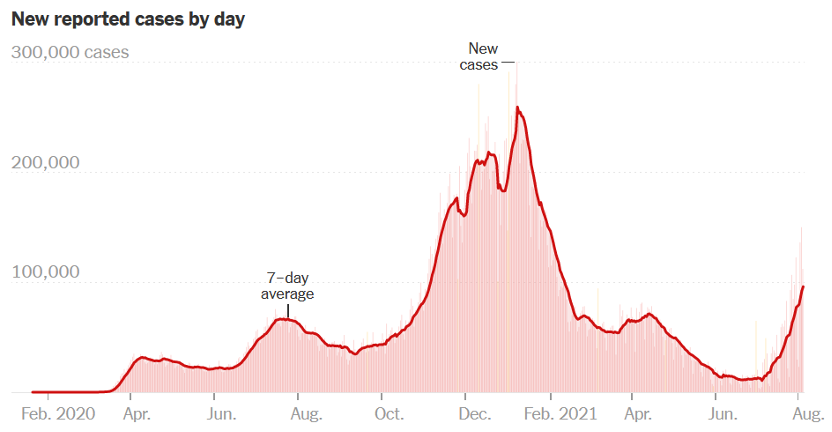
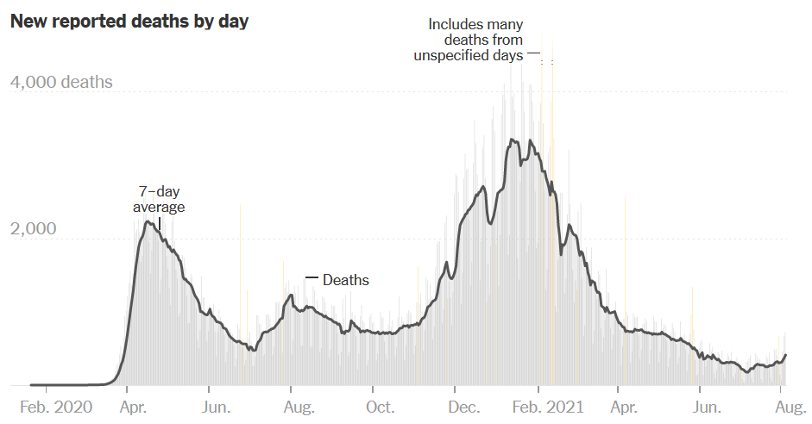
I was doing exactly what you're doing last fall – engaging in long discussions with seemingly smart people – and it led me to some spectacularly embarrassing (because I'm so public) calls such as saying that the third wave wouldn't materialize here because we had reached the herd immunity threshold.
I couldn’t have been more wrong. As you can see in these charts of U.S. cases and deaths, the third wave was a catastrophe, killing 321,341 Americans between November 1 and April 1 (source):
We were all so, so wrong and so, so dumb.
I shudder when I look back on it – how could a smart, rational guy like me have gone so deeply down such a rabbit hole? How could I have possibly thought that some overeducated, arrogant investors (like myself) were right and 99% of the public health experts in the world were wrong?
It certainly gives me a better perspective – and a little humility – on how people can fall for conspiracy theories like QAnon...
I normally don't reply to e-mails like yours because it's clear that I'd be simply wasting my time. But I know you – and therefore know that you’re smart and rational enough to pull yourself out of the rabbit hole you're in.
I wish you luck in doing so!
Lastly, I want to thank Samuel W. for sending me this chart, which makes a case for vaccination better than anything I could write:
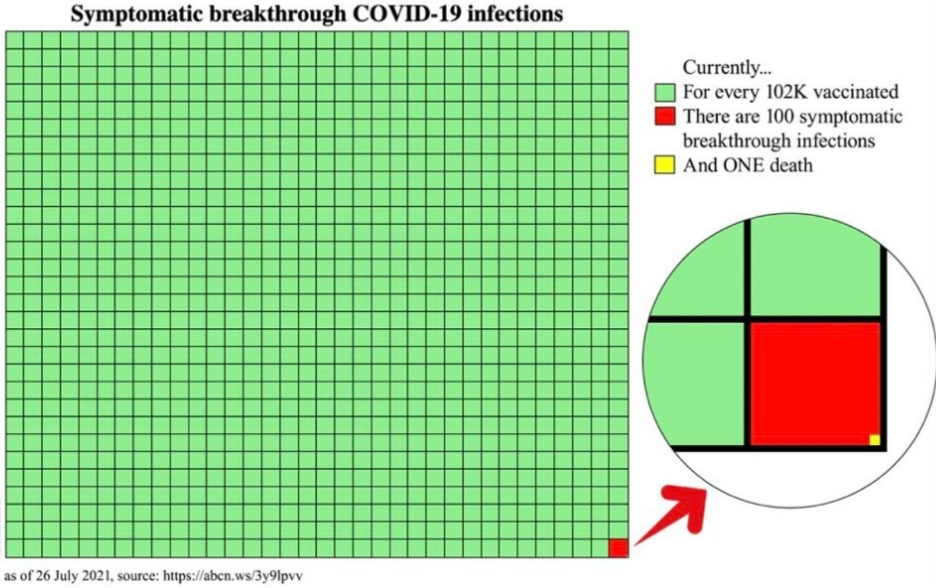
In short, if you get vaccinated, then your odds of getting a symptomatic case of COVID-19 are less than 1 in 1,000 – and your odds of dying are less than 1 in 100,000!
Best regards,
Whitney