

I saw 'GameStop: Rise of the Players' at an AMC theater yesterday; Hedge Fund Melvin Lost $6.8 Billion in a Month. Winning It Back Is Taking a Lot Longer; The Huge Tax Bills That Came Out of Nowhere at Vanguard
1) After Digital World Acquisition (DWAC), my next two top stocks to avoid in 2022 among my Dirty Dozen (which, as of Friday's close, were already down 26% on average versus negative 7% for the S&P 500 Index since I named them on January 4) are GameStop (GME) and AMC Entertainment (AMC).
When I saw that the new documentary GameStop: Rise of the Players was showing at a nearby AMC theater, I figured I could get insight into both companies at the same time, so I went to see the 3:00 p.m. showing yesterday. (You can watch the trailer here.)
What I saw confirmed my view that both stocks are going to collapse this year.
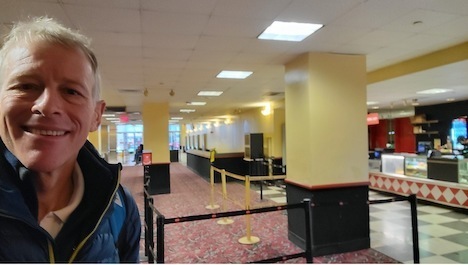
The seven-screen AMC complex on Third Avenue and 87th Street was a ghost town. As you can see in these two pictures, the lobby and concessions areas were empty, and there was maybe a half dozen people in my theater. Yes, there's still a pandemic, but COVID cases in New York City are down by more than 90%...

As for the movie, I enjoyed it, especially seeing my friend Andrew Left of Citron Research, who was refreshingly honest in admitting how he got run over by shorting GameStop (and subsequently pledged never to publish short research again, which is a shame because he did a great service for the markets, exposing all sorts of fraud and overvaluation).
The bulk of the movie profiles a small handful of mostly individual investors who bet on GameStop's turnaround. I have to tip my hat to them for correctly identifying a stock that wasn't going bankrupt immediately and would catch a tailwind from the late 2020 launch of the new Xbox and PlayStation consoles.
But their bull case for the stock did not change my mind that this is a dying business that will ultimately go away entirely. There's simply no reason for GameStop to exist.
Take a look at this chart of the company's revenue and operating income since 1999:
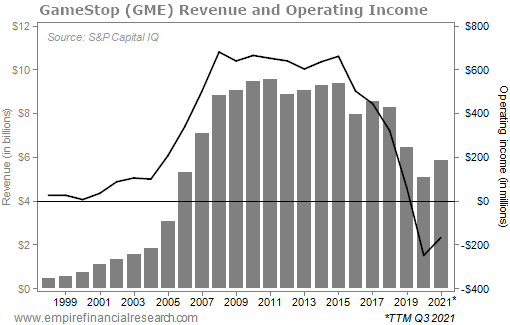
You can see that it was a robust growth story for a full decade, then turned into a decent cash cow, with stable revenue and an annual operating income of around $650 million for eight consecutive years, but then went into steep decline starting in 2016, with profits turning to losses the last two years.
If you didn't know what company this was – just that it was a retailer – and simply looked at that chart, how would you value it? Maybe 50% of revenue? (That's being generous – it's where Best Buy (BBY), a far superior company, trades.)
If so, with a trailing 12-month revenue of $5.9 billion, GameStop would be valued at just less than $3 billion.
Today, its market cap and enterprise value are more than double that, at $7.5 billion and $6.7 billion, respectively. (The company has nearly $800 million of net cash because it smartly used its inflated share price to issue stock last year and raise $1.7 billion of cash.)
My price target is $50, down more than 50% from here.
That said, I wouldn't short this stock. It's "only" 2 times overvalued – and you never know when the Reddit crowd might fall in love with it again and jam it upward...
2) Speaking of people who got run over by GameStop, here's an in-depth story in the Wall Street Journal about Gabe Plotkin of Melvin Capital, who's trying to recover from losing $6.8 billion last January shorting GameStop and other meme stocks. After being down 54.5% that month, he was actually up 33.4% the rest of the year, but lost 17% in the first three weeks of this year... Hedge Fund Melvin Lost $6.8 Billion in a Month. Winning It Back Is Taking a Lot Longer. Excerpt:
Gabe Plotkin wasn't sleeping. His bets against meme stocks such as GameStop were backfiring, and losses at his $12.5 billion hedge fund were mounting. Strangers angry about his wagers were bombarding him with threatening messages and texts.
At the worst point in January 2021, Melvin Capital Management was losing more than $1 billion a day as individual investors on online forums such as Reddit banded together to push up prices of stocks Melvin was betting against. "We were in a terrible position. Stared death in the face," Mr. Plotkin told employees in a Zoom meeting late that month. "But we've made it through."
The damage, though, was severe. Melvin's loss that month was 54.5%, or roughly $6.8 billion, one of the swiftest and steepest declines for a hedge fund since the financial crisis of 2008...
Mr. Plotkin and his top deputies, including Chief Operating Officer David Kurd and partner Greyson Clymer, stayed up late into the nights plotting their strategy for survival.
They sold down stakes in some companies, exited the short bets they could and cut Melvin's leverage to the lowest level since its launch, while trying to preserve what they could of the portfolio. The firm was out of its GameStop short position by the market's close on Jan. 26.Other prominent hedge funds had double-digit percentage losses in January, too, but Melvin's wounds were the deepest, according to industry executives.
Melvin executives told clients the rules of the game had changed overnight. In a call near the end of January, Mr. Plotkin told investors that Melvin's process was sound, just not geared for an aberrant, social-media-fueled tidal wave no one could foresee. He outlined changes Melvin would make to safeguard against another such episode.
Almost no clients pulled out their money over the course of the year, people familiar with the firm said. Melvin took in billions of dollars more from new and existing clients, a show of faith in Mr. Plotkin that also provided a new source of management and performance fees.
3) Vanguard is one of the world's most reputable money management firms, having pioneered index funds, so I was shocked to read this: The Huge Tax Bills That Came Out of Nowhere at Vanguard. Excerpt:
It's easy for a small investor to make big mistakes. It would be even easier for giant investment firms to help prevent them – but, sadly, the asset-management industry seems to have other priorities.
Just look at what happened last month to some investors in Vanguard's Target Retirement funds. They got whacked with huge capital-gains distributions. Those payouts triggered painful tax bills they could easily have avoided if Vanguard had simply warned them not to hold these funds outside of a tax-advantaged retirement account.
Make sure you don't make this mistake!
Best regards,
Whitney
P.S. I welcome your feedback at WTDfeedback@empirefinancialresearch.com.