

Last night's event; Stan Druckenmiller Recounts His $3 Billion 'Lesson' From The Tech Bubble; Big Tech's Big Problem; The Social Dilemma; SEC Gives More Investors Access to Private Equity, Hedge Funds; I've applied for the next Eco-Challenge
1) Did you miss last night's big event?
Along with my colleagues Enrique Abeyta and Berna Barshay, I hosted a special webinar to discuss the upcoming November election and its potential effect on the markets.
I made a big prediction for the outcome... and put together a brand-new model portfolio of eight world-class businesses that I expect big things from leading up to the election and beyond.
But if I'm right about the outcome of the election, these stocks could absolutely soar.
If you missed the event, you're in luck... For a limited time, you can watch a replay right here.
2) Kudos to Stanley Druckenmiller – one of the all-time great investors – for sharing how he got sucked into the Internet bubble right at its peak because he couldn't stand the pain of seeing everyone else making so much money.
It's a good lesson for today's many bull market geniuses... Stan Druckenmiller Recounts His $3 Billion 'Lesson' From The Tech Bubble. Excerpt:
"So, I'll never forget it. January of 2000 I go into Soros's office and I say I'm selling all the tech stocks, selling everything.
This is crazy at 104 times earnings. This is nuts. Just kind of as I explained earlier, we're going to step aside, wait for the next fat pitch. I didn't fire the two gun slingers. They didn't have enough money to really hurt the fund, but they started making 3 percent a day and I'm out.
It is driving me nuts. I mean their little account is like up 50 percent on the year. I think Quantum was up seven. It's just sitting there...
So like around March I could feel it coming. I just – I had to play. I couldn't help myself. And three times during the same week I pick up a – don't do it. Don't do it. Anyway, I pick up the phone finally.
I think I missed the top by an hour. I bought $6 billion worth of tech stocks... and in six weeks I had left Soros and I had lost $3 billion in that one play.
You asked me what I learned. I didn't learn anything.
I already knew that I wasn't supposed to that.
I was just an emotional basket case and couldn't help myself.
So, maybe I learned not to do it again. but I already knew that.
3) In her Empire Financial Daily e-letter yesterday, my colleague Berna Barshay wrote a smart piece, Big Tech's Big Problem, about the challenges that social media giants like Facebook (FB) and Twitter (TWTR) face in dealing with conspiracy theories like QAnon. Excerpt:
While conspiracy theories have always existed, the Internet and social media have greatly increased the ability to spread misinformation widely, quickly, and cheaply. We've seen this with events ranging from 9/11 to Sandy Hook, and in the arena of public health, with false information about vaccines and COVID-19 spreading like wildfire. One can only imagine what things would have been like if social media existed in the 1960s during the time of the assassinations of JFK, RFK, and MLK.
As we've seen with anti-vaxxer misinformation campaigns, propaganda can draw in the far left just as efficiently as the far right. And the fanatical idea that 9/11 was a "false flag," inside job by the U.S. government also holds nearly equal appeal on both the right and the left. A 2016 poll by YouGov found that 17% of Clinton voters and 15% of Trump voters believe "the U.S. government definitely or probably helped plan 9/11."
As a society, we must confront the rapid spread of conspiracy theories in general, QAnon included. But as we inevitably kick the can on that, conspiracy movements present a clear and present danger to social media businesses, who could ultimately pay a regulatory price for promoting them. Nowhere is the problem as acute as at Facebook, whose recommendation algorithm has been widely accused of pushing people to QAnon.
This reminded me of the new documentary I just watched on Netflix, The Social Dilemma, which "explores how addiction and privacy breaches are features, not bugs, of social media platforms."
It's pretty darn scary, as this review in the New York Times highlights: 'The Social Dilemma' Review: Unplug and Run. Excerpt:
That social media can be addictive and creepy isn't a revelation to anyone who uses Facebook, Twitter, Instagram and the like. But in Jeff Orlowski's documentary "The Social Dilemma," conscientious defectors from these companies explain that the perniciousness of social networking platforms is a feature, not a bug.
They claim that the manipulation of human behavior for profit is coded into these companies with Machiavellian precision: Infinite scrolling and push notifications keep users constantly engaged; personalized recommendations use data not just to predict but also to influence our actions, turning users into easy prey for advertisers and propagandists.
As in his documentaries about climate change, Chasing Ice and Chasing Coral, Orlowski takes a reality that can seem too colossal and abstract for a layperson to grasp, let alone care about, and scales it down to a human level. In "The Social Dilemma," he recasts one of the oldest tropes of the horror genre – Dr. Frankenstein, the scientist who went too far – for the digital age.
In briskly edited interviews, Orlowski speaks with men and (a few) women who helped build social media and now fear the effects of their creations on users' mental health and the foundations of democracy. They deliver their cautionary testimonies with the force of a start-up pitch, employing crisp aphorisms and pithy analogies.
"Never before in history have 50 designers made decisions that would have an impact on two billion people," says Tristan Harris, a former design ethicist at Google. Anna Lembke, an addiction expert at Stanford University, explains that these companies exploit the brain's evolutionary need for interpersonal connection. And Roger McNamee, an early investor in Facebook, delivers a chilling allegation: Russia didn't hack Facebook; it simply used the platform.
Much of this is familiar, but "The Social Dilemma" goes the extra explainer-mile by interspersing the interviews with P.S.A.-style fictional scenes of a suburban family suffering the consequences of social-media addiction. There are silent dinners, a pubescent daughter (Sophia Hammons) with self-image issues and a teenage son (Skyler Gisondo) who's radicalized by YouTube recommendations promoting a vague ideology.
4) I have mixed feelings about what the U.S. Securities and Exchange Commission ("SEC") did recently: SEC Gives More Investors Access to Private Equity, Hedge Funds. Excerpt:
The Securities and Exchange Commission deemed more investors capable of navigating the opaque world of leveraged buyouts, hedge funds, and startups, a decision likely to fuel further growth in loosely regulated private markets.
Commissioners voted 3-2 on Wednesday to approve a proposal expanding its definition of so-called accredited investors to include holders of an entry-level stockbroker's license, "knowledgeable employees" of nonpublic firms and others. It also opened the door to further broadening the category to holders of other credentials.
Until now, investors could be considered accredited if they had $1 million in net assets, not counting their primary residence, or at least $200,000 in annual income.
The thresholds aren't indexed for inflation, so the ranks of people who meet them will likely continue to grow.
The SEC didn't provide an estimate of the number of people who would qualify under the new rule, but its decision to designate certain credentials as a measure of financial literacy is likely to prompt other groups – from chartered financial analysts to holders of law degrees and MBAs – to seek accredited-investor status.
"Now that they've opened this door, there's going to be a lot of trucks trying to drive through," said Tyler Gellasch, executive director of Healthy Markets, an investor group focused on market structure. "It's really hard for them to credibly distinguish one qualification from another."
When I ran various hedge funds for nearly two decades, I always found it irritating that I had to verify that every investor was accredited – or, worse yet, had to turn away prospective investors.
But I understood and accepted the trade-off: I had to limit both the number and type of investors in exchange for far less oversight and regulation (than, for example, mutual funds, which are open to all). I worry that by opening up "the opaque world of leveraged buyouts, hedge funds, and startups" to millions more Americans, we'll see a rise in the number of folks who lose a lot of money – whether through highly risky and speculative investments going bad or even outright fraud...
5) Every year for the past six years, I've tackled a big challenge to push myself physically and mentally – and to raise money for my favorite charity, KIPP charter schools.
It started in 2014 with a program called "Leadership Under Fire," a 62-hour beatdown run by some ex-Navy SEALs (here's an article about it: Hedge fund and finance gods are spending their weekends doing an intense Navy SEAL training program). It continued with the NYC Marathon, the World's Toughest Mudder, climbing various peaks in the Alps and, just three months ago, climbing The Nose of El Capitan in Yosemite (here's a link to my write-ups and pictures of these adventures – warning: it's 489 pages!).
So, it probably won't surprise you that, last month, when I started watching a new 10-episode series on Amazon's (AMZN) Prime Video, World's Toughest Race: Eco-Challenge Fiji, I quickly decided that I wanted to do it.
Within a few days, I recruited three friends – all world-class athletes in different disciplines: ultramarathons (Charlotte), kayaking (Bob), and rugby (Marcus) – and we submitted an application, which includes a video (you can watch ours here – I suggest watching it at 1.25x or 1.5x speed).
None of us have ever done this type of race, but we've all done plenty of somewhat-related crazy things... so I think we have the skills, endurance, stubbornness, and tolerance for pain and suffering that's required to do well. We're not going to be on the podium, but I think we could win the "200-plus" age group (by next year, our average age will be 50 and our combined age 200 – I don't think that's an actual category, but I'm declaring it as one!).
I'll let you know if they pick us!
If they do, the race will be next year in the Patagonia region of Argentina, either in February (COVID-19 permitting) or (more likely, I suspect) November.
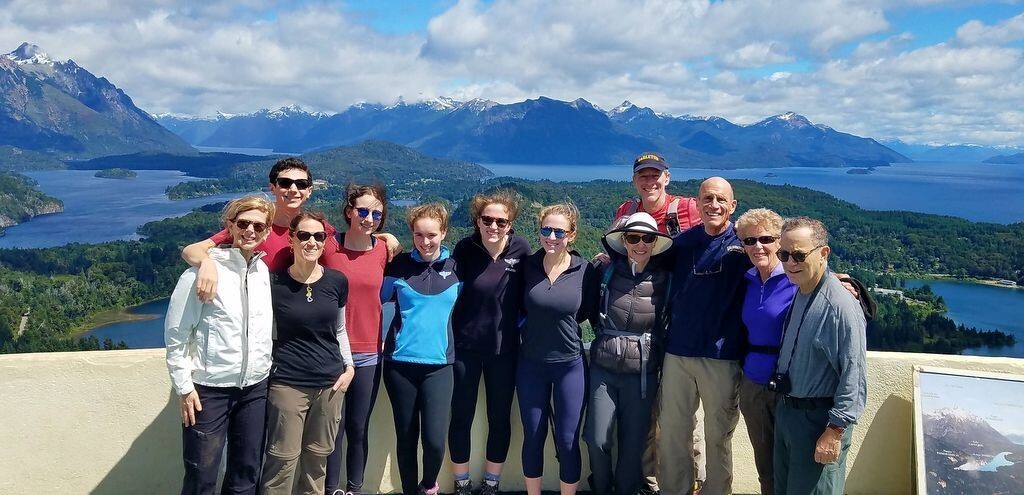
P.S. My extended family spent the holidays in Argentina in December 2017 – here's a picture of us in Patagonia, which is absolutely gorgeous. It reminds me of the Swiss Alps:
Best regards,
Whitney