

Manhattan Emptied Out During the Pandemic. But Big Tech Is Moving In; String of Firms That Imploded Have Something in Common: Ernst & Young Audited Them; SEC investigating Loop Industries; Friendly wager on the presidential election for charity; How I mitigate risk when I climb
1) This is great to see: Manhattan Emptied Out During the Pandemic. But Big Tech Is Moving In. Excerpt:
Facebook has just leased enough new office space in Manhattan to nearly triple its current local work force, including at one of the city's most iconic buildings, the 107-year-old former main post office complex near Pennsylvania Station.
Apple, which set up its first office in New York a decade ago, is expanding to another building in Manhattan. And Google and Amazon are stitching together corporate campuses in the city more quickly than anywhere else in the world. Amazon paid roughly $1 billion in March for the iconic Lord & Taylor building on Fifth Avenue.
Despite a pandemic that has ravaged New York, hollowed out many of its office buildings and raised fundamental questions about its future, the four companies collectively known as Big Tech are all significantly expanding their footprint in the city, giving it a badly needed vote of confidence.
With fears that the virus could spike again in the colder months, many companies are grappling with how, when and even if office workers will come back to buildings in Manhattan. And the tech giants have not brought their workers back yet, either.
Even so, the giants have not only moved forward with previous growth plans, but have also increased their pace of hiring and office acquisition during the pandemic.
2) I hope this Wall Street Journal article brings about much-needed change not only at Ernst & Young, but at all of the big accounting firms: String of Firms That Imploded Have Something in Common: Ernst & Young Audited Them. Excerpt:
This year, $2 billion is missing at a German fintech company, $300 million of sales has been found to be fabricated at a Chinese coffee chain, and $5 billion in undisclosed debt has been uncovered at two related companies listed in the U.K. Together, the incidents cost shareholders of the companies roughly $30 billion.
All had been audited by Ernst & Young. Last year, EY also audited office-space company WeWork, which nearly collapsed after fumbling a planned initial public offering.
EY is one of the Big Four accounting firms, whose audits are meant to give investors confidence in companies' figures. EY missed red flags or failed to aggressively pursue them at some of the companies ahead of their scandals, and for the most part it was outsiders who raised questions first, a review based on publicly available documents and interviews with people close to the events shows. Now, regulators are scrutinizing EY's work.
The EY audit clients that faced financial issues were German payments processor Wirecard; China's Luckin Coffee; hospital operator NMC Health; and NMC sister company Finablr, which owned the Travelex currency service.
3) In Wednesday's e-mail, I wrote:
Nate Anderson of Hindenburg Research – who wrote the report that exposed the electric-truck developer's deception – released another short report yesterday on plastics recycler Loop Industries (LOOP), which crashed the stock by 33%. Here's a link to it: Loop Industries: Former Employees and Plastics Experts Blow the Whistle on This "Recycled" Smoke and Mirrors Show.
Sure enough, Loop disclosed in a filing last week that it has "received a subpoena from the U.S. Securities and Exchange Commission ('SEC') requesting certain information from the Company, including information regarding testing, testing results, and details of results from our Gen I and Gen II technologies and certain of our partnerships and agreements."
4) According to nearly every poll and betting site, President Donald Trump is likely to lose his bid for re-election in two weeks.
However, there's a wide range of estimates regarding how much of an underdog he is – The Economist gives him a mere 8% chance of victory, while real-money betting site PredictIt gives him a robust 40% chance.
I think that Biden is going to win (to be clear: I'm not making a political statement about what I want to happen... rather, this is my best, unemotional assessment of the odds).
If you disagree and think President Trump is going to pull another upset, then let's make a friendly wager to benefit either your favorite charity or mine (KIPP charter schools in New York City, on whose board I've served for the past two decades).
This is something I've done for each of the last three presidential elections, and it's raised nearly $100,000 for KIPP and various other wonderful charities.
To participate, all you have to do is e-mail me at WTilson@empirefinancialresearch.com and let me know how much you'd like to wager, ranging from a minimum of $100 to a maximum of $2,500. I will accept all offers up to a total of $25,000.
5) My guide and I are continuing to climb every day in Red Rock Canyon National Conservation Area on the outskirts of Las Vegas. I've been posting pictures and descriptions on Facebook here: Thursday, Friday, Saturday, Sunday, and Monday.
Here's one of my favorite pictures, going up a chimney on an iconic route named Epinephrine:
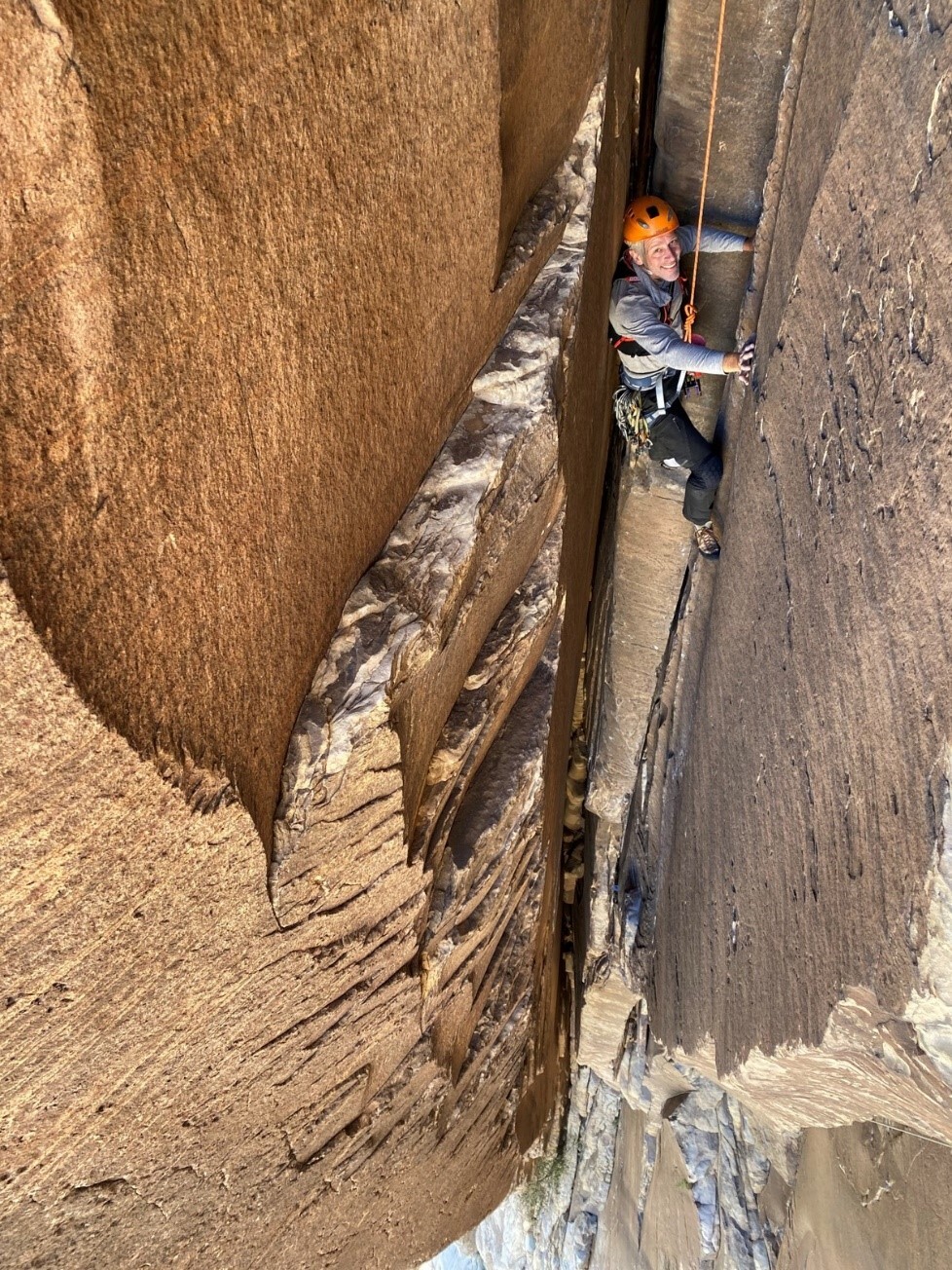
When you look at a picture like that, you may think I have a death wish... But rest assured, I don't!
I think about risk a lot, both in my professional life as an investor, as well as in my personal life. In both areas, it's OK to take risk if: a) the reward is sufficient... and b) you take steps to reduce the risk as much as possible.
To me, the joy I get from climbing is worth taking some risk – but I would never, for example, climb without a rope – as Alex Honnold did in the movie Free Solo.
In fact, I take many steps to reduce risk, as I discuss in this excerpt from my forthcoming book, The Art of Playing Defense:
In the summer of 2015, my wife Susan and I did the famous Haute Route, a week-long, hut-to-hut glacier trek from Chamonix, France, at the base of Mt. Blanc, the highest peak in the Alps, to Zermatt, Switzerland, at the base of one of the world's most iconic peaks, the Matterhorn. We discovered that we both love trekking and climbing in the mountains, enjoying the spectacular beauty of the great outdoors and the physical and mental challenges. But unlike Susan, when I looked up at Mt. Blanc and the Matterhorn, I had a burning desire to climb them, so I vowed to come back the next year and try.
Before doing so, however, I did some research on how dangerous they are. I learned that a handful of people die on these peaks every year – roughly 1 of every 5,000 people who attempt Mt. Blanc and 1 in 2,000 on the hairier Matterhorn. I didn't like those odds, but when I dug deeper, it turned out that most deaths occurred among inexperienced amateurs climbing without guides. In fact, I couldn't find a single story about someone dying while roped to a professional guide.
So I decided to do two things: 1) get training; and 2) hire Geoffroy Arvis, one of the two professionals who'd guided Susan and me (and five others) on the Haute Route.
To learn the basics of rock climbing and mountaineering, I signed up for a five-day private training course at a mountaineering school called Petra Cliffs in Burlington, Vermont. The husband-and-wife team who run it, Steve and Andrea Charest, took me into the White Mountains and gave me a crash course on equipment, knots, lead climbing, and many other skills.
Then, when I actually did the climbs, I was roped to Geoffroy at every moment, which certainly aligned our interests! He is one of only roughly 6,000 people to be certified by the International Federation of Mountain Guides Associations. These guys are superstars. They go through a rigorous, multiyear training program, so they are superior climbers and skiers, know the mountains, understand weather patterns, and can identify hidden dangers like crevasses and avalanche zones.
A guide's job is not only to keep you safe on the mountain, but perhaps even more importantly, keep you off the mountain if snow or weather conditions are dangerous. For example, I met Geoffroy in Chamonix on July 1, 2017 for our planned ascent of Mt. Blanc the next two days. But on the morning of the 2nd, he looked at the forecast and didn't like what he saw – showers and thunderstorms in the afternoon – so he delayed us by a day.
Had I been on my own, I probably would have risked it because I was on a tight schedule. The plan called for us to summit and then descend Mt. Blanc on July 3, drive to Zermatt on the morning of the 4th, and hike up to the hut at the base of the Matterhorn that afternoon. Then, we'd summit on the morning of the 5th and I'd take a train back to Geneva that afternoon to catch my flight home the next morning.
By delaying us by a day, Geoffroy killed my plans to climb the Matterhorn on this trip – I ended up having to fly back to Europe to climb it a month later – but that wasn't his concern. He was too wise and experienced to mess around with thunderstorms.
Sure enough, soon thereafter an American woman was killed by a lightning strike near the summit of the Matterhorn. Her mistake was still being on the mountain in the late afternoon when storms tend to come in. In contrast, when I climbed both Mt. Blanc and the Matterhorn, Geoffroy had us out of the hut at 4 a.m., on the summit by 9 a.m., and back in the hut, enjoying lunch, by 1 p.m.
Lastly, Geoffroy kept me safe when we were climbing. I can't imagine doing either of these climbs without a seasoned guide. Though the routes were well-trafficked, there were many times when I could have gotten off the trail – which can be deadly. There are dozens of places where one slip can lead to a fatal fall.
After hearing about my climbs in the Alps and, more recently, Yosemite, people often ask me if my next goal is to climb Mount Everest. My answer is always, "absolutely not." The highest peak in the Alps, Mt. Blanc, is only 15,781 feet, well below Everest's 29,029. In the Alps, there's no "death zone," whereas near the top of Everest, the air is so thin you can only survive for a few hours without supplemental oxygen. Eight percent of climbers who have attempted Everest have died. It's much lower if you exclude those who climbed without oxygen or guides, but it's still an unacceptable level of risk for me.
Best regards,
Whitney