

Michael Lewis Doesn't Do Villains; Everybody's Talking About the Wrong Sam Bankman-Fried Book; 10- and 30-year bonds have lost half their value; S&P 500 max drawdowns and returns since 1980; Why attacks on civilians in Ukraine and Israel will backfire
1) Following up on last week's e-mail about Michael Lewis's new book about Sam Bankman-Fried, Going Infinite: The Rise and Fall of a New Tycoon, Lewis has come under substantial fire.
Critics are condemning Lewis for having fallen under SBF's spell and writing a book that lamely excuses SBF rather than exposing him for the obvious fraudster that he is. Here's a good summary of the argument: Review: Michael Lewis's Going Infinite. Excerpt:
A writer of Lewis's caliber presumably also knows of many parables about people who get too close to a subject to be able to view it objectively, too, but those don't earn a place in the book.
At no point does Lewis seem to reflect on whether the six months he spent shadowing Bankman-Fried prior to the CEO's fall from grace – during which Lewis thought he was writing the story of a nerdy tycoon's rise to unimaginable wealth and influence in a possible new sector of finance – may have influenced his own evaluation of the situation.
The time Lewis spent observing Bankman-Fried in the company's ritzy Bahamian offices, joining him on travels abroad, and even accompanying him to parties where they brushed elbows with the likes of Hillary Clinton and Leonardo DiCaprio certainly seems to have endeared the fallen billionaire and now accused fraudster to Lewis, who throughout the book continuously overlooks red flags and omits context that would paint a very different picture.
To this day, Bankman-Fried claims that the collapse of FTX, and the more than $8 billion in missing customer funds, is all the result of mismanagement and sloppy record-keeping, but not intentional fraud.
By writing a book that largely backs up Bankman-Fried's claims, Lewis seems to be staking his own substantial reputation on this being the truth – or, at least, on the government being unable to prove beyond a reasonable doubt that it isn't. If Bankman-Fried is convicted in the upcoming trial, Lewis's book will take an awkward place on the shelves of history...
Far from providing an incisive inside view into a historic collapse that saw billions of dollars go up in flames at the expense of multitudes of people who were financially ruined, Lewis has still produced the hero story he originally set out to write.
By the end of Lewis's first ever conversation with Bankman-Fried, he writes: "I was totally sold." By the end of the book chronicling the same man through his company's dramatic collapse, that doesn't seem to have changed.
And here's a New York Times review along the same lines: Michael Lewis Doesn't Do Villains. Excerpt:
With his new book about the crypto mogul Sam Bankman-Fried – and new questions about his old work – the famously charmed writer finds himself under a microscope.
One of my readers suggested that there's a better book about him and the crypto industry, Number Go Up: Inside Crypto's Wild Rise and Staggering Fall, by Bloomberg reporter Zeke Faux. This reviewer in Wired agrees: Everybody's Talking About the Wrong Sam Bankman-Fried Book. Excerpt:
Going Infinite suffers immensely by comparison to another new book covering the SBF saga. Bloomberg reporter Zeke Faux's rollicking Number Go Up: Inside Crypto's Wild Rise and Staggering Fall, which came out in September, is the far superior guide to understanding the FTX debacle and Bankman-Fried himself.
It is worth noting that both Faux's and Lewis' books open with the writers confessing that they'd been initially taken in by SBF and describe conversations they'd had with him before his downfall, but there is a key distinction. Lewis recounts how impressed he'd been without hinting that he no longer feels that way.
Faux takes a different approach. The opening line is a quote from Bankman-Fried: "I'm not going to lie," SBF promises Faux. "This was a lie," Faux writes. This accomplishes two things: First, it signals immediately to the reader that Faux now gets it, that he knows Bankman-Fried was full of it. Second, it's funny...
While SBF appears in the opening of Number Go Up, it's not solely focused on the FTX debacle; in fact, Faux spends more time trying to understand how the stablecoin Tether continues to function, and he recounts a harrowing trip to Cambodia to observe perhaps the most depraved pocket of the cryptocurrency world, the flat-out evil cottage industry of "pig-butchering" scams.
People in the United States often find out about these scams by getting odd direct messages and texts from unknown numbers, who then spark up a conversation with them. If the conversations continue long enough, these strangers will inevitably start suggesting that they might be able to help the person at the other end make money in the crypto markets.
The reality behind these messages is pitch-black: organized criminals are trafficking people and forcing them to trick Westerners into sending them cryptocurrency, beating and sometimes even killing those who fail to successfully pull off enough scams.
It is by treating Sam Bankman-Fried in this way – as just one among many weirdos making bank, neither the silliest nor the most evil – that Faux gives readers a clearer view of the man, more so than Lewis' close-read search for meaning. In Number Go Up, Faux points out that SBF had, before his downfall, "all but admitted that much of his industry was built on bullshit."...
Reading Going Infinite, it's easy to be reminded of the box metaphor, because it's clear that Lewis aches for Bankman-Fried to be, underneath it all, a man of misunderstood substance.
This is the strength of Number Go Up: It doesn't pretend there's something inside, just beyond our reach. Instead, Faux explores how flimsy the whole crypto industry really is, including its fallen bigwigs – and how the deep part is the delusion that powered it. Sometimes a mysterious box is just empty.
I've downloaded it and, when I get a chance to listen to both books, will let you know what I think.
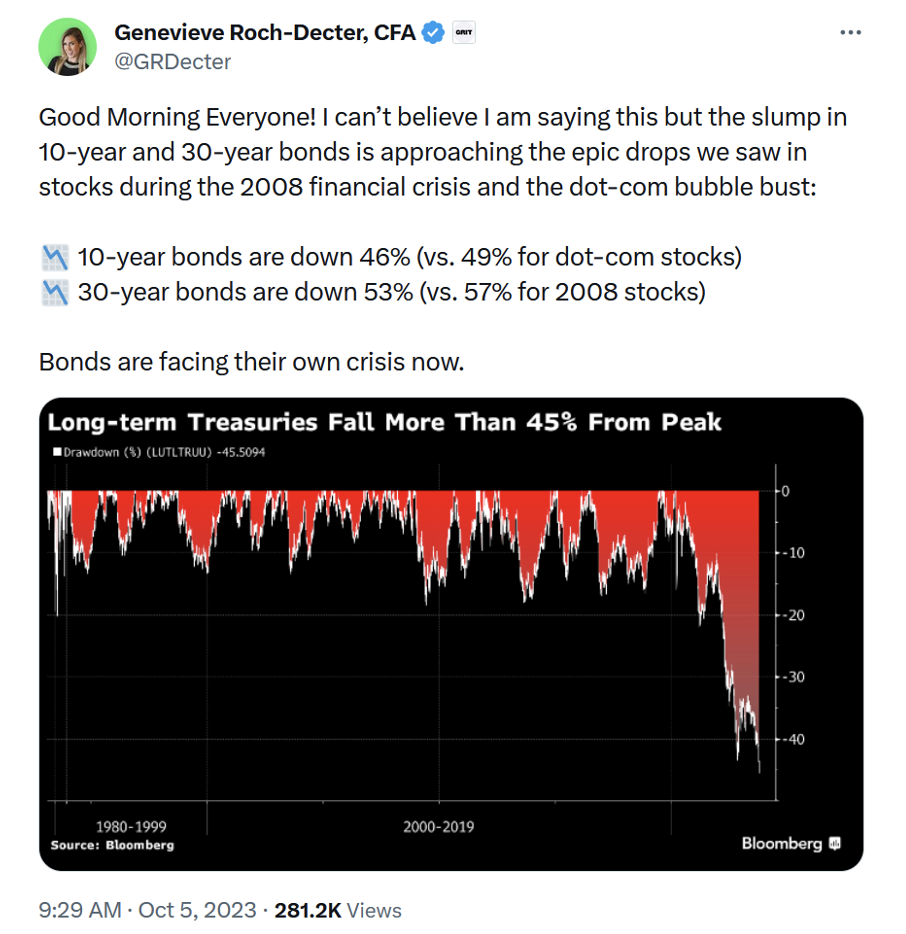
2) Wow – I knew bonds had performed poorly, but not this poorly!
3) A friend included this chart in his hedge fund's investor pitch deck, which shows the S&P 500's maximum drawdown and final return each year going back to 1980:
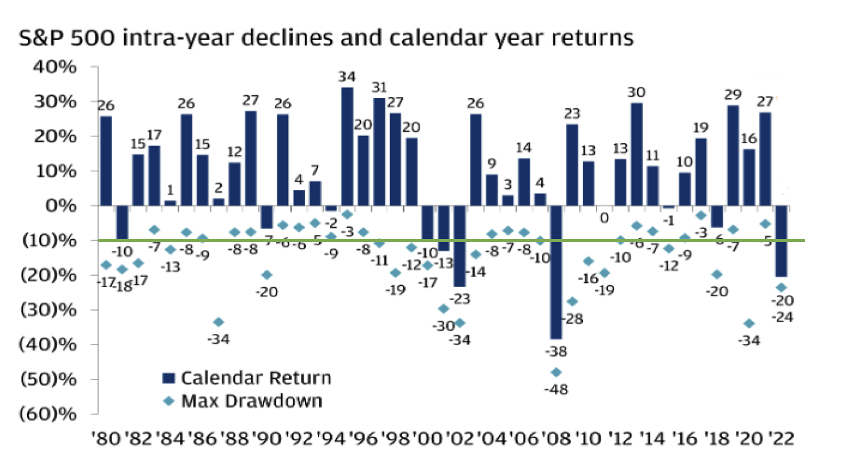
I was managing money during nearly half this period, so this brought back some good – and painful – memories! I noticed a few things:
- In the last 43 years, the market has only been down 10 times, only four times more than 10% (green line).
- The maximum drawdown during a year, however, has exceeded 10% 21 times (almost half).
- The market rose more than 10% in 24 years.
- The market has only once had back to back down years (three years in 2000-2002).
The main message: Stocks are the best place to be for the long run, but – and this is critical – you must not let short-term volatility shake you out.
4) I've always loved stupid criminals and terrorists.
Russian President Vladimir Putin thinks he's advancing his interests by attacking civilians in Ukraine and backing Hamas to do the same in Israel, but the truth is the exact opposite.
As I've long said, every time he attacks civilians in Ukraine, creating headlines sympathetic to Ukraine around the world, it further strengthens Ukrainians' resolve and opens spigots of aid and military equipment. The odds, for example, that Germany starts sending its Taurus missiles to Ukraine just went up a lot.
As for Hamas' attack on Israel, it's unclear what Putin's role was. One friend wrote: "Russia's just made its latest move in Israel – via Hamas. Seeking to distract from Ukraine." Another added:
Russia benefits in several realms – intelligence and leadership bandwidth is consumed in the West, trouble in the region usual bolsters oil prices, it spooks people about escalation more generally, and reminds people that arms stocks must be maintained for other contingencies.
Then there is the Iran angle with both Hamas and Hezbollah. This even complicates an already fraught U.S.-Turkey relationship. That said, though Russia has been a Hamas supporter from the very beginning, I would be surprised if the coordination were more than deniable winks and nods. Some people wanted a multipolar world, and they are getting one...
P.S. Apart from any other "coincidental" anniversaries, yesterday was Putin's birthday.
I Googled "Was Russia behind the Hamas attack on Israel?" and this was the first link: Hamas assault on Israel suggests external support, planning - Robert Lansing Institute. Excerpt:
Moscow and Tehran most likely took a direct part in organizing, approving, and politically supporting the Hamas operation against Israel.
On October 7, the day Vladimir Putin's celebrates his birthday, Hamas terrorists kicked off what they call Operation Al-Aqsa Storm against Israel. Within just 30 minutes, they launched some 5,000 rockets and projectiles from the Gaza Strip. The militants penetrated the Israeli territory by land, sea, and air, taking civilians hostage and waging urban battles in densely populated areas.
In May 2021, an RLI report noted that the Russian Foreign Ministry was coordinating the activities of anti-Israel Palestinian terrorist groups, providing their leaders with a safe platform for meetings in Moscow. From 2015 to 2020, top leaders of MFA Russia and Hamas held seven formal meetings. By meddling in Palestine's internal political affairs, Russia is counting on strengthening its influence in the region and across the Arab world...
After the attack on Israel, Deputy Head of Russia's Security Council Dmitry Medvedev outlined what he believes are the main positive aspects of the Palestinian assault:
- Israel will compete with Ukraine for military aid on the international stage, which will lead to a weakening of support for Kyiv.
- It distracts international public focus from the war in Ukraine.
- It will allow to cut the supply of air defense capabilities to Ukraine on the eve of massive Russian attacks on Ukraine's energy infrastructure in the winter period involving Iranian-made kamikaze drones.
- Russian war crimes in Ukraine pale against the background of the atrocities the Palestinians are committing on Israeli soil.
- A number of Russian propagandists, affiliated with military intelligence, who have long been spreading fake news of Ukraine trading in foreign military aid, are now spinning narratives alleging Kyiv's supplies of weapons, donated by foreign partners, to Palestinian militants. According to our estimates, Russia, through its warm relations with Hezbollah, will send to the Gaza Strip a few units of weaponry captured on Ukraine's battlefields – as evidence to back their claims.
Since the Cold War, Moscow has viewed Israel as a hostile nation allied with the US Since then, the Kremlin has sought to maintain relations with Palestinian radical groups, orchestrating their attacks in a way that would best undermine US interests in the hybrid warfare format.
I doubt that even Putin would be stupid enough to have any direct involvement with Hamas' attack. But he's no doubt pleased by it for the reasons outlined above – but this is a serious mistake. Israel will quickly decimate Hamas and the sole lasting effect will be that the entire world is reminded about the need to stand up to terrorism, whether by Hamas or Putin.
At a time when support for Ukraine has been wavering among the American public (see: U.S. public support declines for arming Ukraine, Reuters/Ipsos poll shows) and in Congress – $26 billion watered down to $6 billion, and then even that amount didn't make it into the emergency 45-day funding bill – Putin should have sat tight and let his sympathizers and stooges and Internet disinformation farms do their work (see: Putin's Next Target: U.S. Support for Ukraine, Officials Say).
Instead, the combination of these two events – major attacks on civilians in Ukraine and Israel – has significantly increased the world's resolve to stop Putin and, in particular, the chances that Congress approves a big aid package.
Best regards,
Whitney
P.S. I welcome your feedback at WTDfeedback@empirefinancialresearch.com.