

One of the most powerful women on Wall Street; That's What She Said: What Men and Women Need to Know About Working Together; My conversation with a woman business co-founder
1) There are so few women at the highest levels of finance – a topic about which I published two articles in the New York Times in 2014: Evaluating the Dearth of Female Hedge Fund Managers and A Deeper Conversation on Women in Hedge Funds.
So I read this profile with great interest, written long ago by my friend Julia La Roche, of Elizabeth Myers, who is now the Global Chairman of Investment Banking (Equity Capital Markets) at JPMorgan Chase (JPM): One of the most powerful women on Wall Street leads a team that has generated $1 billion in fees this year – here's her story. Excerpt:
Myers sat down with Business Insider for an hour-long interview, during which she came across as humble and down to earth – she's attained her position largely out of the media's spotlight. Passionate about mentoring other women at JPMorgan, Myers is someone who has clearly invested in relationships with her colleagues, clients, and former classmates.
"I not only have the utmost respect for Liz, but am in awe of her," Alexandra Lebenthal, the CEO of municipal-bond firm Lebenthal Holdings, told Business Insider. "She is one of the women who have reached the top echelons of Wall Street, but she wears it with modesty and grace. Liz is a power player, regardless of her gender."
I love how she's been going to Berkshire Hathaway's (BRK-B) annual meetings since the 1980s!
In the early 1980s, a family friend told Myers' mum about a talented stock-picker in Omaha, Nebraska, named Warren Buffett. Her mum started to read about him and soon became an investor in Berkshire Hathaway.
Myers' parents started making the pilgrimage to Omaha for the Berkshire Hathaway annual shareholders meeting, which at the time was held at the Orpheum Theatre – a much smaller venue than today. Eventually it became a family tradition with Myers and her two brothers joining their parents for the trip in the late 1980s.
2) Coincidentally, I just finished reading (listening to) That's What She Said: What Men and Women Need to Know About Working Together:
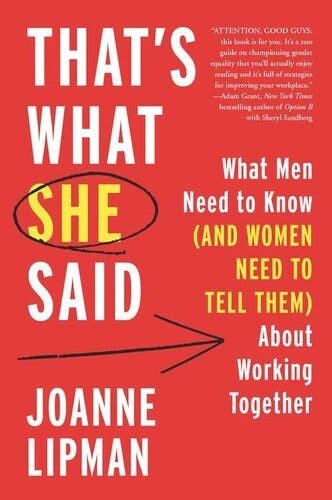
It really opened my eyes to many things I didn't fully appreciate, and I'm going to strongly suggest to my daughters (ages 25, 22, and 19) that they read it. In fact, I think every professional – both women and men – should read it!
Here's a review in the New York Times, which provides an excellent summary if you don't have time to read the book: The Plight of Working Women, as Seen by the Woman in the Corner Office. Excerpt:
offers a persuasive examination of the innumerable institutionalized prejudices, roadblocks and often unconscious undermining that women face in nearly every aspect of public and private life. Some of her facts will be familiar to H.R. directors, women's studies scholars and reporters who cover gender equality. They will likely be revelatory to nearly everyone else. Lipman's not wrong that those with power are loath to give it up: One study by Catalyst, an organization devoted to working women, found that 74% of men surveyed on what undermines their support for gender equality said fear – of loss of status, of other men's disapproval and of making a mistake – all of which, Lipman writes, has men "walking around on eggshells." But she also believes that most men, certainly those in the upper echelons of management, "don't need beating up with a two-by-four. They'd like to see an equitable workplace, they just can't figure out what they're supposed to do about it." She's here to tell them; here's hoping they're paying attention.
Lipman, a former journalist for the Wall Street Journal and the founding editor of the short-lived Condé Nast business magazine Portfolio, is a skilled assembler of data and a graceful storyteller. She starts with a sketch of just how male by default the universe is, from the standard office temperature (set to accommodate the higher metabolic rate of 40-year-old, 154-pound, suit-wearing men) and male-centric design at Apple (the iPhone 6 Plus was too big for many women's hands and pockets) to the potentially dangerous side effects for women of the original prescribed doses of Ambien, a drug that was tested only on men, a still-common practice. All due, in part, to the lack of women in decision-making roles across industries and sectors, which, the data clearly show, is a financial mistake.
3) Scott Galloway and Kara Swisher's Pivot conference in Miami opened last night with a fun beach party, during which I had the pleasure of meeting and having a long chat with Vanessa Alvarez, the COO and co-founder of Nexme, a Seattle-based startup that has developed an on-demand real estate platform delivering instant access to home and full-service real estate agents. (If you're looking to buy a home in the Seattle or Boston areas, check out Nexme's Apple or Android app.)
Vanessa has a remarkable personal story. Her family emigrated from El Salvador and ended up in Providence, Rhode Island where Vanessa was born and raised.
My friend Joel Klein, who once helmed New York City public schools, once said that the quality of public schools our nation provides is primarily a function of two things: the color of your skin and your zip code. This was certainly true for Vanessa – her family couldn't afford to live in a neighborhood with good schools, so she had no choice but to attend failing ones. Not surprisingly, she ended up dropping out of both high school and college.
After four years of working, however, she returned to school, earned her college degree, and ultimately had a successful career in cloud computing at Amazon (AMZN) and Microsoft (MSFT) before launching Nexme. (You can read her LinkedIn profile here.)
Having just finished That's What She Said, I asked Vanessa if she had read it. She hadn't, so I described some of the key points to her and inquired, for example, if she was often treated differently than Nexme's other co-founder (a man).
"Absolutely," she said. "It's one of the reasons we made my partner the CEO – it's just a lot easier to raise money if the CEO is a man."
As proof, she pulled out her phone and showed me this article: Female Founders Raised Just 2% of Venture Capital Money in 2021. Excerpt:
Female founders secured only 2% of venture capital in the U.S. in 2021, the smallest share since 2016 and a sign that efforts to diversify the famously male-dominated industry are struggling.
It was the second year in a row that women's percentage of VC funding shrank...
When women teamed up with a male co-founder, they tended to raise more. Female and male founder teams captured 15.6% of total venture cash in 2021 – the highest amount since 2017.
My colleague Berna Barshay has told me plenty of stories about the challenges of being a woman in the male-dominated business world – I hope she'll share some of them in the free Empire Financial Daily e-letter (which, if you don't already receive, you can sign up for here)...
Best regards,
Whitney
P.S. I welcome your feedback at WTDfeedback@empirefinancialresearch.com.