

A Big Clue About the Market's Next Move
What to expect from the Fed this week... The U.S. is booming... The rest of the world, not so much... A big clue about the market's next move... 'New all-time highs could be just around the corner'... Last call for tonight's big reveal...
 The Federal Reserve kicked off its July policy meeting today...
And it will announce its latest decision at 2 p.m. Eastern time tomorrow.
The Fed typically reserves significant policy announcements for meetings where a press conference is scheduled to follow. That isn't the case this month, so no significant changes are expected.
However, the Fed has previously said it expects to raise rates two more times this year, so analysts will be looking for confirmation of this forecast. We suspect they'll get it.
The latest measures of price inflation remain at or above the Fed's official 2% target. Unemployment is at multidecade lows. And last Friday's report on gross domestic product ("GDP") showed the U.S. economy grew at a 4.1% annualized rate in the second quarter, the fastest pace in nearly four years.
In short – for now, at least – all signs suggest the U.S. economy continues to improve.
The same can't be said for the world's other major economies...
This morning, we learned that the broad European economy slowed again last quarter. As the Wall Street Journal reported...
The European Union's statistics agency Tuesday said the combined gross domestic product of the 19 countries that use the euro – the broadest measure of the goods and services they produce – increased at an annualized rate of 1.4% in the second quarter, down from 1.5% in the first. That was its slowest expansion in three years...
The eurozone economy entered 2018 on a high, having racked up its most rapid expansion in a decade during 2017. However, growth slowed sharply in the first three months of this year, a setback policy makers and many economists attributed to unusually cold weather and a series of labor strikes in Germany and France. The failure of the economy to rebound in the second indicates that other forces are at work.
The European Central Bank ("ECB") has already announced plans to end its quantitative easing ("QE") bond-buying program this December. But unlike the Fed – which has now raised the short-term Federal Funds rate seven times since December 2015 – the ECB has made no definitive plans to begin raising its own short-term interest rate, which remains at 0% today. Today's news suggests that is unlikely to change anytime soon.
It's a similar story in Japan...
As longtime readers know, back in 2016, the Bank of Japan ("BOJ") "doubled down" on its efforts to push inflation higher. It essentially promised to do whatever it takes... for as long as it takes... to drive inflation above its long-held target of 2%.
The BOJ has certainly kept that promise so far. Over the past two years, it has pushed short-term rates well into negative territory... fixed 10-year interest rates near 0%... and become the single largest buyer of Japanese government bonds and Japanese stocks (via exchange-traded funds) in the world.
Earlier this year, analysts began to worry that the BOJ's commitment to stimulus was wavering. But we were skeptical. As we noted at the time, nearly 18 months after launching this unprecedented stimulus, inflation was still nowhere near 2%, let alone above it.
That remains the case today... which is why we weren't surprised to hear the BOJ defied expectations yet again this morning by keeping its policy largely unchanged for another month. From a separate Journal report this morning...
Bank of Japan Gov. Haruhiko Kuroda said he would let a key interest rate creep up a tenth of a percentage point but otherwise stuck to his ultra-easy monetary policy, defying a global trend toward tightening...
For the first time, the BOJ under Mr. Kuroda provided forward guidance on how long its current rates will continue. The answer was "an extended period of time," bucking hopes from banks and some other market players for a quick move toward higher rates along the lines of the Federal Reserve.
Given recent weakness in prices, "we will likely have to continue monetary easing longer than expected, and we wanted to secure credibility for doing that by showing forward guidance," Mr. Kuroda said at a news conference. "I think this will make it possible for us to completely deny market speculation that the bank would head toward an exit [from easing] or raise interest rates in the near future," he said.
In other words, like Europe, don't expect Japan to begin "tightening" until – or unless – prices begin to rise significantly.
Of course, economic growth and inflation aren't the only areas where the U.S. is diverging from the rest of the world...
Our colleagues Ben Morris and Drew McConnell have been tracking a similar trend playing out in the stock market over the past several months. As they noted in the June 25 issue of DailyWealth Trader a little more than one month ago...
Let's start by looking at the recent price action in both U.S. stocks and non-U.S. stocks...
For non-U.S. stocks, we'll use the Vanguard FTSE All-World ex-US Fund (VEU). It is the largest exchange-traded fund dedicated to diversified non-U.S. stocks. It holds stocks from more than 40 different countries, with larger weightings in developed markets and smaller weightings in emerging markets.
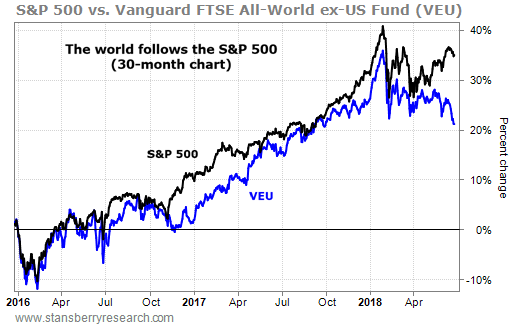
In the chart below, you can see that for two and a half years, VEU has traded mostly in line with the U.S. benchmark S&P 500 Index. But the two have moved in different directions since early May...
As they noted, this is often an important signal...
U.S. and global stocks don't trade in lockstep every week or even every month. But when they separate significantly like we've seen over the past few months, one group often finds a way to "meet up" with the other.
In other words, history suggests we'll soon see either U.S stocks play catch-up to the downside by falling, or we'll see global stocks play catch-up by surging higher.
That's exactly what happened the last time U.S. and global stocks diverged in late 2015...
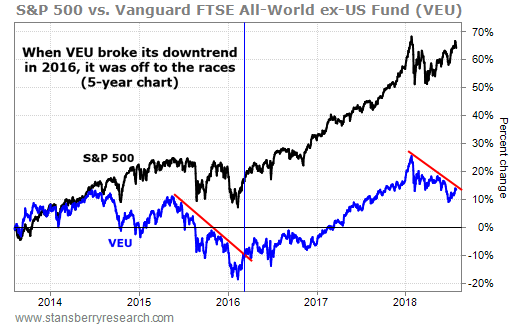
Just like we saw early this year, both suffered sharp corrections that summer. And just like we've seen of late, U.S. stocks held up far better over the next several months. By April 2016, the S&P 500 had nearly recovered its losses entirely, while VEU was still down more than 15% from its 2015 highs.
As you likely guess from the chart above, that divergence ended in the latter scenario... Global stocks broke out of their downtrend and followed U.S. stocks higher over the next two years.
Of course, there's no way to know for certain which way the divergence will resolve this time around...
But as regular Digest readers know, most of the reliable long-term indicators we follow suggest the U.S. markets remain healthy today. This suggests global stocks are likely to play catch-up to the upside once again.
Ben and Drew agree. In fact, as they just noted in this morning's edition of DailyWealth Trader, we could be just days away from a similar breakout like we saw a little more than two years ago. From the issue...
In the chart below, you can see that early-2016 breakout. U.S. stocks hit a new all-time high and soared shortly after. You can also see that the markets are in a similar situation today. U.S. stocks are near new highs. And VEU is close to breaking out of a downtrend...
To be clear, like us, they aren't ready to declare we're 'out of the woods' just yet...
VEU hasn't officially broken out yet. It could still turn lower and fall to new lows, which could begin to pull U.S. stocks lower. But if VEU continues higher from here, it would be another strong sign that the "Melt Up" is about to resume...
If VEU can break out of its downtrend, new all-time highs in U.S. stocks could be just around the corner. It's hard to imagine now. But it could even signal the start of another multiyear rally in global stocks.
We'll be keeping a close eye on VEU in the coming days. If it breaks out, we'll be prepared to take advantage.
One last thing before we sign off today...
You've likely heard that our friend Dr. Richard Smith is hosting a special live event this evening at 8 p.m. Eastern time.
But if you've been on the fence about attending, we urge you to reconsider. That's because tonight's event will be different from those you may have attended in the past.
You see, Richard will NOT be talking about TradeStops – his powerful portfolio management software – tonight.
Instead, he'll be revealing his latest innovation... a new set of tools unlike anything you've likely seen before.
Unlike TradeStops – which is designed to help you make more money while taking less risk, regardless of which stocks you own – this new technology is designed to help you identify the absolutely best stocks to buy for your portfolio at any time.
For years, we've heard one big complaint from otherwise satisfied subscribers...
It's often difficult to choose from among our many open recommendations.
Frankly, we get it... We publish an incredible amount of research each month. If you subscribe to more than a few of our services, there's simply no way to invest in all of our recommendations. Even with unlimited capital, you'd quickly find yourself trying to manage an unwieldy portfolio with dozens and dozens of positions.
Unfortunately, as financial publishers, we're prohibited from providing individual investment advice. So unless you're in a position to join one of our top-tier Stansberry Portfolio Solutions products – and see exactly how we would allocate a complete portfolio from across our recommendations – we haven't been able to offer much beyond that.
But Richard's new Ideas by TradeSmith software could be a great solution...
It can help you identify the best opportunities from across all of our research (and any others you receive). It will give you access to several powerful stock-picking strategies Richard has developed over the years. (One of these in particular – which Richard has dubbed "Kinetic VQ" – has a track record you may not believe.) And it includes a proprietary indicator to give you a clear, real-time look at the underlying "health" of the broad U.S. markets.
But even if you're not interested in learning more about Richard's new software, we encourage you to tune in. You see, Richard will be sharing exactly what his market-health indicator is saying about U.S. markets today – and revealing several of his favorite, actionable opportunities – live on the air tonight.
Again, this event kicks off at 8 p.m. Eastern time... and it's absolutely free for all interested Stansberry Research subscribers. Click here to attend.
New 52-week highs (as of 7/30/18): AllianceBernstein (AB), Blackstone Mortgage Trust (BXMT), and Williams Partners (WPZ).
If you attend Richard's live event tonight, we'd love to hear from you. Send us a note to feedback@stansberryresearch.com.
Regards,
Justin Brill
Baltimore, Maryland
July 31, 2018