
A catalyst for one of our favorite companies... More signs of deflation... And more record-low yields... The 'Bond God' likes gold... Your last chance to discover Dan Ferris' huge investment opportunity...
 Porter says it will be one of the greatest recommendations in his career... and we just saw a catalyst to send this stock soaring.
I'm talking about fast-food giant McDonald's. Shares have stumbled recently amidst worries that McDonald's was a dying business... that "fast casual" chains like Chipotle would replace McDonald's as consumers grew more health-conscious. McDonald's sales have slowed... And the company faced a PR crisis when stores in China were serving contaminated meat.
But we weren't worried. As we wrote in the August 26 Digest...
McDonald's isn't going anywhere. PR crises pass. Things will eventually calm down in Russia. Meanwhile, energy giants BP and ExxonMobil have dumped loads of oil into our oceans... Both companies survived.
Plus, as our "disappearing middle class" thesis continues to play out, McDonald's should regain its popularity... $10 lunches at Chipotle are great when you can afford them. But when things get tight, McDonald's Dollar Menu looks more and more attractive.
McDonald's is also campaigning against its unhealthy image. The company has introduced grilled chicken and veggie wraps and fruit to its menus... It also hosted a press event where chefs created "gourmet" meals from its ingredients.
Plus, as Porter pointed out in a private e-mail about McDonald's woes, "betting against sugar and fat is a losing proposition"...
At the end of the day, McDonald's is still the world's largest restaurant by revenue. The stock trades at a reasonable 15.6 times forward earnings. And it produced more than $4 billion in free cash flow last year.
Plus, it pays a 3.4% dividend today. In today's low-interest-rate environment, that dividend (paired with McDonald's fair valuation) will act as a magnet to capital.
Still, the price action of McDonald's hasn't been stellar lately...
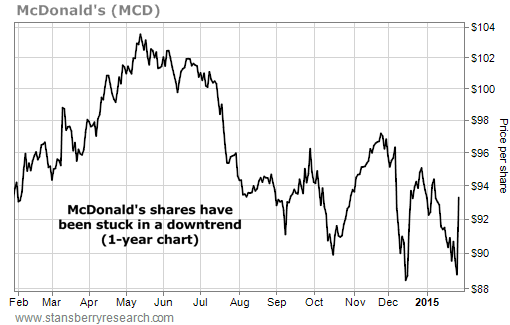
Yesterday, the company announced CEO Don Thompson would retire. Shares jumped 5% on the news.
Thompson had a rough road replacing former McDonald's CEO Jim Skinner. Skinner was a Wall Street darling... Under his guidance, McDonald's thrived...
Under Skinner's roughly eight years at the helm, revenues increased from $17 billion to $28 billion. Operating margins expanded from 17% to 31%, and free cash flow surged from around $2 billion to nearly $4 billion.
Wall Street loved Skinner. McDonald's had fallen short of Wall Street's earnings expectations for half of the 30 quarters that preceded Skinner's appointment. The company beat Wall Street expectations in 28 of Skinner's 30 quarters at the helm. If nothing else, Skinner knew how to play Wall Street's game. And the stock price shot from $25 to around $100.
Thompson's three-year stint hasn't been so illustrious... McDonald's missed earnings in six of his first 10 quarters at the helm. And the bad news continued with McDonald's recent earnings announcement.
McDonald's said Thompson is leaving under his own accord, but we know better. We believed Thompson would be shown the exit as McDonald's struggled to reinvent itself. Here are some excerpts from the November 2014 issue of Stansberry's Investment Advisory...
A Bloomberg report from last week speculated that the combination of McDonald's strong financials and low share price had powerful hedge-fund activists eyeing the company. (This would, however, not be good for Mr. Thompson's job security.)
We often quote Warren Buffett saying "When a business with a reputation for failure meets an executive with a reputation for brilliance, it is usually the business' reputation that remains intact." In McDonald's case, the opposite is true. Most other companies would kill for McDonald's breadth, scale, brand, and competitive advantage. The company's CEO appears to be in over his head and on his way out. Does that change the fact that kids will still be eating Happy Meals 20 years from now? We doubt it.
And while the Wall Street Journal says the move doesn't appear to be at the request of an activist hedge fund... it does make the company a more attractive investment. McDonald's already took care of the dirty work.
McDonald's is the definition of a capital-efficient company. It generates loads of cash without the need to make large capital investments to maintain the business. It generates high returns on assets. It consistently grows revenues (with the exception of the recent slowdown). And it maintains such large amounts of free cash flow that it's able to pay excess capital to its shareholders.
McDonald's is a world-class brand that will be around for a long time. And we're happy to wait for our thesis to play out. As Porter wrote in November...
We don't know where MCD shares will go tomorrow, next week, or next month. But one of the benefits of taking a "forever" view is that you aren't burdened with perfectly timing your entry price.
Thompson can't take all the blame for McDonald's poor performance, though. Outside of the U.S., we're seeing less growth and more deflationary pressures – especially in McDonald's large European market.
The European Central Bank just initiated another round of quantitative easing to battle its sagging economy. Money is flowing into sovereign debt...
Yields on the 10-year U.K. government bond (the gilt) hit a record low of 1.4% today.
Denmark – which falls outside of the European currency union – cut interest rates for the third time in 10 days today. Certificate of deposit (CD) rates in Denmark are now -0.5%. Denmark's currency is pegged to the euro... And after the move from the Swiss National Bank, investors are pouring into the currency, hoping for a revaluation.
Along the same lines, Germany – the economic engine of Europe – joined the deflationary camp for the first time since 2009...
The country's Federal Statistics Office today said it expects harmonized consumer prices (calculated to track broader European currency union prices) to fall 0.5% in the year to January – down from a 0.1% rise in the year to December. That would be the first time German prices fell since September 2009.
Plunging oil prices are largely to blame. Across the European currency union, prices fell 0.2% in the year to December. Prices fell in 12 of the 19 member nations.
Rates are also falling domestically, with the U.S. bond hitting a record-low yield of 2.3%. You'll notice the iShares Ultra 20+ Year Treasury Fund (UBT), which tracks the price movement of the long bond with added leverage, is in our 52-week highs list below.
As we've previously noted, falling and negative interest rates around the world make gold even more attractive.
As Steve Sjuggerud wrote in the latest issue of True Wealth...
Global interest rates are at record-low levels, which helps the case for gold. For example, five-year German and Japanese government bonds now pay zero-percent interest, and five-year Swiss bonds have a negative interest rate! With all these record extremes, this is an incredible moment and we have to take advantage of it. Our upside potential from here is 200%-plus returns in two years.
"Bond God" Jeff Gundlach, fund manager and founder of Doubleline Capital, echoed our sentiments at the Inside ETFs conference on Tuesday. He told the crowd he was adding to his gold position... Mind you, this is coming from one of the largest and most popular managers of fixed-income assets...
Gold remains a safe haven in times of turmoil. People have given up because [it was] boring and painful.
Gundlach joked that gold is now yielding more than Swiss bonds... and noted an increase in gold prices is usually a sign of volatility ahead.
And while we're happy a man of his stature agrees with our long-gold thesis, we doubt Gundlach has done the same level of research on gold and other commodities that we have.
In today's DailyWealth, Extreme Value editor Dan Ferris explained why he thinks buying natural resource stocks today is the greatest opportunity in his career.
As we've noted, commodities from gold to iron ore have been crushed. And the only time you make money in resource stocks is after a wipeout... after the market gets so bad that nobody wants to buy. That's the point of maximum upside. And we're approaching that point today.
Dan welcomes the bad news in the resource market. As he wrote...
Bad news makes great stocks cheap. Great investors can take advantage of these "bad news" opportunities because they know what stocks they'd like to own before the market falls.
I can't know exactly when iron ore, copper, or other natural resource stocks will start rising again, but I suspect that it will be sometime this year. Right now, many solid resource businesses are trading at their lowest prices since the financial crisis, more than five years ago.
Investors who can look past the bad news today and single out great resource businesses selling at great prices have an incredible opportunity to make a lot of money over the next few years.
Dan has recommended a handful of high-quality resource stocks – across many sectors – to profit from what he sees as a major uptrend. We explained the situation in more detail in yesterday's Digest. But tonight is your last chance to hear from Dan about the best investment opportunity he has seen in his career. You can view Dan's presentation for free by clicking here.
New 52-week highs (as of 1/28/15): Blackstone Group (BX), Cempra (CEMP), Invesco Value Municipal Income Trust (IIM), Nuveen Municipal Opportunity Fund (NIO), and ProShares Ultra 20+ Year Treasury Fund (UBT).
A quiet day in the mailbag, so we're taking this opportunity to mention something special coming up on our calendar...
Are you interested in learning more about exchange-traded funds (ETFs) and how to trade them? If so, mark your calendar for Stansberry Research's first-ever ETF Master Class, hosted by Steve Sjuggerud on February 14.
Steve, along with his lead analyst Brett Eversole, will be discussing the ins and outs of ETFs, including why they are superior to mutual funds... what makes them ideal for leveraging up your positions... and how to find the best opportunities in any type of market.
Steve and Brett will also be answering your questions about ETFs, so if you have ever wondered what an ETF is or how they work, go ahead and send your questions by clicking here for the chance to have Steve answer your specific questions during this educational event.
Regards,
Sean Goldsmith
Baltimore, Maryland
January 29, 2015
