

A Chart You Probably Don't Understand (Yet)
Editor's note: It sounds unbelievable, but it's true: The absolute best time to buy bonds is during a crisis.
But if you're still not convinced, this Digest is for you...
In today's classic essay, Porter shows exactly how his distressed-bond strategy performed during the last financial crisis... and shares a sample of his team's latest Stansberry's Credit Opportunities research...

A Chart You Probably Don't Understand (Yet)
 Today is part four of my five-part series about investing in corporate bonds – specifically, distressed corporate bonds.
If you haven't yet, please read the earlier Digests (from Monday, Tuesday, and Wednesday) first, as there may be terminology and ideas expressed below that won't make sense unless you're familiar with the preceding work. And don't worry... my last bond essay is tomorrow. After that, I will try not to mention them again for a while.
Let's begin with a thought experiment. Let's test the hypothesis...
My interest in buying distressed corporate debt lies in a belief that the market for lower-quality corporate bonds is extremely inefficient. That's because major institutional investors won't buy (and often are not allowed to own) distressed corporate bonds, and because most individual investors know nothing about these securities.
Likewise, the market is inefficient because there is limited access to information about these securities. Their SEC filings are hundreds of pages long (which intimidates most investors, even professionals) and just getting a price quote can require making a phone call and waiting five or 10 minutes for a broker to call around. All of these factors contribute to an illiquid market. The upside of these inconveniences is that securities regularly become totally mispriced relative to their underlying value and security.
That's a big part of the reason I want to pull my hair out when subscribers complain about having to use a nine-digit CUSIP number... or about having to use the phone to buy a bond... or about having to wait a week – a whole week! – to close the purchase of 100 bonds.
Yes, dear friends... buying distressed corporate bonds can be a pain in the neck. But it is this friction that creates the opportunity we have today. If buying bonds were as easy as buying stocks... if the information on bonds were as widely available... if investors were tremendously interested in these securities, with hundreds of institutions set up to research them and to make markets in them... then all of these inefficiencies in pricing would disappear. They would be easy to buy. But they wouldn't be worth buying.
Just think about that for a minute. The same factors are in play across every market, for any kind of product or service. For example, I enjoy a good cigar every now and then. You can buy cheap cigars at just about every gas station in America. But try finding a genuine Cuban-made Cohiba Behike.
Likewise, you can buy a cheap hamburger at any one of McDonald's 14,000-plus U.S. locations for around $1. But try finding a genuine, ground ribeye burger at any fast food joint. You won't be able to. If you're looking for the highest quality, or even the most value (which is not found at the lowest price), you have to shop around.
The same thing is true about investments. The best investments you will make in your life will almost always be harder to find and less liquid than simply buying common stocks. Complaining about the inconveniences of trading corporate bonds is tantamount to complaining about the opportunity in corporate bonds. You can't have one without the other.
If I'm right about the suppositions I've made over the last few days, the best time to buy corporate bonds is during a crisis. That's when other investors are trying to (or are forced to) sell them. That's when the yields on these securities can reach absurd levels, offering you more protection from default. That's when the prices on these securities often fall to absurdly low levels, which offers you even more protection from default.
If I'm right about these ideas, then an average analyst should have been able to find incredible investments during the last big credit cycle.
I've published the following chart several times in multiple newsletters. Longtime subscribers have seen it dozens of times before. But... I doubt even they understand why I've published it so often or why I ascribe so much importance to what it tells me.
This chart shows you the "spread" – the difference in yield between U.S. Treasury bonds and noninvestment-grade corporate bonds. In plain English, this shows you what investors, on average, are demanding in extra yield in order to hold junk bonds instead of sovereign bonds...
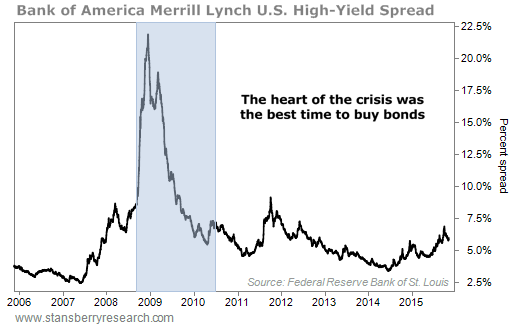
Note the period between September 2008 and the end of 2010. That was the heart of the crisis. It was the best time to buy bonds.
If you have to read that once or twice to really understand it, please do. It's critical that you understand what this chart means. Don't even think about buying corporate bonds unless you understand this chart.
Here's the easy way to understand it...
If I were going to sell you either a five-year U.S. Treasury bond or a five-year Stansberry Research bond, how much more interest would you expect from my company? You're either going to lend the U.S. government $1,000 or you're going to lend my company $1,000.
If we were offering you the same interest rate – the U.S. five-year rate is around 1.5% today – which bond would you choose? Most investors (all of them, actually) would pick the U.S. Treasury bond. While my company has been around for 15 years and has always been profitable (thanks to you, dear paid-up subscribers), nobody in his right mind would assume my company is as reliable as the U.S. Treasury.
Instead, I would have to offer considerably better terms to interest the average investor. Would you buy my bond instead of the U.S. Treasury bond if I offered to pay 5% a year? What about 10%? What about 20%? At some point, the average investor would decide that the higher yield offered by noninvestment-grade corporate debt is worth the risk.
This chart shows exactly how much more interest was required to make the average investor choose junk bonds. As you can see, the "premium" changes a lot based on the current default rate. As default rates for corporate bonds increase, investors become more leery of corporate bonds and demand higher interest rates to buy them.
At the peak of the last corporate-default cycle (during the spring of 2009), investors were demanding 22 percentage points more on each year's interest payments than they expected from U.S. Treasury bonds of similar duration. That's a huge premium. Those incredibly high interest rates make it difficult to lose money buying corporate bonds.
Keep this in mind: That interest-rate spread was created by the falling prices of corporate bonds. Imagine a corporate bond that was issued with an 8% coupon in 2006, maturing seven years later in 2013. During the last crisis, a bond like this would have had to offer investors something around 25% a year in yield in order to be sold.
If you read my earlier Digests about bonds, you already know that the coupon is fixed. It never changes. Thus, the only way someone could have sold the bond at that time was by discounting it heavily... by lowering its price more than 70%.
That's the corporate-default cycle in action. It can cause huge losses for investors, even if their bonds don't actually default. Think about an institution that isn't allowed to hold junk bonds. It might own several hundred million dollars' worth of bonds that get downgraded from investment-grade to noninvestment-grade. It then has to sell those bonds. But who is going to buy them?
It's this kind of forced, panicked selling – into a market that has generally poor liquidity – that causes bonds to be discounted so heavily. The best part is, since corporate bonds have average durations of around seven years, if you buy a corporate bond during one of these panics, you can earn high yields for years.
That's why the only time you should invest in junk bonds is during a crisis. That's the only time it's really worth it. This also explains why we recently launched our first bond letter (True Income) in 2008 and why we relaunched it as Stansberry's Credit Opportunities.
So, you might be wondering how True Income analyst Mike Williams fared during the last crisis.
Was he willing to buy deeply discounted bonds during the heart of the crisis? Did those bonds perform well? Did they provide investors with high total returns to compensate them for the risks of the corporate-bond market?
I went back and looked at every deeply distressed bond that Mike recommended following the Lehman Brothers bankruptcy from September 2008 to 2010.
I used the Lehman bankruptcy because it was the "bell" that announced a genuine crisis. I picked the end of 2010 to close on a year end and because by that time, the panic was clearly over in the bond market. I decided to consider a bond "deeply distressed" if Mike recommended buying it at less than $0.70 on the dollar.
I decided on these criteria before I reviewed the track record. But in fairness, I knew that Mike's recommendations averaged 16% annual returns from 2008 through the end of 2010. I knew Mike had done well... but I didn't know how he had done on his truly distressed recommendations.
The first deeply distressed deal he got into following the Lehman crisis was an International Lease Finance bond with a 5% coupon that matured in 2010. ILFC was a subsidiary of AIG. It owned airplanes and leased them to major airlines. This was a secure bond. The collateral was high-quality planes.
Mike recommended this bond in October 2008 when it was trading at a deep discount to par, only $0.69 on the dollar. It was sold at par in 2010, producing capital gains of just more than 50%. Investors would have also collected $50 in interest in 2009 and around another $25 in interest for the partial years' ownership in 2008 and 2009. That's $75 in interest, or a total yield of almost 11%. The total return, therefore, would have been around 60%.
Next, in February 2009, right near the peak of the crisis, Mike recommended what would go on to be one of our research company's best recommendations of all time – a Rite Aid 8.5% convertible bond due in 2015. Mike was able to get these bonds for only $0.32 on the dollar. They would go on to convert into stock and make total returns of more than 700%.
Mike would recommend four more deeply distressed bonds to his True Income subscribers. In September 2009, he found a Sears bond trading at $0.61 on the dollar. The bond matured at par a year later, producing a capital gain of 72%.
In March 2010, he recommended buying another convertible bond – this time, a Global Industries bond at $0.63 on the dollar. He sold it a little more than a year later for $0.98 on the dollar, producing capital gains of 56%.
Next, in September 2010, Mike recommended buying a Brunswick Corporation 7.125% bond due in 2027 for only $0.66 on the dollar. As you can see, to find distressed opportunities at this stage, he had to buy convertible bonds or be willing to go out a long time on his maturities. The crisis was passing and with it, so were the best opportunities. He recommended selling that bond after it reached par in June 2012, producing total returns of 55%.
Finally, the last truly distressed bond he recommended during the heart of the last crisis was a Liberty Media 4% bond maturing in 2029. Our buy price was $0.58 on the dollar. Today, this bond is still trading at precisely $575 – the same price at which he recommended it. But it has paid its coupon, earning investors almost 9% a year.
The average return of these six recommendations would be an absurdly high number because of the home run Mike hit with the Rite Aid bonds. That's why I didn't tell you the average. It isn't really representative because the sample size is so small.
What's far more important is that during this crisis, when most people were afraid to buy any stocks or bonds, all of Mike's recommendations performed well. Every single one. It's this irony – that the best and safest opportunities came during the crisis – that I hoped to show you with this analysis.
As bonds get cheaper and their yields go higher, they become safer.
The same isn't true in the stock market, as I'm sure you know if you've ever seen a high-dividend-paying stock decline in price and then cut its dividend. Remember, bonds are essentially binary: They either pay or they default. They cannot cut the coupon. That's why our analysis focuses so strongly on finding the bonds that will pay.
Since our experience with Mike and our first distressed-corporate-bond letter, we've had a lot of time to think about how to get even better results. Because of their binary nature and because the factors that lead to a default are almost all strictly quantitative (there's either enough cash or there isn't), there are plenty of ways to use computers (instead of a single analyst) to find opportunities in bonds. Using computers would allow us to screen every single bond and not just rely on the kind of stock-by-stock sleuthing that leads us to make equity investments.
To do this successfully, I've built a team of analysts and I've spent a fortune on computers and data. There are two accountants (Bryan Beach and Mike DiBiase), who have a combined 30 years of experience with public companies.
We have an experienced lawyer (Bill McGilton) who has read thousands of contracts and bond debentures. That's critical, because you have to know how each bond differs in the collateral structure that underlies it. And of course, we have two market analysts – Brett Aitken and me. We have experience with many of these issuers from the equity side. We know the relative quality of these businesses.
We start our research process with the entire U.S. universe of corporate-bond issues: 40,000 in all. We screen for maturity of less than five years, which greatly reduces the risk of default. And we screen for an original issue amount of more than $500 million, which gives us the best chance at enough liquidity to get into these investments.
That gets us down to a more reasonable universe of around 5,000 different bonds from around 1,000 issuers. All of these issuers are given a score with our proprietary ratings system.
Our rating process is similar to the major agencies' – Moody's, Standard & Poor's, and Fitch. We know that because we compare our ratings against theirs. The biggest difference is that our ratings are purely quantitative. The ratings agencies talk to companies' management. We won't let their rosy presentations influence our ratings.
Lastly, we only rate issuers, not individual bonds. You could argue this is a shortfall of our approach, but if the goal is only to pick bonds that aren't going to default, then the subordination of individual bonds is irrelevant.
Our system reduces a huge population of potential investments down to a couple dozen companies to look at. Then the manual part of our process begins. We scan the list and throw out any companies you wouldn't want to loan money to because they have a high probability of defaulting. We consider the debt of these companies to be toxic.
This makes it easy to identify a handful of bonds to really dig into. Important: Our system finds bargains at all different levels of risk. Sometimes there are completely safe bonds that are trading at a discount. For example, on one of our first total-market screens, we found a great little insurance company with more cash than debt. Why in the world are its bonds trading at $0.95 on the dollar?
During this "manual" stage, having a lawyer on staff is critical. In this case, Bill rolled up his sleeves and found some fine print that shows if there's an all-cash takeover for this company, the bonds could convert to around 20 shares of stock. There's no guarantee these shares would fully cover the face value of the bonds. There is no way a 100% automated system would catch stuff like this, which is why we study everything fully before we recommend it.
In the end, we're left with a small group of bonds that offer us compelling yields in return for the actual risk we face. We will publish a sample of these names in every issue, showing you more than just the bond we recommend you buy. This will allow you to diversify your investments across the bonds that show up on our screens.
It will also give you a wide range of bonds to consider at various risk levels. For example, here's our best selection of "distressed" bonds at the moment. Keep in mind, these aren't recommendations. The prices of many of these bonds have been driven up in recent months by investors chasing yield as interest rates are now negative in many places around the world.


As you can also see from our pie chart, 96% of the bonds that have received a "distressed" rating from us are not yet trading at a significant discount to par. Some of them are still trading at a substantial premium to par. This indicates that we are still a long way from our best buying opportunities. Until this market falls a lot more in price, we probably won't be recommending distressed bonds. Instead, we'll focus on the opportunities in our "moderate" risk category.
Even so, remember... no matter how well we do our jobs... sooner or later we will recommend a bond that defaults. And that's bad. It's impossible to know with any precision what the outcome of a default will be. In some cases, like the General Motors bankruptcy, the bondholders are simply ripped off in clear violation of the U.S. bankruptcy code.
In other cases, investors who are able to provide "debtor in possession" financing end up siphoning away all of the remaining assets. That's why you want to avoid buying a bond that defaults. Having said that, it's important to remember that bonds offer far less downside, on average, than stocks.
Here are the facts, as compiled by Moody's, the world's largest bond-ratings agency...
Moody's has kept default statistics on bonds since 1920. While these statistics don't include every bond ever issued, they do cover the majority of the U.S. corporate-bond market. Thus, from a statistical perspective, these records are many times larger than required to constitute a reliable sample.
Over this 88-year period, the 10-year default rate on the lowest-rated, investment-grade corporate bonds ("Baa") is only 7%. The recovery rate on senior unsecured bonds from 1987 through 2008 was 46.2%. Investors who buy even the lowest-quality investment-grade corporate bonds rarely experience a default (7%), and even in these tough cases, investors recovered almost half of their principal (46.2%).
Another way of reducing risk is to only buy bonds with shorter durations. The default rate plummets as you move the duration of your portfolio into shorter time frames. From 1920 through 2008, the default rate on investment-grade corporate bonds in their first five years of trading was only 3.1% – less than half of the 10-year default rate.
These low default rates and high recovery rates are why I say it's virtually impossible to lose money by investing in investment-grade corporate bonds as long as you diversify.
And here's the ironic thing... According to various studies of actual investor behavior and returns, even if you only earn 5%-7% annually on these safe corporate bonds, that would be more than most stock investors made, on average, during the roaring bull markets of the 1990s and the 2000s. Studies show that individual investors typically earn around 3% a year in stocks, on average, because they tend to always buy at market tops and then sell at market bottoms. If you're honest, you might discover that you would have been far better off only buying bonds than stocks.
Ah... but greed exists. Thankfully for newsletter publishers, everyone thinks he can beat the odds and build his own George Soros-like investment account. Who knows, maybe you can. The best stock investor over the longest period of time is Warren Buffett. His long-term compound return in stocks is almost 20% annually.
I believe Buffett is likely to be at least twice the investor as anyone reading this newsletter (and also the guy writing it). So anyone who can earn 10% a year or more on their entire portfolio is doing a great job. Expecting to earn more will almost surely lead to disappointment. No, it's not impossible. Long-term studies of Steve Sjuggerud's investment recommendations in True Wealth reveal average annual returns in excess of 15%, which is extraordinary. But it's unlikely that most stock investors will do that well.
What might help you bridge the gap? You're probably far more likely to make 10% average annual returns – or a little more – by investing in noninvestment-grade corporate debt than you are investing in stocks. As you've seen, it's possible to get double-digit yields when you buy these kinds of corporate bonds at a discount. And if you're earning more than 10% a year on coupons alone, it would be nearly impossible not to make substantially more than that on average, as long as you have a fairly diversified portfolio.
Of course, there are risks. According to Moody's data, the five-year cumulative default rate for B-rated bonds ("junk bonds") is a little more than 21%. So you have to be careful. Default is a real possibility on any of these bonds that have more than a five-year duration (and even on some that don't).
Keep in mind, the junk-bond market didn't develop until the 1980s. So when studying recovery rates, it's important to remember that the sample size isn't as large as the investment-grade corporate market. Moody's only has data on junk bonds from 1982 through today. During that period, the recovery rate for A-rated corporate bonds was 40.9%. The recovery rate on B-rated junk bonds was 40.6%. The recovery rate on noninvestment-grade bonds is almost identical to the recovery rate on investment-grade bonds.
Considering how much more interest you can earn in junk bonds, it's fair to say that you're far better off owning a junk bond that defaults than you are owning an investment-grade corporate bond that defaults. That's surprising, isn't it? Well, just remember... junk bonds default about three times more often, so it's a misleading stat... but it's still true.
In short, when you're buying junk bonds, you should wait until they are trading at a big discount to par ($100). This allows you to reduce your risk tremendously, as yields on these bonds will normally be in excess of 15% annually. If you know the average recovery on these bonds will be around $40 and you can get two years' worth of interest payments (say, $30 in total), you really aren't risking much capital.
Even so, you want to avoid default, because the big gains are earned when you cash out at par ($100). And the way to avoid default is to make sure that the company in question has the cash to pay you. As bonds are binary, that's all that matters. The business doesn't have to do well... it just has to have enough cash to pay you.
Regards,
Porter Stansberry
Editor's note: Porter and his team believe the next massive opportunity in bonds is about to begin. The last time conditions were this good, subscribers were able to make as much as 770% in the "boring" bond market. If you're not already a Stansberry's Credit Opportunities subscriber, it's not too late to profit. Click here to learn more... including how Digest readers can take advantage of a special, limited-time offer.