
A superbug hits Los Angeles... 179 possible infections... Why this is just the beginning... And what companies are doing to stop the threat... Predicting the health care boom... Doc names four 'Strong Buys'...
 A superbug is wreaking havoc on the West Coast...
Superbugs attacked more than 170 patients at the UCLA Ronald Reagan Medical Center.
NBC News reported this week that an e-mail went out to 179 patients who had possibly been exposed after an investigation found seven patients infected. What's worse, the superbug may have contributed to two deaths.
UCLA identified the superbug as carbapenem-resistant Enterobacteriaceae (CRE). We know that's a mouthful to pronounce. But there are plenty more just like them. They are antibiotic-resistant bacteria.
The Centers for Disease Control and Prevention (CDC) calls them a "family of germs" that are highly resistant to antibiotics. Back in 2013, the CDC outlined 18 drug-resistant threats to the United States and categorized them as urgent, serious, or concerning.
CRE got "urgent" status.
You might be thinking that 179 possible infections is nothing to worry about. Think again...
Yesterday, biotech specialist and Stansberry Venture editor Dave Lashmet gave his readers an example of how a simple needle stick can bring down the biggest, fittest, and strongest of us. As he said in the issue...
|
Dave has researched and written about superbugs over the past six months. He has attended conferences, studied drug trials, and met with doctors and experts in the field to understand in detail what CDC Director Tom Frieden calls the "nightmare bacteria" – or the simpler term, superbugs. He first wrote about them last August in Stansberry's Investment Advisory.
Most important for Stansberry Research readers, Dave has unveiled some outstanding investment opportunities – companies developing new drugs to fight against these superbugs. In September, he told Stansberry's Investment Advisory subscribers about pharmaceutical company Cubist. Pharma giant Merck bought Cubist in December. Subscribers booked a 49% profit in just three months.
|
In early December, Stansberry Venture subscribers learned about another small-cap drug developer fighting superbugs. As of yesterday's close, Dave's subscribers were up 106% in two and a half months...
And in the February issue of Stansberry Venture – out yesterday – Dave revisited the "superbug" theme, highlighting the serious threat that superbugs pose...
|
Dave is currently working on a new research piece about superbugs, including some of the companies making the top drugs to fight this epidemic. If his track record is any indication, these companies should be big winners...
In the four months since Dave started writing Stansberry Venture, he has recommended a triple-digit winner and two big double-digit gains. The average gain in his portfolio is 78% with an average holding period of just 77 days (not including the position he recommended on Tuesday).
While he hasn't focused on superbugs, Dr. David "Doc" Eifrig has been an outspoken bull on health care and medical stocks for more than five years.
In July 2010, Doc recommended shares of pharmaceutical giant Eli Lilly. He explained why a blue-chip company like Lilly could withstand deflationary market forces. (Remember, we were coming out of the subprime crisis.)
As you can see from the chart below of the SPDR Health Care Fund (XLV) – which holds a basket of some of the highest-quality names in health care – the sector had gotten crushed...
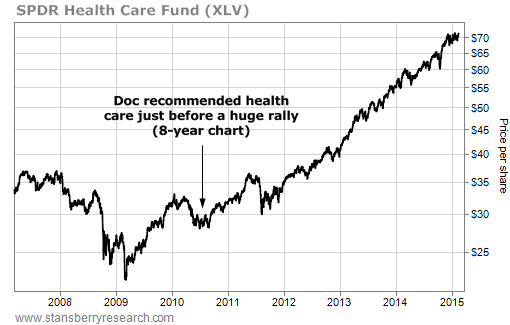 Doc believed the sector was set for a huge rally. As he told Retirement Millionaire subscribers...
|
In addition, some of the safest names in health care were sporting huge yields. Eli Lilly's dividend at the time was 5.7% – 82% higher than the 3.1% yield available on 10-year Treasurys. And Lilly was earning more than enough to maintain its dividend.
Doc also liked the fact that Lilly had a long history of paying and increasing its dividend...
|
As we've noted many times in the Digest, buying high-quality companies that pay healthy and increasing dividends is the best way to grow your wealth in the market over the long term.
In the case of Eli Lilly, Doc's Retirement Millionaire subscribers booked gains of 133% after he recommended closing the position last week.
In addition to a big win with Lilly, Doc's subscribers are sitting on other huge gains in health care. As of yesterday's close, they're up 181% in drugstore chain CVS Caremark, 109% in medical-equipment manufacturer Medtronic, 87% in pharma giant Johnson & Johnson, and 161% in the Fidelity Select Medical Equipment & Systems Fund.
Kudos to Doc for being all over the health care trend in its early stages. But he says big gains are still ahead. In his latest issue, Doc listed two blue-chip health care stocks as "Strong Buys." One of these companies, he says, is "one of the most attractive stocks in our portfolio." It trades at a reasonable 17 times earnings today. If you're looking for a safe place for new money today, this is it.
In total, Doc listed four companies as "Strong Buys." Doc's recommendations should make up the backbone of your portfolio. His conservative approach to investing and the education he shares in each issue make Retirement Millionaire a must-read.
You can get immediate access to Doc's recommended list of buys with a risk-free trial subscription to Retirement Millionaire. A one-year subscription costs just $39. Click here to get started.
New 52-week highs (as of 2/18/15): Apple (AAPL), ProShares Ultra Nasdaq Biotech Fund (BIB), Cempra (CEMP), Cisco (CSCO), CVS Health (CVS), Esperion Therapeutics (ESPR), WisdomTree Europe Hedged Equity Fund (HEDJ), iShares Core S&P Small-Cap Fund (IJR), Medtronic (MDT), 3M (MMM), PowerShares Buyback Achievers Fund (PKW), PowerShares QQQ Fund (QQQ), PowerShares Ultra Technology Fund (ROM), ProShares Ultra Health Care Fund (RXL), Constellation Brands (STZ), Target (TGT), United Technologies Corporation (UTX), and Valero Energy (VLO). A light day in the mailbag, outside of one reader who thanks Porter for his investment advice along the way... Send your thoughts to feedback@stansberryresearch.com. "Porter you may remember me from earlier feedback as the mom of four boys and grandma of 10 from Minnesota. We have agreed on many things and I gave you unsolicited advice on several occasions. I always felt like you could be one of 'my boys' when I read your material. I wanted to let you know your article on why you are still buying stocks really was excellent and helped me see how I was making a mistake in not buying stocks that are as you say capital efficient and that with trading stops I can do so safely.
"I have been letting fear keep me from doing enough of that. You are right I need to selectively buy and build up my dividends at the best prices. One of the reasons you finally were able to help me see, is that you are taking the world situation as seriously as I do and yet you still have a plan to continue with this growth while you can. I also welcomed your view into the way you are allocating your assets. Thank you, I believe you have helped me and my 4 boys and 10 grandchildren more than you know." – Paid-up subscriber JoAnne Ryan
Regards,
Sean Goldsmith
February 19, 2015
