

An easy 'quiz' that will change the way you think about stocks...
An easy 'quiz' that will change the way you think about stocks... What pizza can show you about investing... How Porter and his analysts choose stocks...
Editor's note: Porter is returning from the launch party of his new OneBlade razor, so we're doing something a little unusual in today's Friday Digest...
As you may know, Stansberry Data is a supplementary publication to our company's flagship service – Stansberry's Investment Advisory. In it, readers get a "behind the scenes" look at the systems, screens, and data Porter and his analysts use to identify investment ideas.
Stansberry Data focuses on Porter's four favorite areas of the market: capital-efficient companies... insurance companies... oil companies... and companies that own "trophy assets."
Today, we've adapted one of the most popular issues of theStansberry Data Capital Efficiency Monitor, written by lead analyst Bryan Beach on April 14. As one subscriber put it, this was "one of the best written examples of explaining financial concepts [with] simple everyday facts we can all relate to."
Stansberry Data is great for folks who love to crunch numbers. But as you'll see below, Porter and his analysts also provide plenty of practical advice on how to think about investing and markets.
We hope you enjoy it. We'll pick back up with our regular fare on Monday.

Let's start today's Capital Efficiency Monitor with a quiz:
True or false: A pizza cut into 64 slices will always be smaller than a pizza cut into four slices.
The answer, of course, is false. When comparing the size of two pizzas, the number of slices is completely irrelevant. You can cut a pizza into as many slices as you like, it will still be the same size... and it will still have the same value as a pizza.
The same holds true when we compare two businesses. We get a lot of people asking about how the nominal value (the price – in dollars – of a single share) relates to the value of the company. The nominal share price is a reflection of how many shares, or slices, the business has. But it doesn't actually reflect the value of the business.
To demonstrate, let's look at two well-run companies from our Stansberry Data Monitors – Alleghany Insurance and software behemoth Microsoft. When you add up the value of all the outstanding shares – a metric known as "market capitalization" – you'll see that the Microsoft "pizza" is immense. On a market-cap basis, Microsoft's business is worth around $343 billion. Alleghany, on the other hand, has a market cap of around $8 billion. So
Microsoft's "pizza" is 43 times more valuable than the Alleghany pizza.
The number of slices in a normal pizza is somewhat arbitrary. A restaurant can slice the pizza into as many equal portions as it likes. Similarly, company managements can split up their companies into as many shares as they like.
In our example, the $343 billion behemoth Microsoft pizza has been cut into 8.2 billion slices... so each slice costs around $42 ($343 billion divided by 8.2 billion = $42 each). Meanwhile, Alleghany management cut its much smaller $8 billion pizza into only 16 million slices... meaning each slice costs around $500. Note that Alleghany's higher nominal share price is simply a function of management's decision to issue fewer shares. That share price has no bearing whatsoever on the value of the business.
When it comes to company valuation, focusing on "per share" stock prices makes about as much sense as using "number of slices" to compare the respective size of two pizzas.
While your mouth is watering, let's use another pizza analogy to demonstrate another investing principle we get asked about often – measuring the quality of a business.
Imagine two pizzas. Pizza No. 1 was hand-tossed minutes ago and promptly topped with fresh tomato sauce. It is covered with the finest veggies, meats, and cheeses. It just came out of the oven and the steam is filling the display case in front of you. Pizza No. 2 was made a couple of days ago and has been sitting in a fridge ever since. The crust is thin, the "sauce" looks like ketchup, and the cheese kind of smells like socks. There's a microwave if you want to eat it hot.
Pizza No. 1 and Pizza No. 2 both cost $15. Which one do you want to buy? Every pizza lover (really, every sane person) would give the same answer: Pizza No. 1.
Every hour of every day, investors are faced with a similar choice. But the decision is hardly as unanimous.
To illustrate, let's take a look at two car companies. Both are relative newcomers in the crowded U.S. market. Both have detractors, but they're winning market share, loyalty, and they're growing revenue at a rapid pace. And, perhaps most importantly, the market values both companies at around $30 billion.
In 2014, Company No. 1 sold around 5 million cars. In 2014, Company No. 2 sold 28,000 cars. You read that correctly... it took Company No. 2 an entire year to sell what Company No. 1 sells in around two days.
From 2010 to 2014, Company No. 1 has generated more than $2 billion in free cash flow – a metric that measures the cash a company has left over after paying all bills and investing in necessary infrastructure. Over that same time frame, Company No. 2 has burned through $2 billion in free cash flow.
Why in the world would Company No. 2 – which loses money and has 0.5% of Company No. 1's sales volume – be worth the same amount as Company No. 1? Great question. We don't have an answer. Obviously, the market expects astronomical growth from Company No. 2. We're skeptical.
Company No. 2, as you probably guessed, is one of our favorite whipping boys – Tesla. Company No. 1 is Hyundai. Now, we barely know anything about the company – based on a cursory review of the company's financials, it appears to be a relatively well-run automaker. We use it as an example because it's in the same industry with the same $30 billion price tag.
When we think about pizza, most people understand the "value" of a pizza is the price of the whole pie – not the price per slice. It's just common sense. But for some reason, when thinking about companies, as we saw above, these exact same concepts seem unintuitive.
Valuation boils down to two concepts: overall price and quality. In our pizza example, we used "market cap" as an approximation for price. However, in Stansberry Data, we prefer to use enterprise value. Enterprise value represents the price at which one could buy an entire company – it's the market cap, plus all of the company's debt, less the cash balances on the company's balance sheet.
We measure quality using the aforementioned free cash flow metric. There's no better measure of a business' prospects. Great businesses generate loads of cash. Period. Earnings before interest, taxes, depreciation, and amortization (EBITDA) is another readily available and useful measure of a business' quality and measures the same thing in a slightly different way.
Obviously, we look for opportunities to buy high-quality businesses at low prices. With our measures of price and quality in place, we simply compare these two numbers, and voila... we have a measure of a company's "cheapness." While value varies based on industry, generally a company with an EV/FCF ratio of less than 10 is incredibly cheap.
In the past, the Capital Efficiency Monitor used a general valuation rule of thumb (10-11 times EV/EBITDA) for every company and eliminated any company that was more expensive than that general guideline. This worked OK... but we can refine our measures of "cheapness."
We now use a "Buy Range" valuation, which is tailored to each company, allowing us to customize "cheapness" based on each company's specific trading history. Specifically, the "Buy Range" starts at a valuation of around 20%-30% higher than the 10-year valuation low point. We think that's a pretty good indicator of "cheapness"... and buying a great company below that threshold almost always generates outsized returns.
Really, the Buy Range prices are simply a guideline we've set for ourselves... a trigger we use to decide which companies warrant further examination. For some companies – like Microsoft – we're actually willing to pay more than the Buy Range amount. Other companies aren't necessarily "Buys" even when they do trade for a significant discount to the Buy Range.
Our Capital Efficiency Monitor ranks thousands of companies based on ten years of performance metrics, such as return on assets, history of returning cash to shareholders, the ability to consistently generate free cash flows and grow revenues, etc. Once we have used these metrics to measure a business's "quality," we then evaluate valuation – or how cheap the stock is – based on historical trading patterns.
To return to our analogy, the Capital Efficiency Monitor identifies the highest quality "pizzas" in town. From there, we make sure we are getting a fair price for the whole pie. The number of slices (i.e. the dollar value of an individual share) is completely irrelevant.
 Porter and his research team don't make recommendations in Stansberry Data. And Stansberry's Investment Advisory subscribers already receive their best recommendations. But in Stansberry Data, they show readers the tools they use to generate many of their recommendations in Stansberry's Investment Advisory.
Ifyou'd like to learn how and why they recommend the stocks they do – or, to borrow a cliché, if you'd like to learn "how to fish" rather than just get handed a fish – we urge you to take a look at Stansberry Data.
You can get the details on a special risk-free offer right here. And if you're already a Stansberry's Investment Advisory subscriber, you can take advantage of a special offer to extend your current subscription at no additional cost to what you're currently paying.
New 52-week highs (as of 7/9/15): short position in Suncor Energy (SU).
In today's mailbag, subscribers share some feedback on Porter's new OneBlade razor. Send your thoughts to feedback@stansberryresearch.com.
"Just a note on my OneBlade, which I received today. I have only opened the package, so this is not a review on the actual product itself, only the delivery, packaging, and initial impression of the tool. I am also including some "real world" photos, as opposed to the packaged promo photos on the website.
"Ordering: Smooth and seamless with no website issues. Communications/emails: Immediate upon ordering, and immediate upon shipping. Professional and with the exact info required. Delivery: Prompt and smooth via FedEx (order placed on 3 July, received 9 July which is great, and to Canada no less). Boxing: Everything sealed, no parts shaking around inside. Packaging: Here is where it gets interesting – in my opinion, the packaging was top notch. The elastic string was a cool touch.

"Travel box: Very nice, leather wrapped with red stitching and logo.

"Inside: Simple instructions, foam (of some sort) to hold everything in place.
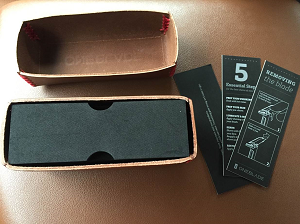
"Under the cover: Everything secured, silica gel pack, some packing to hold the razor on the stand and prevent movement (great touch).
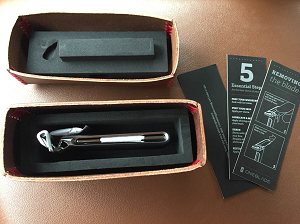
"And finally, the tool itself: Fantastic look to it. The weight of the razor lets you know right away that this is a man's tool, different than any razor I've looked at before. The attention to detail with polished and brushed parts is fantastic. Both razor and stand have weight to them which looks deceiving and was unexpected. The etched logo and name on stand and razor look great. Movement of the head is smooth and light. Foam bottom on the stand makes perfect sense. All around, it appears every aspect was well thought out, from the engineering standpoint all the way to the aesthetic design. I'm looking forward to my first shave with it. I present my OneBlade, OB-00428:
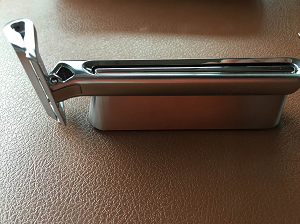
"Porter – so far so good. I'll have another report on my first shave experience." – Paid-up subscriber Stephen Borsy
"Good morning, I was just reading about one blade and it sounds like the perfect solution to my shaving issues. Yes I used a 5 blade razor that causes stress and collects hair. I also only shave about once a week or two and you could say have quite a beard by then. I also shave my scalp and want to check in with you to make sure this is safe to shave my scalp? Would I need to use 2 blades, one for the face and one for the scalp? I'll wait for your reply before I place my order, thanks." – Paid-up subscriber Marvin Flyer
Brill comment: Porter is traveling today, but he asked us to pass along the following...
Yes, our razor would be great for you. You'll have to experiment with whether or not you need to change blades during your scalp shave. I wouldn't think so, but it just depends on how much comfort and smoothness you want.
Regards,
Justin Brill
Baltimore, Maryland
July 10, 2015
|